


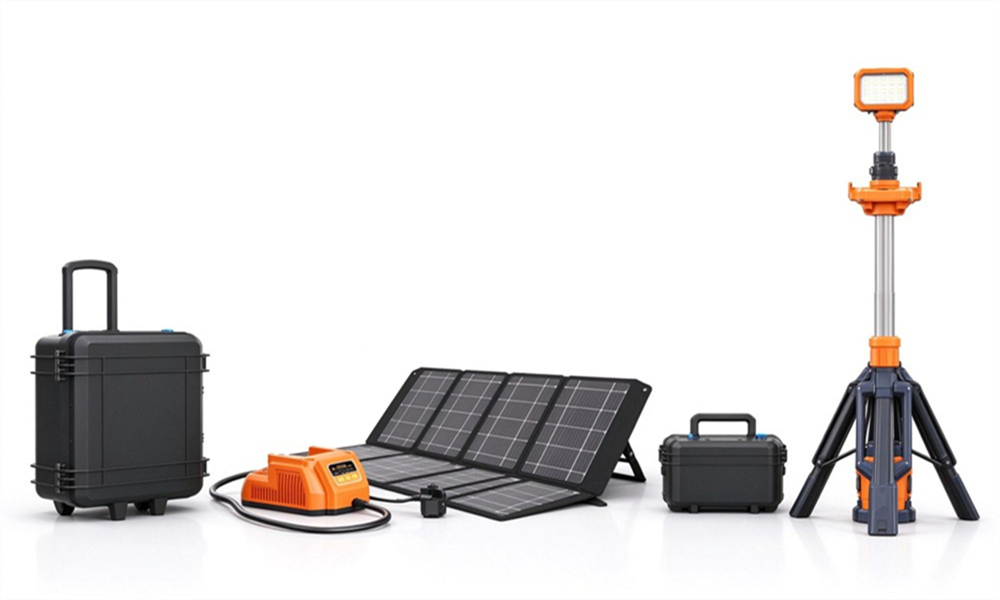
This rechargeable emergency light accessory set includes lithium battery packs, universal chargers, folding solar panel and rolling charging case. It supports off-grid power supply for rescue lighting fleets, compatible with portable and tower lights, ideal for remote disaster and emergency deployment.
Note: Price for reference only. Exact price based on quantity, size, weight and custom details.
model no. :
LT-13Brand:
YRFmarket price :
$396sale price :
$198price range :
30-100/$198Color :
Multiple Colorsport of dispatch :
Guangdong/GuangzhouPayment :
TT, Paypal, Western Unionmin order :
10original region :
Made in ChinaLead Time :
5-15days
Rescue & Rental Fleets
Every rechargeable emergency light runs only as long as its power system. This page covers the ecosystem: lithium battery pack, battery charger, off-grid solar panel and the rapid charging case that keeps a rescue fleet lit.


Bright workshop hero: an MC-series battery charger with two lithium battery packs ready for fleet rotation.
These emergency lighting accessories decide whether a fleet stays lit or sits dark. A reliable rechargeable emergency light depends on the same power ecosystem every shift: a durable lithium emergency light battery, a fast emergency light charger and an optional off-grid solar charging kit so the rechargeable emergency light keeps running even where mains power is unavailable.
The product family here is the same orange-and-navy system used across the portable and tower light range. A D24 battery drops into a compatible host light, an MC charger tops it up from mains, an FS8-200 folding solar panel feeds energy when there is no grid, and a TKC-9 box carries and charges nine cells at once.
All figures below are typical ranges for the series; final capacity, charge time and certifications are confirmed on the order, per contract.
The TKC-9 rolling rapid charging case open in a bright depot, loaded with battery packs.Start with the hero setup. A single orange battery charger sits on a clean bench with two matching lithium battery pack units beside it, a coiled mains cable ready. This is the everyday depot scene: one pack in the host light, one on charge, one fully charged waiting in the rack.
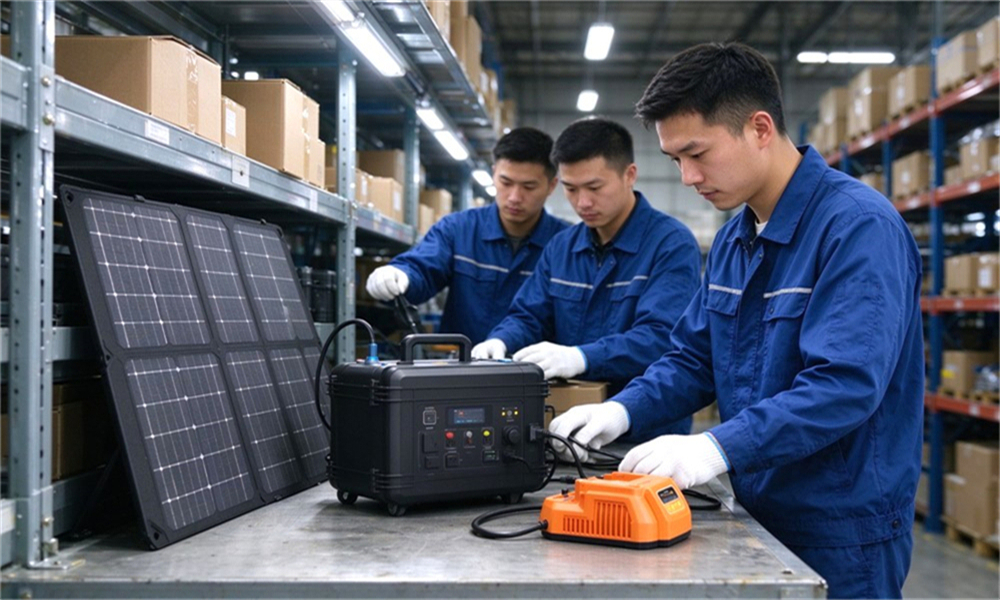
That three-pack rhythm is what keeps a rechargeable emergency light running through an entire shift without anyone waiting around for a charger.
On a maintenance desk, the battery charger does its quiet work: the MC-1 single bay tops one cell while the next host light stays in service. This desktop charger is the smallest link in the rechargeable emergency light ecosystem, the unit a one-vehicle team keeps on the depot bench.
MC-1 single bay charger on an office desk with a power strip.The compact D24-54 lithium battery pack drops straight into a compatible host light. It is the lighter cell for handheld work lights, the one technicians carry all shift without a heavy pack pulling the light down.
The compact D24-54 lithium battery pack on a maintenance bench.Where there is no wall socket, the FS8-200 folding solar panel feeds the same cells through a portable power station. Solar by day, light by night is the off-grid loop that keeps a rechargeable emergency light running far from any grid.
The FS8-200 folding solar panel on grass under bright sun.
Contents
1. What these emergency lighting accessories do
2. Lithium battery pack series: D24-54 vs D24-100
3. MC-1 and MC-2 battery charger lineup
4. Off-grid recharging with the FS8-200 solar panel
5. TKC-9 rapid charging case for field fleets
6. Battery compatibility matrix
7. Spare parts management for fleet owners
8. Off-grid scenario power plans
9. Wholesale ordering from China
10. 18650 lithium pack cycle life and PCM protection
11. Universal input charger compliance
12. FS8-200 solar panel MPPT sizing
13. Unified accessories spec summary
14. Emergency Light Battery and Charger FAQ

A rechargeable emergency light is only half of the system. The light head produces lumens, but the accessories decide how many shifts it can deliver before someone has to plug it in.
This page is written for the equipment manager who already owns the lights and now needs the power side: spares, chargers, solar input and a way to rotate cells in the field.
That is a different buyer from the person choosing the light itself. A well-accessorized rechargeable emergency light stays deployed longer and returns to the depot less often, which is the upside this page helps you engineer.
Think of the ecosystem as four layers. The first layer is the lithium battery pack, the removable cell that slides into the host light. The second is the battery charger, which returns a cell from empty to full from a wall socket.
The third is the solar panel, which generates fresh charge when there is no wall socket at all. The fourth is the rapid charging case, which carries and charges many cells at once during a multi-day deployment.
Battery pack to charger to work light: the compatibility chain in one connection.The picture above shows the whole chain in a single frame: an orange lithium battery pack, a desktop charger, and a telescopic rechargeable emergency light standing on the workshop floor, cables linking them. This is the mental model to keep while reading the rest of the page.
Every accessory described here plugs into this same chain, and the compatibility rules in section six tell you exactly which cell works in which host.
Why does this matter to a rental company? Because rental fleets are judged on uptime. A light that comes back with a dead cell is a light that cannot go out again tonight.
Spare cells on charge, a solar panel for weekend jobs and a rolling charging box for the van are what turn a pile of lights into a dependable hire fleet.
The same logic applies to a rescue team that cannot wait for a depot between callouts. For those teams, a rechargeable emergency light is only useful if its battery system travels with it.
None of this is a substitute for choosing the right host light. If you are still picking the lamp itself, start from the host pages: the solar light tower for wide area work, the diesel light tower for generator-backed sites, the portable light tower for single-person setup, and the remote searchlight for long-throw illumination.
This accessories page assumes that decision is already made. If your fleet includes handheld torches as well as tower units, battery packs and chargers are interchangeable across the range — browse our bulk flashlights catalog for handheld units, and the certified explosion proof light line if your depot serves hazardous-area teams.
The range offers two removable cells, the D24-54 and the D24-100. Both are 24-volt class lithium packs in the same orange-and-navy housing, both slide into compatible host lights, and both charge on the same MC chargers. The difference is capacity and size, and the right choice directly sets how long each rechargeable emergency light runs between swaps.
The D24-54 is the lighter, shorter-shift cell; the D24-100 is the heavier, longer-running cell. Choosing between them is a trade between pack weight and how long a rechargeable emergency light can stay on between charges.
The D24-54 is the compact option. It is smaller and lighter, which makes it the natural choice for handheld work lights and for technicians who carry the pack all shift. It delivers enough energy for a short-to-moderate job, and its lower weight means the host light balances better in the hand.
For a rechargeable emergency light that gets picked up and moved every few minutes, that weight saving is noticeable at the end of a long day.
Feature
Short Work Light (Compact)
Tall Work Light (Extended)
Weight
~1.2 kg
~2.8 kg
Mast Height
0.6 m fixed
1.2–1.8 m telescopic
LED Heads
1 × 30 W
2 × 50 W
Runtime (high)
4 hours
8 hours
Best For
Confined spaces, close work
Open site lighting, area coverage
The larger D24-100 lithium battery pack on a tailgate at dusk.
The D24-100 is the high-capacity cell. It shares the same connector and charging profile but stores roughly twice the energy, which doubles the runtime of a compatible host light on a single charge. It is heavier and bulkier, so it suits tower lights, fixed deployments and any team planning an overnight shift where nobody can come back to swap cells.
On a tailgate at dusk, next to a glowing work light, this is the pack that keeps the site lit through the night.
Side by side: D24-54 left, D24-100 right, on a depot shelf.The side-by-side shot makes the difference concrete. On the left the D24-54, on the right the D24-100, same family, same connector, visibly different volume. A fleet manager often buys both: D24-54 cells for the handheld units and D24-100 cells for the towers.
Because they charge on the same battery charger, the depot does not need separate charging hardware for each type. That shared ecosystem is a real cost saver over a fleet's working life.
The comparison table sums the range. D24-54 when weight and handability matter; D24-100 when runtime matters more than carrying the pack. Exact amp-hour figures, charge time and cycle life are confirmed per order, per contract, because they depend on the host light's draw and the brightness setting used.
What does not change is the shared connector, the shared charger and the shared solar panel input path described later.
A few practical notes. Lithium cells should be stored partially charged in the depot, not fully empty, between jobs. They should not be left in a hot vehicle in summer, and they should be cycled at least once every few months if a unit sits idle. These are normal lithium care habits, not exotic requirements.
They are the difference between a pack that lasts years and one that fades after a season.
The onboard protection board handles over-discharge and over-temperature during normal use, aligned with IEC 62133 portable lithium battery safety guidance. A correctly matched lithium battery pack is what keeps a rechargeable emergency light safe to run through a full shift.
Model
Position
Relative capacity
Suitable host
Typical shift
D24-54
Compact cell
Standard
Handheld work lights
Short to moderate
D24-100
High capacity cell
About double
Tower and portable masts
Overnight / long
The charger range has two desktop units: the MC-1 single bay and the MC-2 dual bay. Both are the same orange housing, both accept the D24-54 and D24-100 cells, and both plug into a standard mains socket. The difference is how many cells they return to full at the same time.
This is a capacity decision for the depot, not a technical one, because the charge profile inside each unit is matched to the same lithium chemistry.
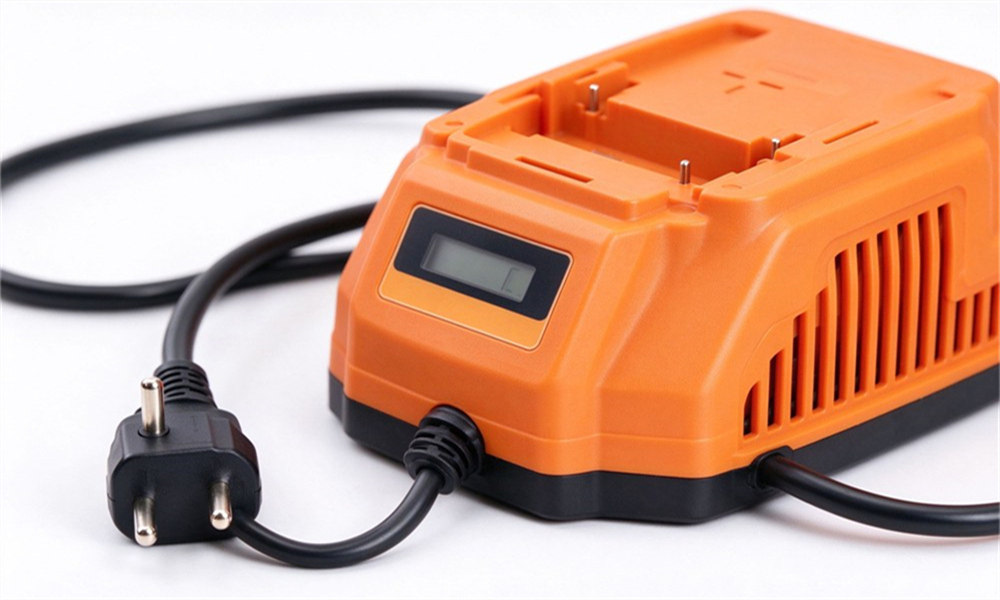
The MC-1 is the single-bay charger. One cell slots in, the indicator shows charging status, and when it is full the pack is ready for the next shift. This is the right unit for a small team, a single workstation, or a rental operation with just a few rechargeable emergency light units.
It sits on a desk or a maintenance bench, draws ordinary mains power, and quietly keeps one spare cell topped up between jobs.
MC-2 dual bay charger with two cells charging on a workshop bench.The MC-2 is the dual-bay charger. Two cells sit in two slots, both charging at the same time, which halves the number of chargers a mid-size fleet needs. For a rental company rotating six to ten lights, a pair of MC-2 units on a bench is enough to keep every cell ready by morning.
Under a workshop work lamp, with a coiled mains cable, this is the workhorse that turns a pile of dead cells into a pile of ready cells overnight.
Charging time depends on which cell you plug in and how empty it is. A D24-54 returns to full faster than a D24-100 simply because it holds less energy. The chargers manage the lithium charging curve automatically, so the user does not set voltages or currents.
Indicator lights show charging and complete states, and the unit stops itself when the cell reaches full.
That automatic management is what lets an equipment manager leave the fleet on charge overnight without supervision. Every battery charger in this range is built around that unattended overnight workflow, so a whole row of rechargeable emergency light cells is ready by morning.
The table makes the choice straightforward. One bay or two bays, same cells, same socket. Buy MC-1 when the fleet is small or when every battery charger will be dedicated to one station; buy MC-2 when bench space is limited and you want double the throughput from the same footprint.
For larger fleets that outgrow desktop chargers, section five introduces the TKC-9, which lets a whole team of rechargeable emergency light units rotate at once, which scales this idea up to nine bays in a portable case.
One rule to pass to the team: only charge the right cell on the right charger. The MC units accept both D24 sizes by design, but do not mix third-party unknown packs into them. Using the matching lithium battery pack keeps the charge curve honest and protects the warranty.
The chargers are intended for depot or vehicle use from standard mains; for remote sites with no mains at all, the solar panel route in the next section is the intended alternative.
Charger
Bays
Accepted cells
Suited to
MC-1
1
D24-54, D24-100
Small team / single workstation
MC-2
2
D24-54, D24-100
Mid-size fleet rotation
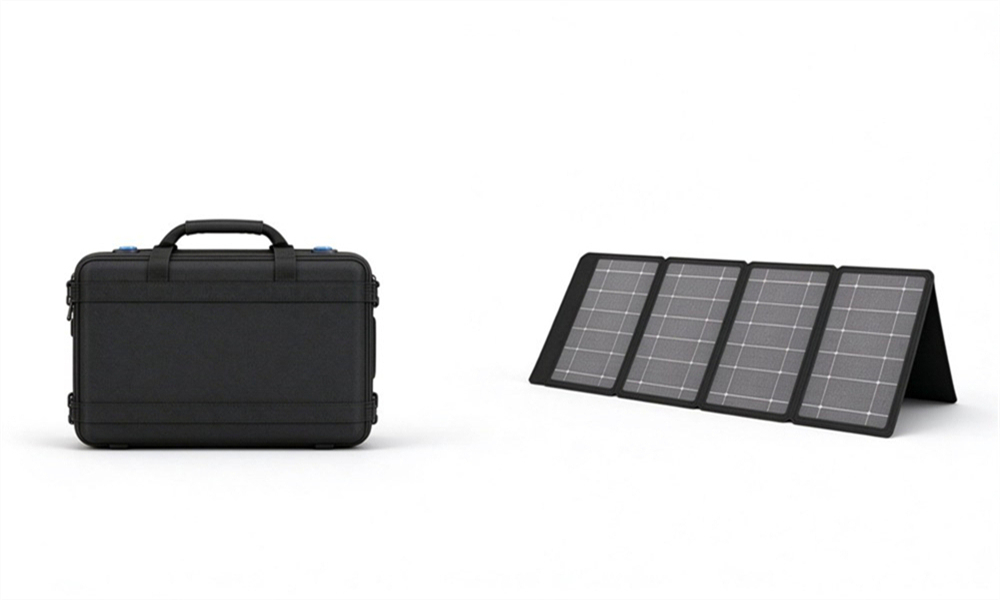
When a callout runs for days and there is no mains socket anywhere nearby, the MC chargers cannot help. That is where the FS8-200 folding solar panel comes in. It is a foldable four-panel unit that opens flat, angles toward the sun, and feeds a portable power station or a compatible charge input.
It turns daylight into a top-up for the same lithium battery pack cells, keeping a rechargeable emergency light running far from any grid.
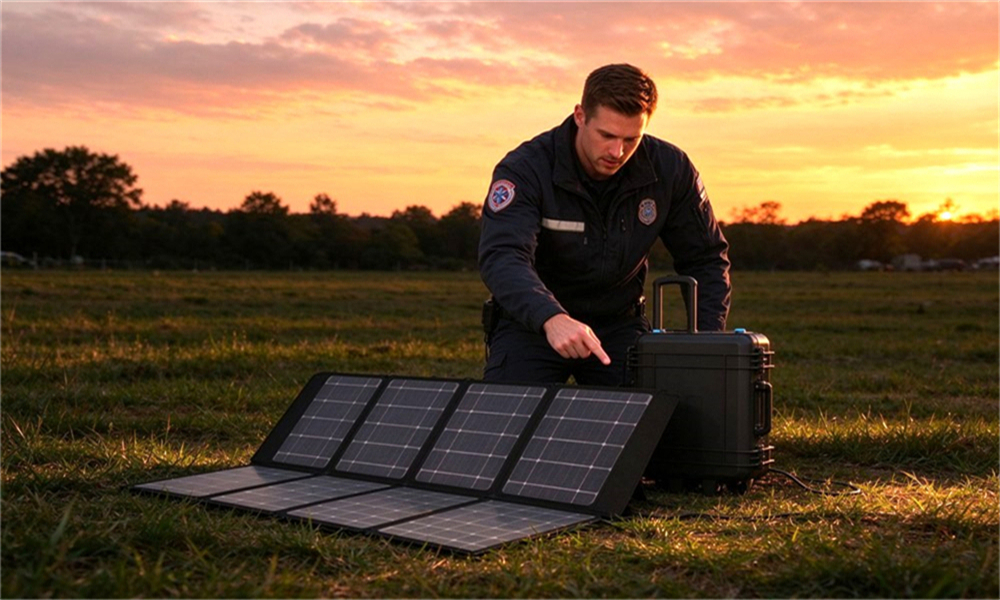
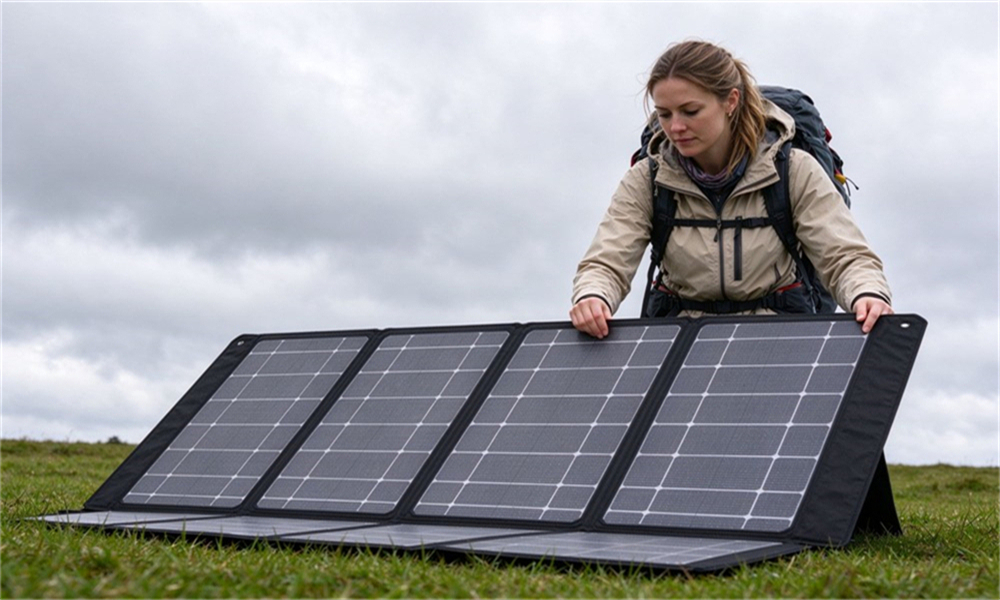
The FS8-200 folds down to a compact carried size and opens into four rigid panels. In the photo it lies on grass in full sun, angled up on its built-in stands, with the black power station beside it taking the feed. A team deploys it like a small table, aims it at the sun, and walks away.
Through the daylight hours it trickles charge into the station, which then feeds the host lights in the evening. A rechargeable emergency light left running on reserve cells can be saved by that daytime solar top-up. That is the core off-grid loop: solar by day, light by night.
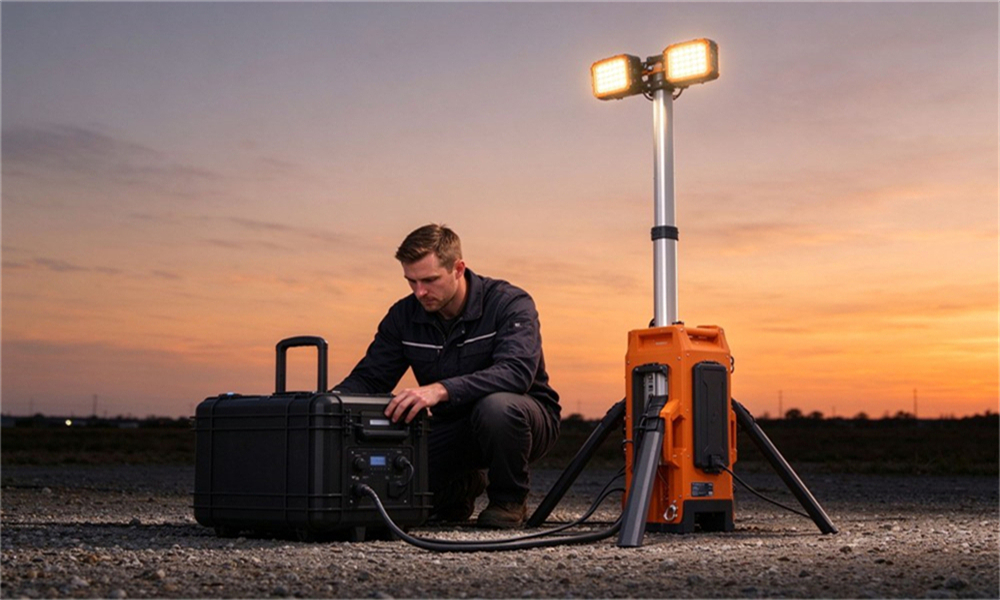
Solar panel, power station and glowing work light on a hillside at golden hour.The hillside scene shows the loop working. The folding panel is set on rocky ground, the black station stands beside it, two orange cells connect to the system, and a portable work light already glows on its tripod. This is what a self-sufficient camp looks like: no generator, no cable to a distant building, just sunlight converted into light.
For a rescue team working in a flooded area or a collapsed site, that independence is the difference between staying through the night and withdrawing when the cells run dry.
How much energy the panel delivers depends on sun hours, angle, and cloud cover. Treat the FS8-200 as a top-up source rather than a fast charger. On a clear day it returns a meaningful amount of charge to the station; on an overcast day it trickles.
That is why the practical approach is to combine solar with spare cells: use the MC chargers when mains is available, and let the solar panel extend the fleet while mains is not. Exact wattage and daily yield are confirmed per order, per contract.
The table compares the three ways to return energy to the cells. Mains is fastest but needs a socket; solar is free and silent but slower and weather-bound; the TKC-9 is the portable middle. For a rechargeable emergency light that sits far from any outlet, the solar route is the only way to top up without a generator.
Professional fleets typically use all three: MC chargers in the depot, the solar panel for remote camps, and the TKC-9 in the response vehicle. That combination means a rechargeable emergency light is never stuck because the nearest wall socket is a hundred kilometers away.
Input source
Setup
Suited when
Trade-off
MC mains charger
Wall socket + MC-1/MC-2
Depot or powered site
Fast, needs mains
FS8-200 solar panel
Fold panel + power station
Remote multi-day camp
Free energy, slower, weather-dependent
TKC-9 case
Rolling case, 9 bays
Field fleet rotation
Carries and charges on site
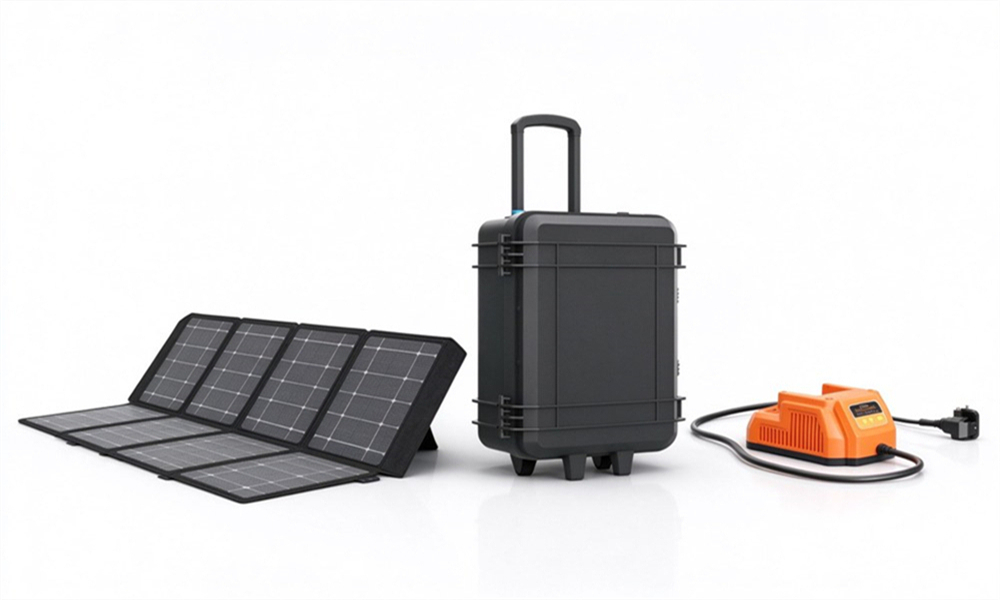
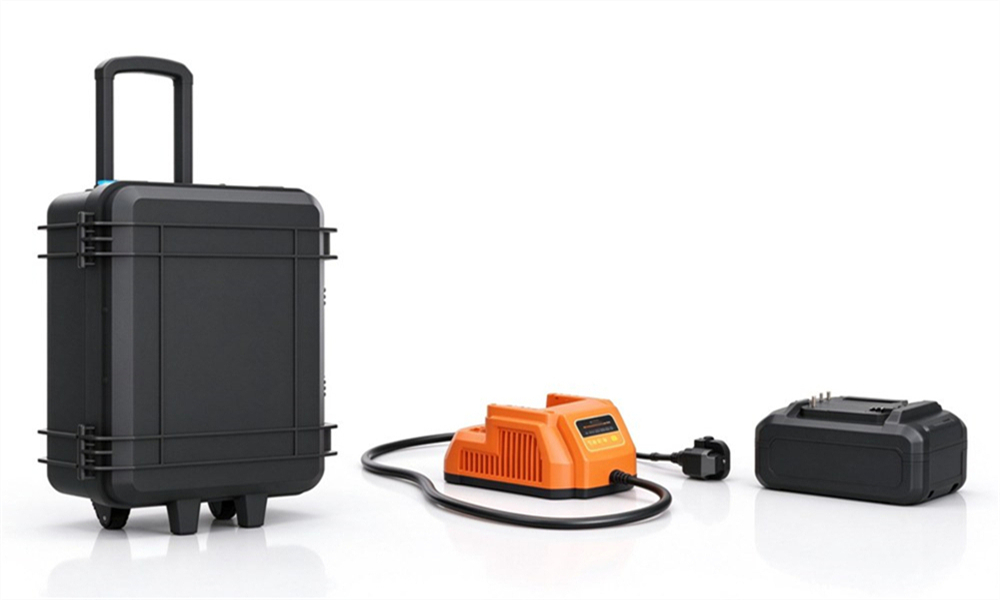
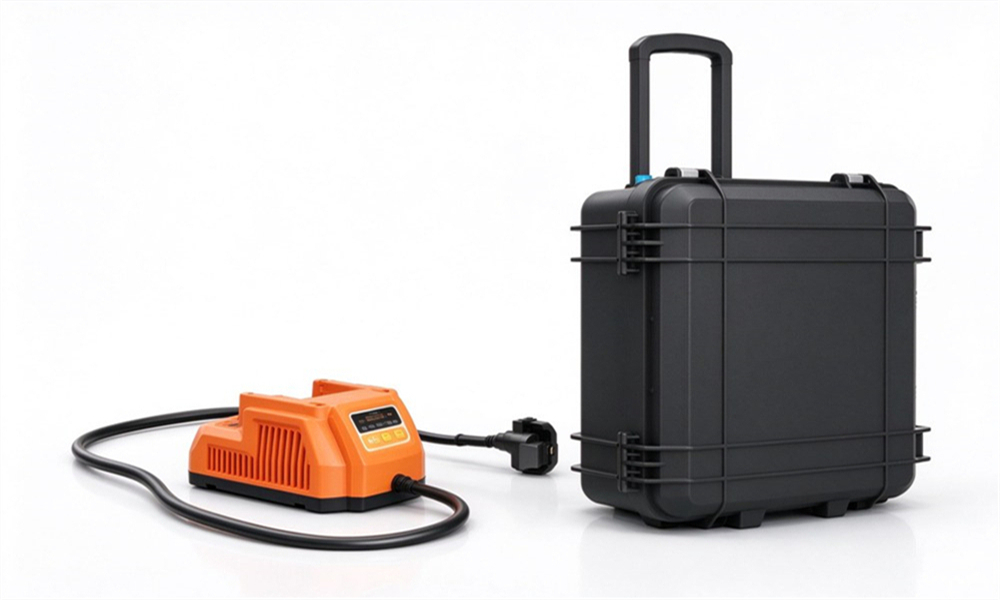
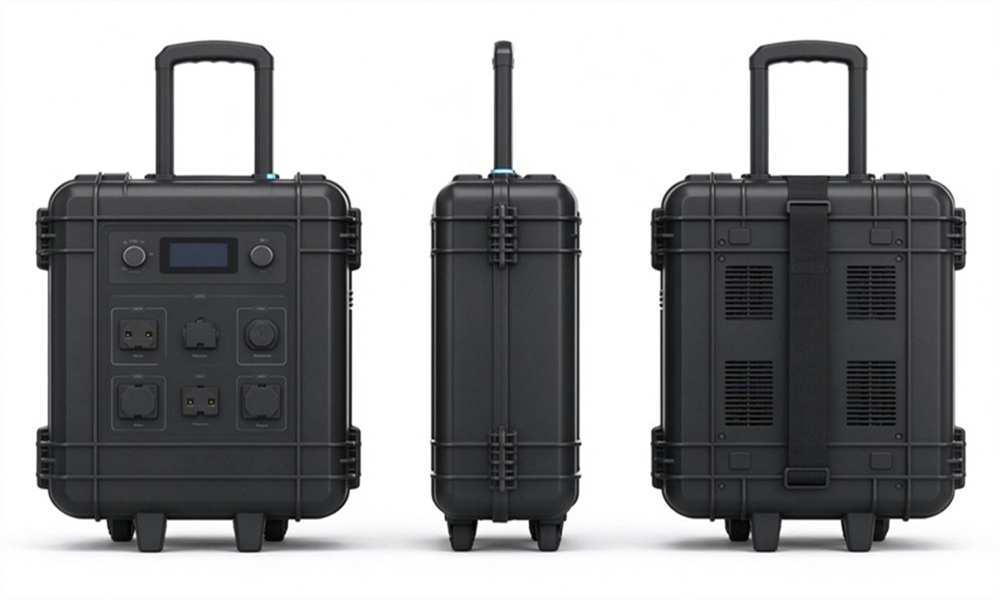
The TKC-9 is the flagship accessory in this range: a black rolling hard case with a telescopic handle that doubles as a nine-bank charging station. It is designed for teams that carry many cells in the field and need to recharge them overnight, in the vehicle or at the base camp, rather than queueing at a desk charger.
Its front panel marks it solar-compatible, which means it can take input from the FS8-200 as well as mains.
The closed TKC-9 rolling charging case on a depot aisle beside a rescue vehicle.Closed, the TKC-9 looks like a heavy rolling case. Telescopic handle up, wheels at the bottom, rugged latches around the edge. It rides in the back of a response vehicle or gets wheeled through a depot aisle.
Beside the red rescue truck in the photo, it reads as exactly what it is: a piece of field equipment, not a bench top appliance.
That transportability is the point. A rapid charging case only helps if it comes with the team.
The TKC-9 open, nine orange battery packs seated in foam bays.Open, the purpose is visible. The lid lifts, foam-lined interior reveals nine slots, and nine orange lithium battery pack cells sit in place, charging through the case's internal distribution. Load nine cells in the evening, plug the case into mains or into the solar panel, and by morning all nine are topped up.
Ready to slide into nine host lights, this single box replaces a bench full of desktop chargers for a rescue squad or rental van.
For a rescue squad or a rental van, this single box replaces a bench full of desktop chargers. Nine cells rotating means nine rechargeable emergency light units can go out fresh every morning.
The case is built rough. Hard shell, sealed latches, carry handle and wheels, so it survives being thrown into a vehicle and dragged over rough ground. The solar-compatible input means a team at a remote camp can park the FS8-200 in the sun during the day and feed the TKC-9 through it, topping the nine cells without a generator.
That silent, fuel-free recharging is a genuine advantage on a long deployment where running a generator all night is noisy, costly and unpopular.
The table lists what the TKC-9 brings. Nine bays, two input sources, and a carry-friendly shell. It is the accessory that scales a fleet from a couple of lights to a whole vehicle load. If your team only runs two or three lights, the desktop MC chargers are enough.
If your team loads a van with a dozen rechargeable emergency light units and drives out for three days, the TKC-9 is the piece that keeps them all fed.
Feature
TKC-9 case
Charging bays
Up to nine cells
Power input
Mains and solar compatible
Transport
Rolling case, telescopic handle, wheels
Target fleet
Rescue squads, rental vans, multi-cell rotation
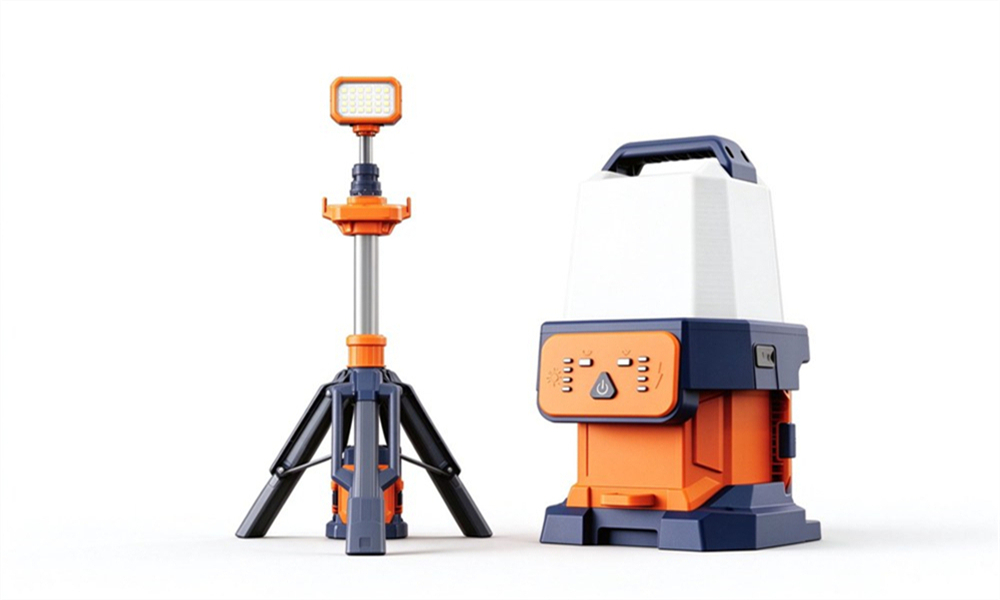
A common question from equipment managers is simple: which cell fits which light, and which charger tops it up? Getting this wrong means cells that will not seat, or a fleet that cannot share spares. This section lays the compatibility rules out plainly.
The rule of thumb is that the D24-54 and D24-100 share the same connector and the same charging hardware; the host light determines which cell it accepts, and the chargers and solar input accept both.
A fleet charging station: two TKC-9 cases and a technician swapping a cell.The depot photo shows the practical reality. Two TKC-9 cases on the shelf, a row of orange cells waiting, and a technician's hands sliding a fresh cell into a charger. When the whole fleet shares one ecosystem, swapping a dead cell for a charged one takes seconds.
That speed is what compatibility is really for: minimum downtime between jobs. A rechargeable emergency light that needs a specialist cell is a light that sits idle when that cell is on charge.
Read the table as a grid. Both MC chargers and the TKC-9 accept both D24 cells directly. The solar panel does not plug into a cell itself; it feeds the power station, which then charges the cells. No accessory charges a host light directly.
The workflow is always the same sequence: remove the empty cell from the light, charge that cell on the MC charger or in the TKC-9, install a charged cell back into the light.
Repeat that swap fast enough and the rechargeable emergency light never actually stops. That is the promise of the whole ecosystem: a rechargeable emergency light kept alive by rotating cells, not by waiting. That modular swap is what makes the system work.
Do not mix in third-party cells with unknown connectors or voltages. Even if a pack looks similar, a different chemistry or a different charge curve can confuse the charger's management and shorten cell life. Stick to the D24 family for the D24 host lights.
If you are matching accessories to a light bought earlier, send the host model when you order, and the correct cell and charger combination is confirmed on the order, per contract. This protects both uptime and warranty.
For teams mixing light types, the shared connector is the saving grace. A handheld work light, a portable mast and a tower can all run on the same D24 cell, which means one spare inventory covers the whole fleet rather than a separate SKU per light.
That is a procurement advantage worth planning for: buy spares by cell type, not by light type, and the depot shelf stays simple.
Accessory
D24-54 cell
D24-100 cell
Host light
MC-1 charger
Yes
Yes
Does not charge light directly
MC-2 charger
Yes
Yes
Does not charge light directly
FS8-200 solar panel
Via power station
Via power station
Feeds station, not light directly
TKC-9 case
Yes
Yes
Charges cells for hosts
Accessories are only part of the picture. A fleet also needs a plan for the things that wear out or get lost: cables, fuses, connectors, charger adapters and spare cells themselves.
Without that plan, a single broken cable takes a perfectly good rechargeable emergency light out of service. This section lays out a lean spare-parts approach for a rental or rescue depot.
An open accessory case holding cables, fuses, connectors, a charger and two cells.The picture shows the recommended setup: an open hard case with foam cutouts holding spare cables, colored connectors, a small charger and two spare cells. Everything a technician might need in one organized box. This beats loose drawers because every item has a home, and a missing piece is obvious at a glance.
A spare cable or fuse can rescue a dead rechargeable emergency light in minutes on site. For a field team, this case rides with the TKC-9, so common failures are fixable on site rather than waiting for a return to depot.
Start the spare list with the consumables. Spare charge cables and input adapters are the leading item, because cables get pinched, rolled over or left at jobs.
Next come fuses and connector replacements, then spare cells at a ratio that matches the fleet: a common rule of thumb is to keep roughly one spare cell for every two to three host lights, on charge at all times.
Charger units are spares too, since a bench charger that fails overnight stops the whole rotation.
The table is a starting checklist. Adjust ratios to your fleet size and job frequency. The principle is that spares should be stocked by what stops the system, not by what is cheap. A three-dollar cable outage can take a thousand-dollar light off hire for a day, so the cable is worth spares.
Keep the kit case sealed, labeled and stored with the charging station, and the team will actually use it instead of improvising.
Track cell age. Lithium packs fade over years of cycles, not dramatically, but runtime per charge creeps down. Note the date each cell enters service, and plan to retire cells that no longer hold a useful shift. Replacing faded cells proactively is cheaper than discovering mid-callout that a "charged" pack only lasts an hour.
This is the quiet maintenance that separates a professional rental fleet from a hobby pile. A fleet manager who tracks cell age keeps every rechargeable emergency light dependable season after season.
Spare item
Why it matters
Typical stock approach
Charge cables
Common failure / loss
2-3 per charger
Spare cells
Rotation backbone
~1 per 2-3 host lights, always on charge
Fuses / connectors
Small but stop the system
Kit box, resealable
Spare charger
Bench single point of failure
1 spare MC unit per depot
Fleet managers supporting hazardous-area operations should also review the explosion proof lighting scenario guide to match battery rotation schedules with Ex-rated equipment requirements.
How do all these accessories combine in real deployments? This section walks three common scenarios, each with a recommended power plan. The scenarios are written for the equipment manager deciding what to send out.
Match your job to the closest one, then scale cell and charger counts to your team size. All counts below are starting points, final quantities confirmed per order, per contract.
A night emergency camp: solar panel, power station and work lights in muddy terrain.The night scene sets the tone. A rescue tent, a folded solar panel, a glowing power station, and several bright work lights standing in muddy ground. This is off-grid emergency lighting in practice: no building, no generator, no cable to nowhere.
The cells in the lights came from the TKC-9, the station topped up from the solar panel during the day, and the whole camp runs silently through the night.
That is the target outcome for the plans below. Each plan is designed so a rechargeable emergency light stays lit without anyone hunting for a wall socket.
For a street repair or an indoor event site where a mains socket is reachable, keep it simple. Send the host lights, enough D24 cells to double-shift, and MC-2 desktop chargers on site or back at the van.
No solar panel needed. This is the lowest-cost plan because mains is the fastest top-up and the chargers are cheap. One MC-2 keeps two cells rotating; add units for larger crews.
For a flooded area, a collapsed structure or a remote worksite, send the TKC-9 loaded with cells, the FS8-200 solar panel, and the power station. During daylight, park the panel in the sun and feed the station or the case.
At night, run the host lights on the rotating cells. Keep at least a third of the cells fully charged as a buffer. This plan avoids a generator entirely, which matters on noise-sensitive or fire-risk scenes.
For a hire operation, the depot is the power hub. Bench the MC-2 chargers together, keep a row of D24 cells on charge, and stage a spare-cell ratio of about one per two to three lights.
The TKC-9 goes out only for multi-day hires. This is the highest-uptime setup because every light comes back to a fast mains charge before it goes out again.
The table condenses the three plans. Choose by whether mains exists, not by what looks impressive. Fleets typically own a bit of everything: MC chargers for the depot, a TKC-9 for the van, and an FS8-200 for the truly remote jobs. That mixed kit means no rechargeable emergency light is ever benched for lack of a power source.
Each rechargeable emergency light then behaves like the reliable tool it was bought to be. Outfit the power side properly, and every rechargeable emergency light in the fleet earns its keep. That mixed kit means no deployment is blocked by a power problem, which is the whole point of stocking emergency lighting accessories in the first place.
Scenario
Recommended power kit
Why
Mains reachable
Host lights + D24 cells + MC-2
Fast, cheapest top-up
Remote 2-3 days
TKC-9 + FS8-200 + station + cells
Silent, fuel-free off-grid
Depot hire fleet
Bench MC-2 row + spare cells
Maximizes overnight uptime
These emergency lighting accessories are produced in China and exported in cartons. The ordering process is the same for a rescue outfitter, a rental company and a distributor. It follows four steps: state your fleet, approve samples, confirm customization, then batch production with export packaging. Our chargers accept 110V-240V universal input, so depots in the USA, Europe and the Middle East can use the same SKU on local mains without a step-down transformer. For larger deployments that need site-wide illumination, pair these accessories with our mobile light tower units. Hazardous-area buyers should also review the explosion proof light certification guide before specifying battery packs for Ex-rated equipment.
Lead times, minimum quantities and prices are quoted per order, per contract, because they depend on model mix and volume.
Export cartons on a pallet, one open box showing orange battery packs.The warehouse shot shows the export stage. Sealed brown cartons on a pallet, one open box revealing the orange cells inside, shipping labels and stretch wrap applied. That is how the accessories leave the factory: cells and chargers packed in export cartons with foam protection, lithium cells packed according to transport rules.
The cartons are built for sea freight on pallets.
Step one is to tell us your setup. Which host lights you already own, how many rechargeable emergency light units you need to support, whether you want D24-54, D24-100 or both, and whether you need MC chargers, the solar panel, the TKC-9 or the full set.
From that we confirm the compatible cell and charger combination and recommend a starting spare ratio. This avoids ordering a cell that will not seat in your existing lights, so every rechargeable emergency light you already own stays compatible.
Step two is sample approval. Before batch production, a sample cell, charger or case is shipped for hands-on testing. Check that the cell seats in your host light, that the charger indicator reads correctly, and that the TKC-9 bays fit your cells.
Step three locks customization such as logo marking, housing color and retail packaging, available on OEM orders. Step four is batch production, lithium-compliant export packing and shipping.
The table lists what each step asks of both sides. Buyers who send a short clear fleet description move fastest; buyers who send uncertain lists usually need a back-and-forth. Sample approval protects the batch order, and ongoing spares keep the depot stocked. All timing and quantities are confirmed on the order, per contract.
Whether you support one rechargeable emergency light or a whole vehicle load, the starting step is the same: tell us your fleet.
From there we confirm the cells, chargers and cases that keep each rechargeable emergency light running. For teams building a full night-lighting kit beyond accessories, the host pages start from the portable light tower and the work light tower range.
Scenario
Recommended power kit
Why
Mains reachable
Host lights + D24 cells + MC-2
Fast, cheapest top-up
Remote 2-3 days
TKC-9 + FS8-200 + station + cells
Silent, fuel-free off-grid
Depot hire fleet
Bench MC-2 row + spare cells
Maximizes overnight uptime
Every D24 pack in this range is built around protected 18650 cells. The cell chemistry, the protection circuit and the transport test regime decide how many shifts a rechargeable emergency light stays in service. This section lists the engineering baseline used on the D24-54 and D24-100 packs.
The D24 family uses nickel-manganese-cobalt (NMC) 18650 cells, rated 2,500 mAh per cell. NMC wins on energy density, which keeps the pack light enough to carry all shift.
LFP cells tolerate more cycles but are heavier for the same watt-hour. We reserve LFP for stationary solar banks, not for a handheld lithium battery pack that a technician carries on a belt.
The pack is assembled as a 2S or multi-cell configuration matched to the host light, with a PCM soldered on the protection side. Cells are sorted by internal resistance before assembly so the pack does not balance unevenly.
The protection circuit module (PCM) sits between the cells and the output connector. It cuts power when any cell leaves a safe window.
Overcharge cutoff is set at 4.25 V ± 0.05 V per cell. Over-discharge cutoff trips at 2.5 V per cell. Over-current protection opens at 15 A, which covers the inrush when a cold LED driver switches on.
Short-circuit protection opens within milliseconds. Temperature sensors shut the pack down if the case exceeds 60 °C during charging or discharge. These thresholds follow IEC 62133-2 portable lithium battery safety requirements for sealed secondary lithium cells.
Cycle life is measured at 1 C charge and 1 C discharge, 25 °C ambient, between 100 % and the cutoff voltage. The D24 packs retain at least 80 % of initial capacity after 500 full cycles.
Practical duty cycles are shallower. A fleet that runs a pack from 100 % to 30 % each shift sees well over 1,000 cycles before the pack drops below 80 % capacity. Shallow cycling is the single biggest lever on pack longevity.
Heat is the other lever. A pack left in a hot vehicle in summer ages two to three times faster than one stored in a 25 °C depot. That is why the spare-cell rule in section seven matters.
Every D24 pack ships with a UN38.3 test summary covering the eight mandatory tests: altitude simulation, thermal cycling, vibration, shock, external short circuit, impact, over-charge and forced discharge. The test report follows UN38.3 Manual of Tests and Criteria.
This documentation is required before air or sea freight of lithium cells. Buyers shipping D24 packs by air receive the test summary and the 1.2 m transport drop packaging photos with the export carton.
The table compares the two packs by cell configuration. Both share the PCM thresholds and the UN38.3 transport regime. The difference is energy stored, which sets runtime in the host rechargeable emergency light.
Pack
Cell config
Energy
Nominal voltage
Weight class
D24-54
NMC 18650, protected
54 Wh
25.2 V (7S)
Compact
D24-100
NMC 18650, protected
100 Wh
25.2 V (7S)
Extended
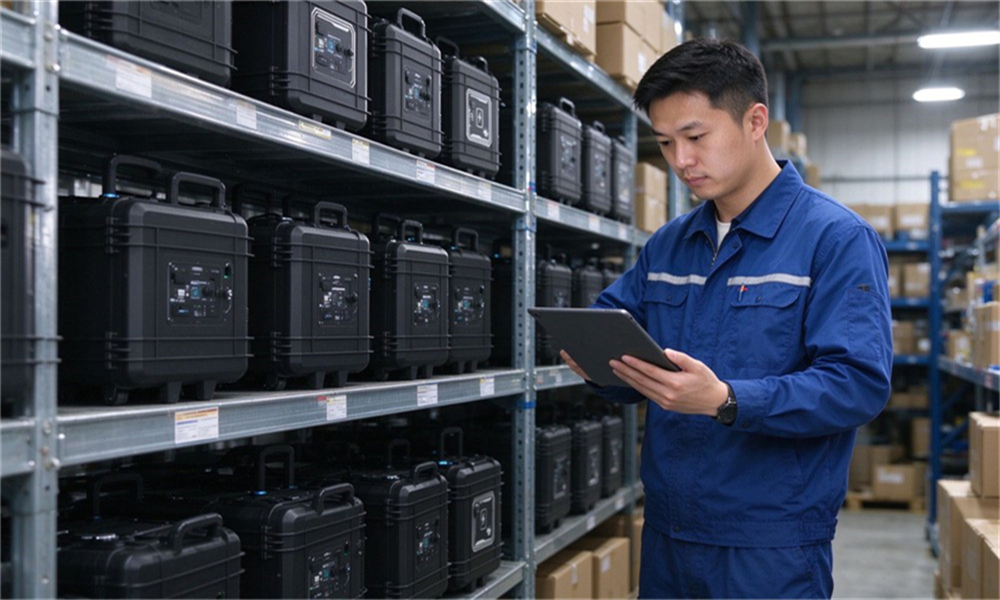
The MC-1 and MC-2 chargers accept 100-240 VAC mains so the same SKU works on US 110 V, European 220 V and Middle Eastern 230 V grids. No step-down transformer is needed in the depot. This section lists the safety baseline behind that universal input.
Input covers 100-240 VAC at 50/60 Hz. Active power factor correction (PFC) holds PF above 0.98 across the range, which keeps input current low and avoids overloading a site socket.
Isolated output separates the low-voltage DC side from mains, so a fault on the cell side cannot feed back into the wall. The output is current-limited and short-circuit proof.
For the EU, the charger follows EN 60335-2-29 household battery charger safety, with CE-LVD marking. For the US, the isolated output meets UL 1310 Class 2 and limited power source requirements.
Korea uses KC, Japan uses PSE. The charger platform carries the relevant certificates on file, so depots on three continents rotate the same D24 cells without region-specific charging hardware.
The charger manages a constant-current then constant-voltage (CC-CV) lithium curve. It holds 1.5 A constant current until the pack reaches 8.4 V (2S) or the pack-specific bulk voltage, then tapers current at constant voltage.
Termination triggers when current drops to 0.05 C. The unit then switches to standby, never trickles. This CC-CV profile protects cycle life and matches the PCM on the pack.
The MC-1 single bay charges one D24-54 pack in about 3.5 hours from empty. The MC-2 dual bay charges two packs at the same time, so two cells return to ready in the same window.
D24-100 takes about twice as long as D24-54 on either bay, because it stores nearly twice the energy at the same charge current. A mid-size fleet running six lights typically benches two MC-2 units.
The table lists the electrical baseline. Exact charge time depends on how empty the pack is and on cell temperature. The charger stops itself when full, so an equipment manager can leave the fleet on charge overnight.
Charger
Input
Output
Bays
D24-54 charge time
MC-1
100-240 VAC
8.4 V / 1.5 A (2S class)
1
~3.5 h
MC-2
100-240 VAC
8.4 V / 1.5 A per bay
2
~3.5 h per bay

The FS8-200 folding panel is rated 200 W peak under standard test conditions (STC). Real-world output is lower, and a correct off-grid sizing uses derated numbers. This section walks the calculation a fleet manager runs before sending the panel to a remote camp.
STC ratings are measured at 1,000 W/m² irradiance, 25 °C cell temperature and AM1.5 spectrum. On a real roof or grassy field, cell temperature rises, soiling accumulates and wiring losses appear.
We use a 0.75 derate factor for planning: 200 W STC × 0.75 = 150 W expected peak. At 4.5 kWh/m²/day average sun hours (Foshan-style subtropical summer), that is roughly 150 W × 4.5 h ≈ 675 Wh of daily yield into the controller.
The FS8-200 pairs with an MPPT charge controller, not a PWM unit. MPPT tracking efficiency sits around 98 %, versus 80-85 % for PWM, because MPPT converts the panel's higher voltage down to the battery voltage and captures the surplus as current.
On a cold morning when the panel runs above its rated voltage, MPPT gains 10-15 % extra energy over PWM. That difference is the margin that keeps a remote camp lit on a partly cloudy day.
A typical host rechargeable emergency light draws 12 W on a medium output. Six hours of run per day is 72 Wh per light per day. A D24-54 pack stores 54 Wh; usable at 80 % depth of discharge is about 43 Wh.
One D24-54 pack therefore supports less than one full day of that 12 W load. To reach two days of autonomy with no sun, the team carries two D24 packs per light. The FS8-200 then tops the packs up during daylight so the two-pack buffer does not deplete.
The PV module itself is qualified to IEC 61730-1 PV module safety construction requirements. Use this table as a planning baseline; exact daily yield shifts with cloud cover and latitude.
Parameter
Value
Note
Panel peak (STC)
200 W
Voc 24 V, Isc 10.5 A
Derated on-site output
~150 W
0.75 derate
Daily yield (4.5 sun hours)
~675 Wh
Into MPPT controller
Host light load
12 W × 6 h = 72 Wh/day
Medium output
Autonomy per D24-54
~0.6 day (80 % DoD)
Need 2 packs for 2-day buffer
Panel dimensions
1480 × 680 × 35 mm
Folded four-panel unit
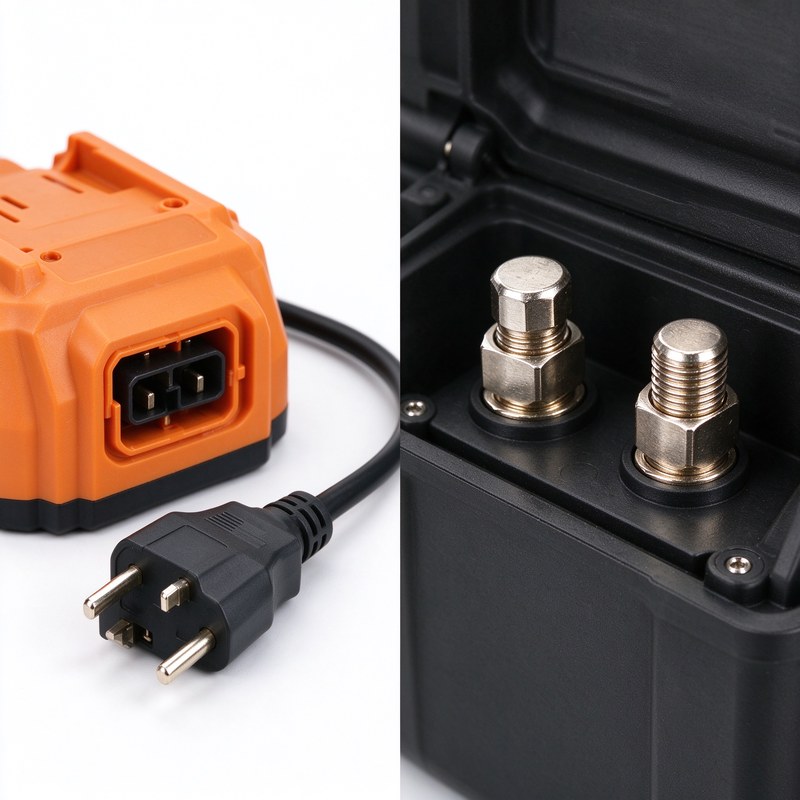
One table, one place. The unified summary below brings the whole accessories family together so a fleet manager can confirm compatibility at a glance. Values are typical; final numbers are confirmed per order, per contract.
Read the grid left to right. A D24 pack drops into a host light, returns to an MC charger or the TKC-9 box, and the FS8-200 feeds the station when mains is absent. Every link in that chain shares the same 25.2 V-class NMC cells.
For hazardous-area teams, pair these accessories with our certified explosion proof light range, and browse the bulk flashlights catalog for handheld units. Explosion protection concepts and certification theory live on the dedicated certification guide, not on this accessories page.
Model
Type
Key rating
Input
Output / capacity
Fits
D24-54
Lithium pack
NMC 18650, PCM, UN38.3
MC charger / TKC-9
25.2 V, 54 Wh
Handheld work lights
D24-100
Lithium pack
NMC 18650, PCM, UN38.3
MC charger / TKC-9
25.2 V, 100 Wh
Tower and portable masts
MC-1
Single-bay charger
EN 60335-2-29 / UL 1310
100-240 VAC
8.4 V, 1.5 A, 1 bay
D24-54, D24-100
MC-2
Dual-bay charger
EN 60335-2-29 / UL 1310
100-240 VAC
8.4 V, 1.5 A × 2 bays
D24-54, D24-100
FS8-200
Folding solar panel
IEC 61730-1, MPPT
Solar 200 W STC
~150 W derated, ~675 Wh/day
Power station then D24 packs
TKC-9
Rapid charging case
9-bay, rolling
Mains or solar
Up to 9 packs at once
D24-54, D24-100
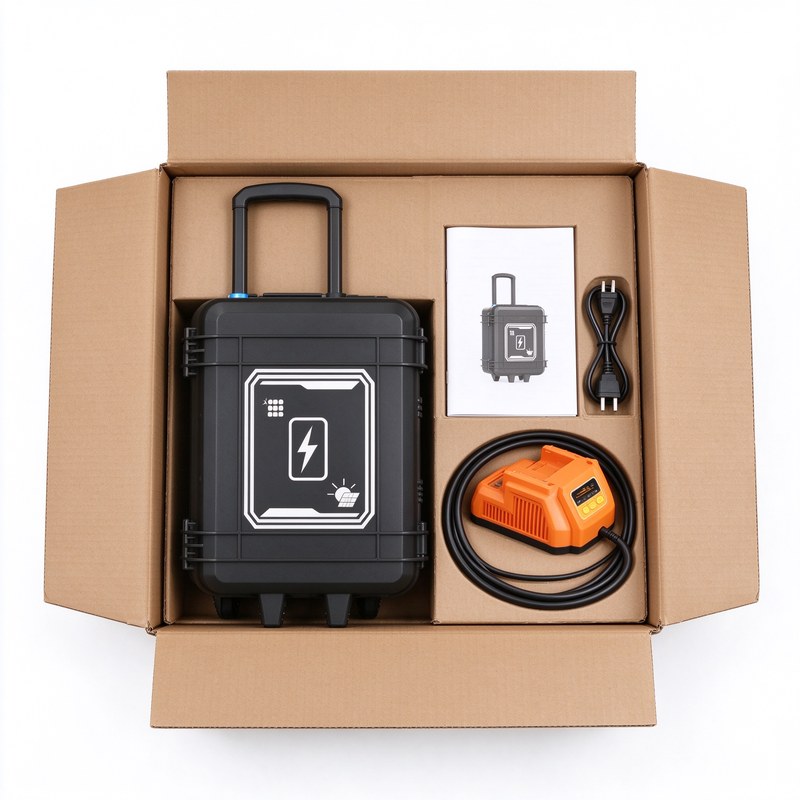
Equipment managers ask the same questions about these accessories on every inquiry. The answers below give direct guidance; exact figures are confirmed per order, per contract.
They are the power ecosystem that keeps a battery emergency light running: removable lithium battery packs, desktop chargers, a folding solar panel for off-grid use, and a rolling multi-bay rapid charging case. The light head itself is separate; these parts supply and rotate its power. Each cell feeds a rechargeable emergency light through the same MC connector.
Choose D24-54 for handheld lights where weight matters and shifts are short. Choose D24-100 for towers and overnight jobs where runtime matters more than carrying weight. Both use the same connector and the same chargers, so a fleet can stock both. Spare packs keep every rechargeable emergency light rotating on the truck.
Yes. Both the MC-1 single bay and MC-2 dual bay accept the D24-54 and D24-100 cells. The MC-1 suits small teams; the MC-2 suits mid-size fleets that want two cells charging at once from one bench footprint. The FS8-200 panel tops up a rechargeable emergency light at remote camps.
Yes, via the FS8-200 folding solar panel and a portable power station. The panel feeds the station, which charges the cells or the TKC-9 case. Treat solar as a slower top-up for remote, multi-day camps rather than a fast depot charger. Store it so a rechargeable emergency light is always ready to deploy.
It is a rolling hard case that charges up to nine cells at once, from mains or solar input. It is for rescue squads and rental vans that rotate many lights in the field, replacing a bench full of desktop chargers during a deployment. This pack matches any rechargeable emergency light in the fleet.
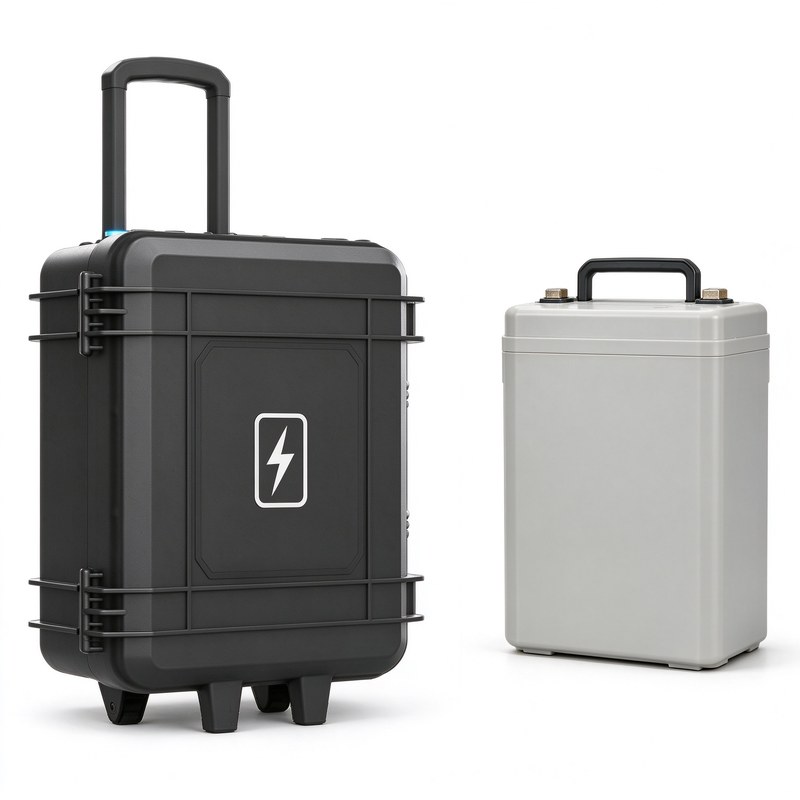
D24 cells share one connector across the compatible light range. To be certain, send your host light model when ordering; the correct cell and charger combination is confirmed on the order. Do not mix in unknown third-party cells. A healthy battery means a rechargeable emergency light never sits dark.
A common starting ratio is one spare cell for every two to three host lights, always kept on charge. Scale up for longer shifts or larger crews, and keep a buffer of fully charged cells for remote deployments. Charging cases let one depot serve each rechargeable emergency light on call.
Charge time depends on cell size and how empty it is; a D24-54 returns to full faster than a D24-100. The chargers manage the lithium curve automatically and stop when full. Exact hours are confirmed per order, per contract. Label every rechargeable emergency light pack before dispatch.
Yes. It is solar compatible, so an FS8-200 panel can feed it during daylight while the team runs lights at night. This gives silent, fuel-free recharging on noise-sensitive or fire-risk scenes. The warranty covers each rechargeable emergency light power unit.
Store them partially charged in a cool, dry place, not fully empty and not left in a hot vehicle. Cycle idle packs every few months. The onboard protection board handles over-discharge and over-temperature during normal use. Keep seals on a rechargeable emergency light stored over winter.

IEC 62133-2 is the safety test standard for portable sealed secondary lithium cells. It covers over-charge, over-discharge, short circuit, thermal and mechanical tests. Every D24 pack is built to this baseline so it can be safely shipped, charged and carried in a response vehicle. This setup suits a rechargeable emergency light used weekly.
EN 60335-2-29 is the EU battery charger safety standard; UL 1310 covers Class 2 and limited power supplies in the US. Dual certification means the same MC-1 or MC-2 unit ships to EU, US and Middle East depots without a region-specific charger, which simplifies fleet spare-part stocking. Compare run time for each rechargeable emergency light model.
At a 0.75 derate and 4.5 average sun hours, plan for about 675 Wh per day into the MPPT controller. On cloudy days expect half that number. Size battery autonomy for two cloudy days in a row rather than a clear-sky average. Rotate stock so no rechargeable emergency light pack sits idle.
A rechargeable emergency light runs 8 to 10 hours on the D24-100 at full output. The D24-54 gives 4 to 5 hours. Runtime drops in cold weather. Confirm figures per host model before bulk order. Solar charging extends a rechargeable emergency light off grid.
Yes. Each rechargeable emergency light charges from a 12V vehicle outlet through the MC-2 charger. Field teams top up packs during transport. Add the FS8-200 solar panel for remote camps without mains power. The connector fits any rechargeable emergency light already owned.
Store the pack in a rechargeable emergency light at 15 to 25 degrees C and 40 to 60 percent charge. The operating range is minus 20 to plus 50 degrees C. Recharge every six months per IEC 62133-2 depot guidance. This is the power core of a rechargeable emergency light system.
Previous :
Hydraulic Mobile Light Tower for Construction & EmergencyNext :
Handheld Work Light for Industrial Inspection and Repair Solar Mobile Light Tower for Disaster Camps and Remote Sites
This trailer-based solar mobile light tower is equipped with high-efficiency monocrystalline solar panels, adjustable LED floodlights and telescopic mast. Powered by gel battery, it offers stable off-grid lighting for construction, disaster relief, remote outposts and emergency rescue tasks. Note: Price for reference only. Exact price based on quantity, size, weight and custom details.
 Diesel Light Tower for Night Construction Mining Emergency Repair Sites
This trailer-mounted diesel mobile light tower integrates diesel generator, telescopic mast and multi LED flood heads. It delivers stable high-power lighting without solar reliance, ideal for construction, road repair, disaster recovery and all-night emergency works. Note: Price for reference only. Exact price based on quantity, size, weight and custom details.
 Portable Telescopic Flood Light for Rescue and Road Work
This TL-200 portable flood light adopts telescopic aluminum mast and dual LED heads, powered by lithium battery. It delivers stable bright illumination for fire rescue, roadside emergency, construction and disaster relief, easy to carry and fast setup. Note: Price for reference only. Exact price based on quantity, size, weight and custom details.
 Remote Control Searchlight for Ports and Perimeter Security Water Rescue
Remote pan tilt rescue light with wireless remote, magnetic base and long throw narrow beam. It supports horizontal and vertical rotation, salt spray resistant housing, suitable for water rescue, port, border patrol and industrial perimeter security. Bulk wholesale, OEM custom color and packaging available. Note: Price for reference only. Exact price based on quantity, size, weight and custom details.
 Disaster Emergency Lighting for Relief Camps and Rescue
Disaster lighting family includes telescopic mast light, remote searchlight and handheld 360 light. Solar charging support, off-grid available, durable for earthquake rubble, flood rescue, camp lighting and emergency road repair. Note: Price for reference only. Exact price based on quantity, size, weight and custom details.
 Handheld Work Light for Industrial Inspection and Repair
This 360 degree rechargeable work light delivers full surrounding illumination, built with strong magnetic base and hanging hook. Multiple brightness modes, durable waterproof housing, ideal for auto repair, industrial inspection, construction and emergency rescue. Note: Price for reference only. Exact price based on quantity, size, weight and custom details.
Copyright © Custom Disaster - Relief Bedding: Tents, Sleeping Bags, Blankets All Rights Reserved
the professional team to service !


