


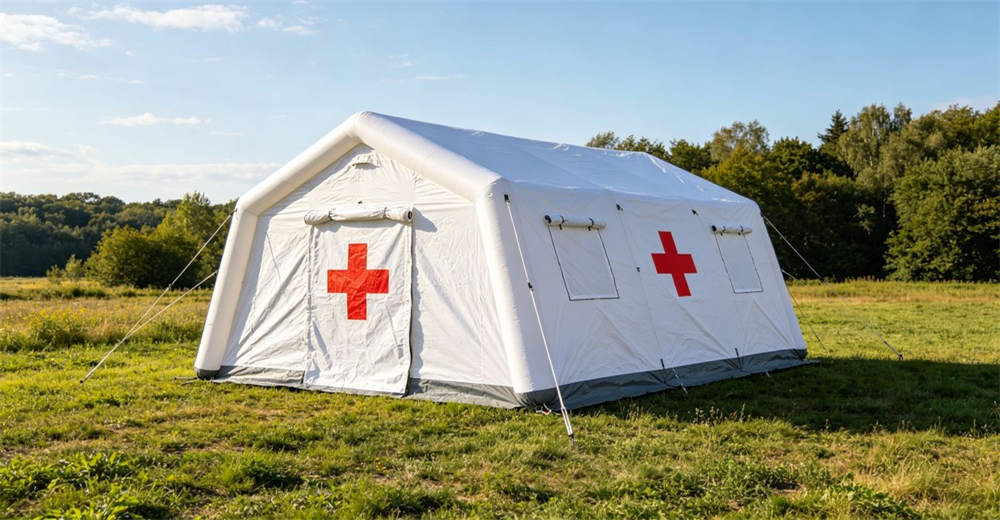
Our inflatable medical tent supports fast on‑site deployment for disaster relief, triage and field hospital missions. Made of heavy‑duty waterproof flame‑retardant PVC, it features high‑frequency welded air beams and reinforced seams. Multiple sizes available, easy to inflate, fold and transport for rescue, pandemic control and global humanitarian operations.
Note: Price for reference only. Exact price based on quantity, size, weight and custom details.
model no. :
IT-6-BBrand:
YRFmarket price :
$933.8sale price :
$466.9price range :
5-100/$466.9Color :
Multiple Colorsport of dispatch :
Guangdong/GuangzhouPayment :
TT, Paypal, Western Unionmin order :
30original region :
Made in ChinaLead Time :
5-15days
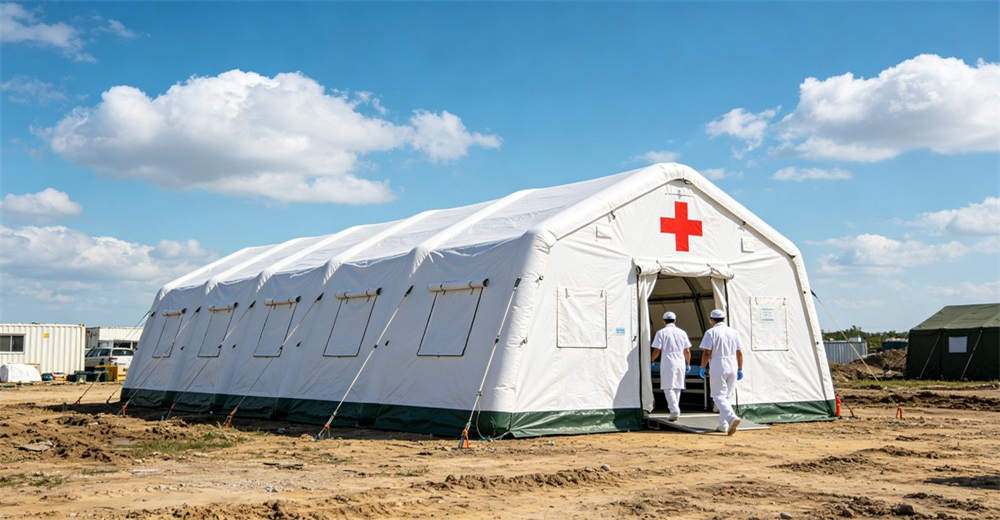
Our medical emergency inflatable tent solutions provide rapid-deployment field hospitals for disaster response, mass casualty incidents, and military operations. With heavy duty air beam medical tent technology and ce certified construction, these tents deliver reliable healthcare infrastructure when minutes matter. As a leading inflatable tent for medical use, our portable medical tent serves as a temporary medical facility tent for disaster relief medical tent operations and emergency shelter medical tent deployments.
 |

|
Table of Contents
Table Analysis: This table outlines the key components required for planning an effective medical emergency response capability, including equipment specifications and operational purposes. Proper planning ensures your medical team is fully prepared for any emergency scenario.
Table Analysis: The following table provides a comprehensive overview of key specifications and configuration options, helping you select the right medical emergency inflatable tent for your operational requirements.
|
|
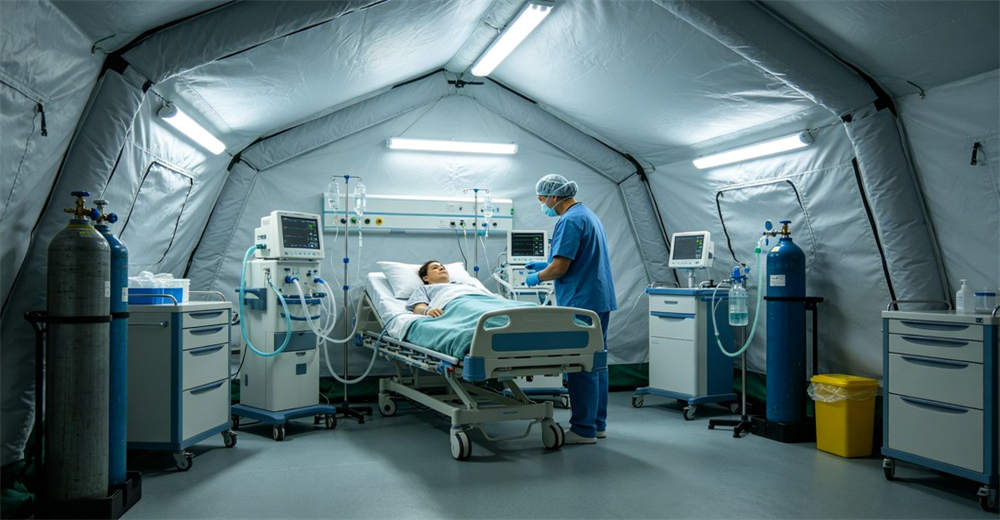
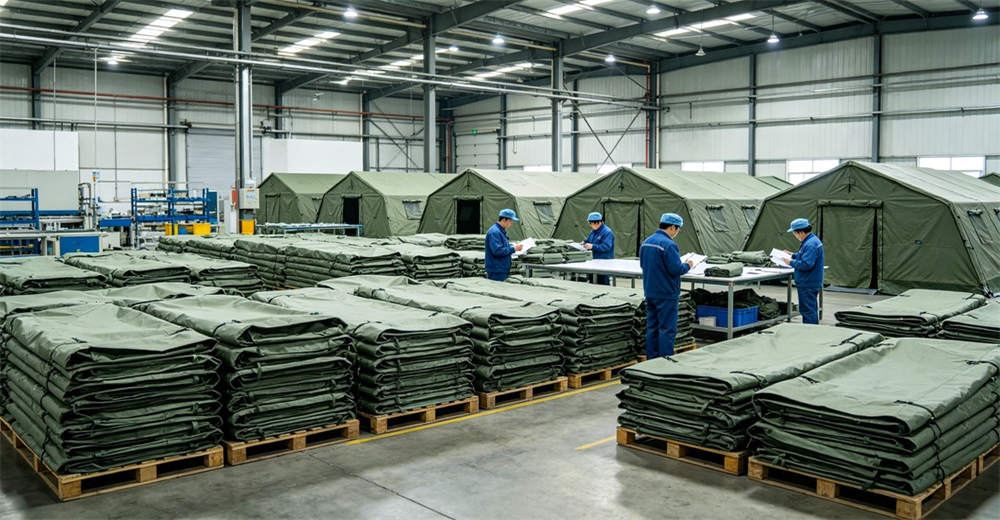
Get factory-direct pricing on complete medical tent systems, deployment consulting, and custom configuration for field hospitals and triage centers. This medical emergency tent is specifically designed for rapid medical response deployment, As a leading manufacturer of medical emergency tent, YRF Textile provides high-quality solutions for emergency response. We offer factory direct inflatable medical tent pricing with custom size medical emergency tent options, wholesale inflatable medical tent rates, and serve as a trusted b2b medical inflatable tent supplier and oem inflatable medical tent manufacturer. Our rapid deployment emergency shelter system allows medical teams to establish fully operational facilities in under 15 minutes.
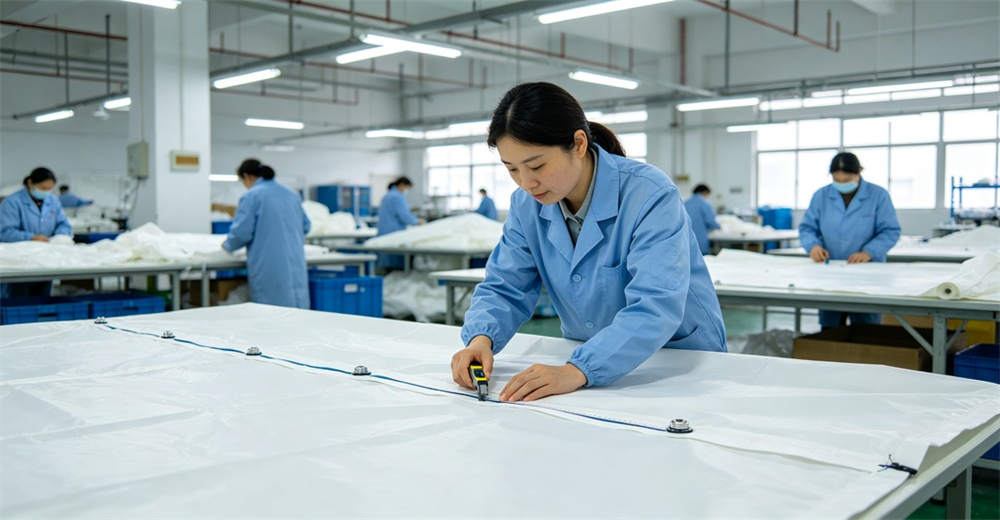
The medical emergency tent features durable 600D Oxford PVC coated fabric. All our tents are certified to Chinese national standards including GB 8624 B1 flame retardant, GB/T 4744-2013 waterproof, GB/T 33744-2017 wind resistance, and GB/T 3923.1-2013 tensile strength. Each tent is constructed with durable pvc fabric for long-term use as a reliable temporary shelter in medical emergencies.
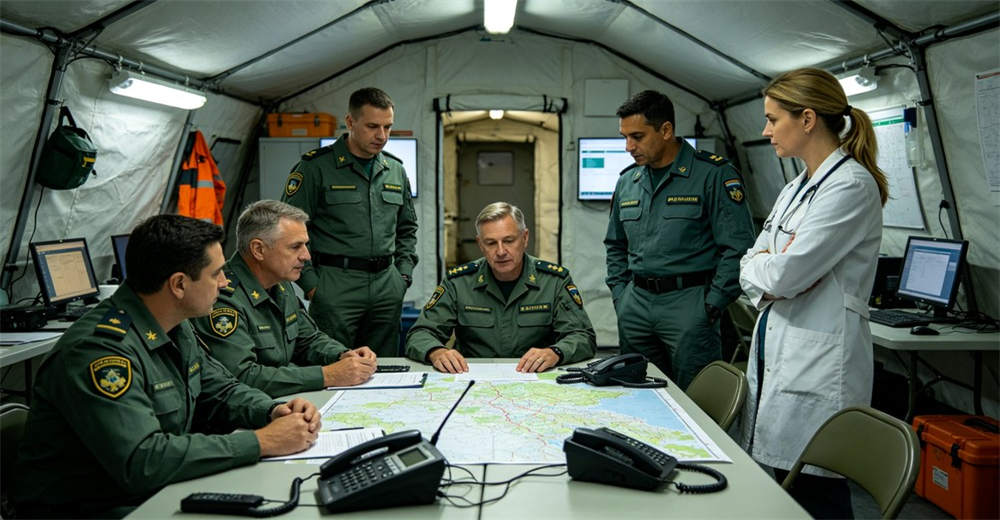
Our medical emergency inflatable tent solutions are engineered with heavy duty air beam technology for rapid setup in critical situations. Each waterproof medical tent is ce certified and available at factory direct pricing.
As a leading manufacturer, we offer portable medical emergency inflatable tent for field hospitals, rapid deployment triage tent for mass casualty incidents, ce certified emergency medical shelter for disaster response, custom size medical tent bulk order for hospitals, and heavy duty inflatable medical tent factory direct price.
Contact us today for a free consultation and custom configuration. Each tent is constructed with durable pvc fab 30-Second Overview: Medical Emergency Tent Deployment When a medical emergency strikes, every second counts.
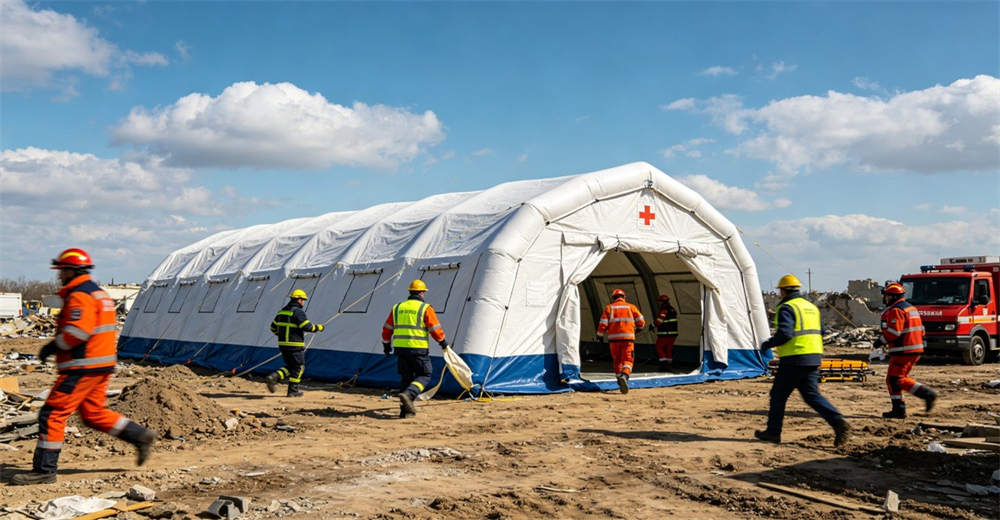
Our medical emergency inflatable tent systems provide rapid deployment temporary medical facilities that can be fully operational in under 30 minutes. Whether you need an emergency shelter for disaster relief, a triage tent for mass casualty incidents, or a complete portable hospital for field operations, our CE certified inflatable medical tents deliver hospital-grade environments anywhere in the world.
As a factory direct manufacturer with over 15 years of experience, we offer custom size solutions ranging from compact 10m² first aid stations to expansive 200m² temporary medical facility complexes. Our heavy duty air beam technology ensures structural integrity in extreme conditions, while our modular and scalable design allows you to build exactly the medical capacity you need. All tents comply with international compliance standards including BS5867, EN 13773, and NFPA 701 for maximum safety and efficiency.
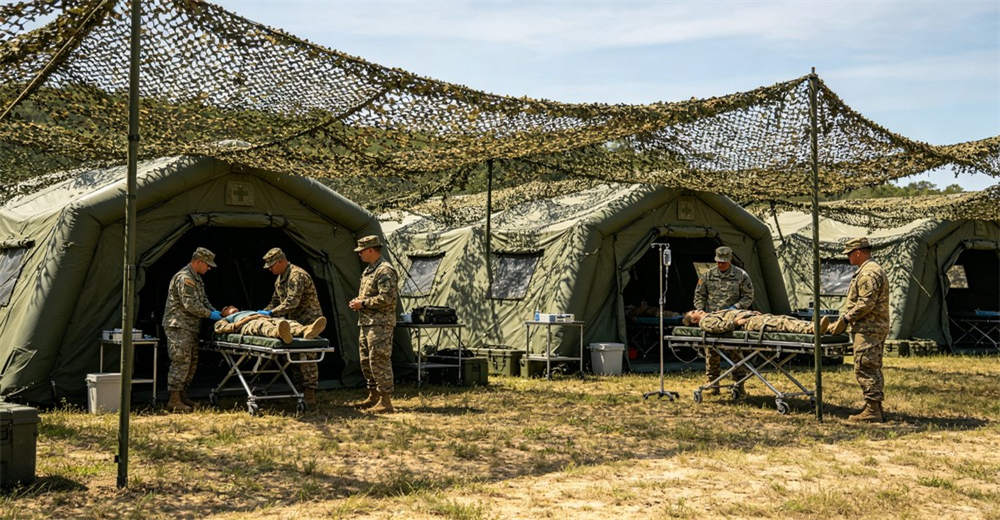
Key advantages at a glance: 5-minute rapid setup, air beam structural system, waterproof & flame retardant PVC fabric, CE certified for medical use, factory direct pricing, custom sizes & colors, modular connection system for building larger complexes, and clinical-grade interior environment suitable for patient care. Our tents are trusted by military forces, humanitarian organizations, hospitals, and emergency response teams worldwide for their reliability, durability, and operational efficiency.
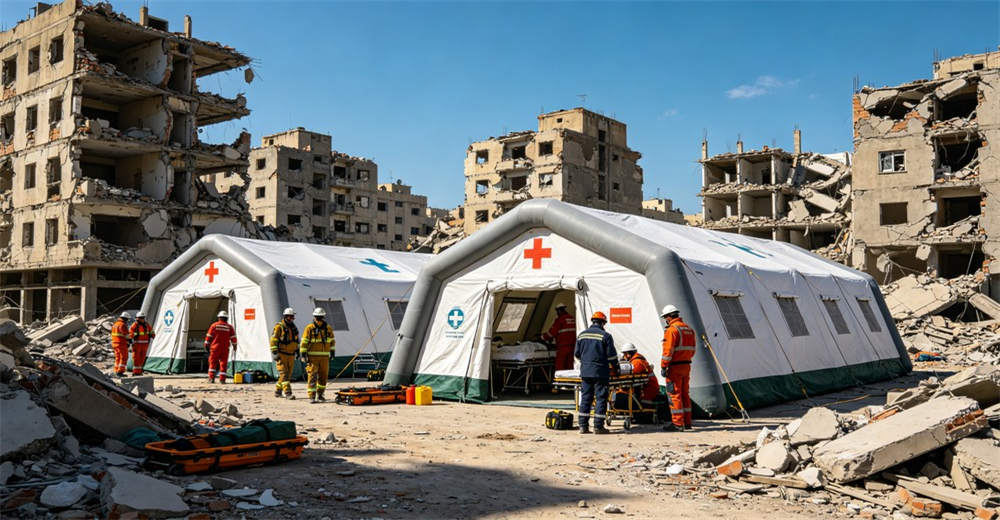
Our medical emergency inflatable tents are designed for a wide range of clinical and emergency applications, from off-grid field hospitals to government tender and contract procurement projects. Every tent is engineered to meet strict medical compliance standards while maximizing operational efficiency in the most challenging environments. The modular and scalable design means you can start with a single unit and expand into a complete medical complex as needs grow.
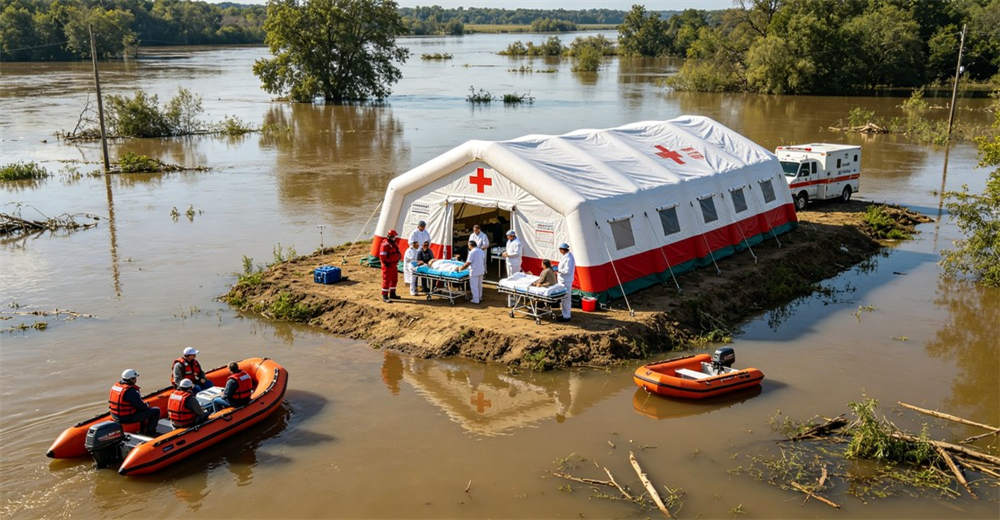
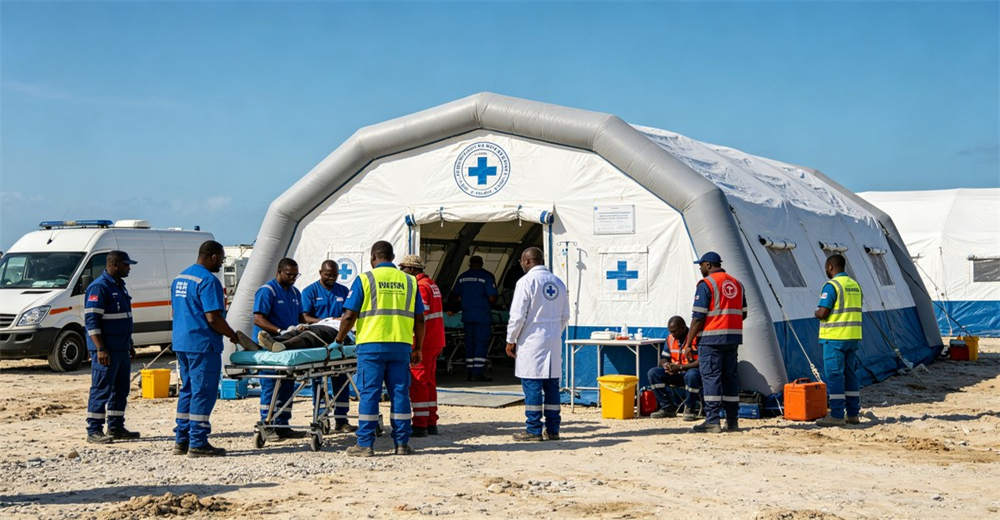
In the deployment of medical emergency tent, Earthquakes, hurricanes, floods, typhoons, and wildfires often result in mass casualties and damage to or destruction of local healthcare infrastructure. Medical tents must be deployed rapidly to provide triage, emergency treatment, and temporary hospital capacity.
Key challenges include: limited access to the disaster site, uncertain ground conditions, potential aftershocks or ongoing hazards, disrupted supply chains, and large numbers of casualties with varied injuries. Tents must be durable enough to withstand post-disaster weather conditions while providing a safe, weather-protected environment for patient care.
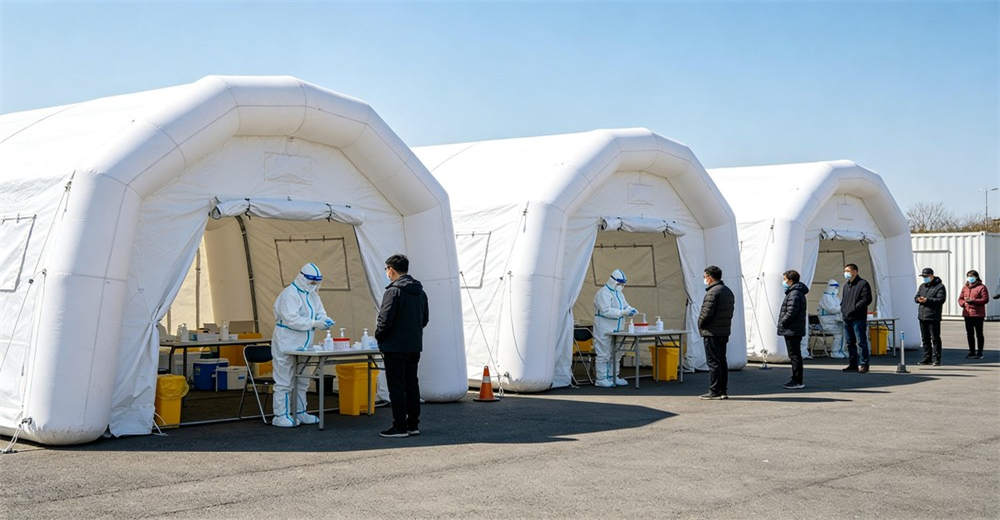
This medicIn the deployment of medical emergency tent, During pandemics and infectious disease outbreaks (COVID-19, Ebola, influenza, tuberculosis), medical tents serve as surge capacity facilities, testing centers, isolation units, and vaccination sites. Key challenges include: infection control requirements (negative pressure, PPE protocols, patient flow management), rapid scaling of capacity, protection of healthcare workers, and community safety concerns.
Tents must support proper ventilation, patient zoning (clean/contaminated areas), and controlled access to minimize disease transmission. Specialized negative pressure HEPA filtration tents may be required for isolating highly contagious patients.
This meIn the deployment of medical emergency tent, Industrial accidents, transportation disasters, building collapses, and terrorist attacks can produce large numbers of casualties in a single location. Medical tents provide on-site triage, emergency treatment, and patient holding areas.
Key challenges include: high patient throughput requirements, coordination with EMS and hospitals, limited on-site resources, varied injury patterns, and potential ongoing hazards (fire, structural instability, hazardous materials). Tents must support rapid assembly, high patient flow, and flexible interior configuration to accommodate triage, treatment, and holding functions simultaneously.
This medical emeIn the deployment of medical emergency tent, In remote rural areas, conflict zones, or regions with limited healthcare infrastructure, medical tents provide temporary clinics and field hospitals for routine care, surgical missions, and vaccination campaigns. Key challenges include: limited access to utilities (electricity, clean water, sanitation), extreme climate conditions, difficult logistics for resupply, and cultural/language barriers.
Tents must be self-sufficient, durable for extended deployment, and compatible with portable power, water, and sanitation systems. Our medical emergency tents is designed for rapid deployment.
Natural Disaster Response (Earthquake, Flood, Hurricane)
In the aftermath of natural disasters, immediate medical infrastructure is critical. Our inflatable medical tents can be airlifted or trucked to disaster zones and fully operational within 30 minutes of arrival.
Triage Area: 30m² tent at disaster entry point for initial patient assessment and categorization (red/yellow/green/black tagging)
Emergency Treatment: 50m² tent for critical care, wound dressing, fracture stabilization, and life-saving interventions
Surgical Unit: 100m² tent with sterile operating field for emergency surgeries and procedures
Recovery Ward: Multiple 50m² tents for post-treatment observation and recovery
Morgue/Cold Storage: Optional temperature-controlled tent for body storage in mass casualty events
Equipment Package: Portable oxygen concentrators, defibrillators, suction units, surgical lights, medication refrigerators, and basic lab equipment. Power supplied by portable generators or solar systems.
For large gatherings such as sports events, concerts, festivals, or political rallies, our tents provide professional on-site medical facilities that can be quickly deployed and removed without permanent infrastructure.
Small Triage and First Aid Station (1-2 tents)
The following table provides a comprehensive overview of key specifications and configuration options for our medical emergency inflatable tent solutions. Each ce certified medical inflatable tent is built with heavy duty materials and air beam technology for reliable performance in emergency situations.
The following table provides a comprehensive overview of key specifications and configuration options for our medical emergency inflatable tent solutions. Each ce certified tent is built with heavy duty materials and air beam technology for reliable performance in emergency situations.
The following table provides a comprehensive overview of key specifications and configuration options for our medical emergency inflatable tent solutions. Each ce certified tent is built with heavy duty materials and air beam technology for reliable performance in emergency situations.
Medium Field Medical Facility (3-4 tents)
The following table outlines key specifications and configuration details for our medical emergency inflatable tent solutions. Each ce certified tent is engineered with heavy duty pvc fabric and reliable air beam technology for dependable performance in critical medical situations.
The following table outlines key specifications and configuration details for our medical emergency inflatable tent solutions. Each ce certified tent is engineered with heavy duty pvc fabric and reliable air beam technology for dependable performance in critical medical situations.
In the deployment of medical emergency tent, For pandemic and infectious disease response, a specialized isolation configuration is required:
For pandemic and infectious disease response, a specialized isolation configuration is required:
Negative Pressure Isolation Tent: 30sqm tent with integrated HEPA filtration, sealed airlock entrance, and directional airflow (negative pressure -15 to -25 Pa) for isolating highly contagious patients
Screening/Triage Tent: 30sqm medical tent at entry for patient screening, temperature checks, and initial classification — separated from clean areas
Treatment Tent: 40-60sqm tent for non-critical patient care, with partitioned patient bays and controlled ventilation
Staff PPE & Decon Area: Dedicated tent or designated area for PPE donning/doffing, hand hygiene, and staff decontamination
Table Analysis: This table outlines the maintenance schedule and care procedures to ensure your inflatable medical tent maintains optimal performance and extends its service life.
Patient Flow: One-way flow from contaminated entry → screening → treatment/isolation → clean discharge, with separate staff and patient entrances
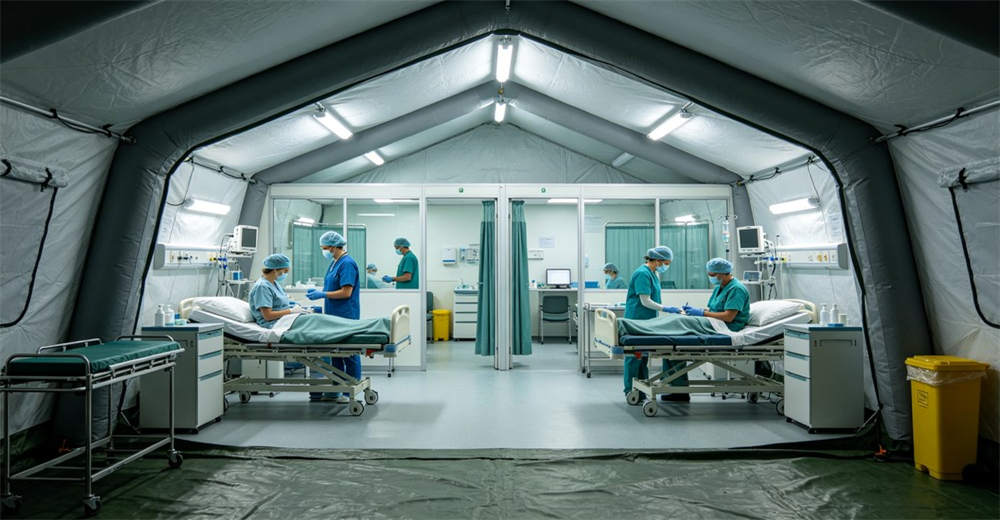
|
Component |
Specification |
Purpose |
|
Primary Tent |
The following table provides a comprehensive overview of key specifications and configuration options for our medical emergency inflatable tent solutions. Each ce certified tent is built with heavy duty materials and air beam technology for reliable performance in emergency situations. 30sqm Medical Inflatable Tent |
Triage, first aid, emergency treatment (8-10 person capacity) |
|
Optional Second Tent |
30sqm Medical or 40sqm Relief Tent |
Patient observation, supply storage, staff rest |
|
Setup Time |
3-8 minutes (2-3 personnel) |
Rapid initial response |
|
Best For |
Small incidents, initial resp The following table provides a comprehensive overview of key specifications and configuration options for our medical emergency inflatable tent solutions. Each ce certified tent is built with heavy duty materials and air beam technology for reliable performance in emergency situations. onse, remote clinics |
Up to 20 patients/hour throu Table Analysis: This table outlines the key components required for planning an effective medical emergency response capability, including equipment specifications and operational purposes. Proper planning ensures your medical team is fully prepared for any emergency scenario. ghput |
Table Analysis: The table below provides a detailed comparison of our recommended medical emergency tent configurations, including dimensions, capacity, key features, and ideal use cases. This comparison helps you select the most suitable tent based on your specific operational requirements and budget constraints.
|
Component |
Specification |
Purpose |
|
Triage Tent |
30sqm Medical Inflatable Tent |
Patient intake, triage classification, initial assessment |
|
Treatment Tent |
40sqm emergency inflatable tent Medical or 50sqm military medical tent Military Tent |
Emergency treatment, minor procedures, patient holding (15-25 beds) |
|
Observation/Recovery Tent |
40sqm Relief Tent |
Patient observation, recovery, temporary holding (15-20 beds) |
Support Tent 30sqm Medical or 40sqm Relief Supply stor The following table outlines key specifications and configuration details for our medical emergency inflatable tent solutions.
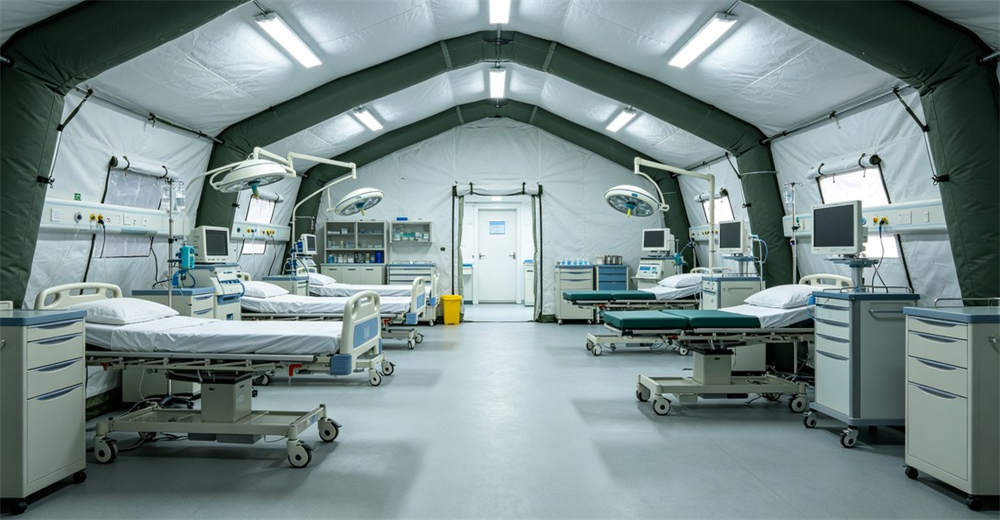
Advanced Material & Construction Technology
Our medical emergency inflatable tents utilize state-of-the-art materials and manufacturing processes to ensure maximum durability, reliability, and performance in the most demanding conditions.
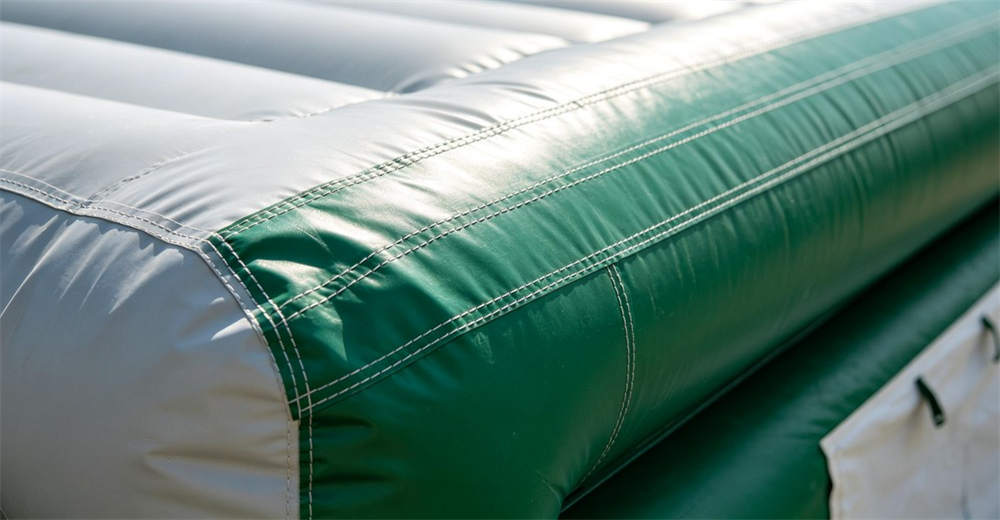
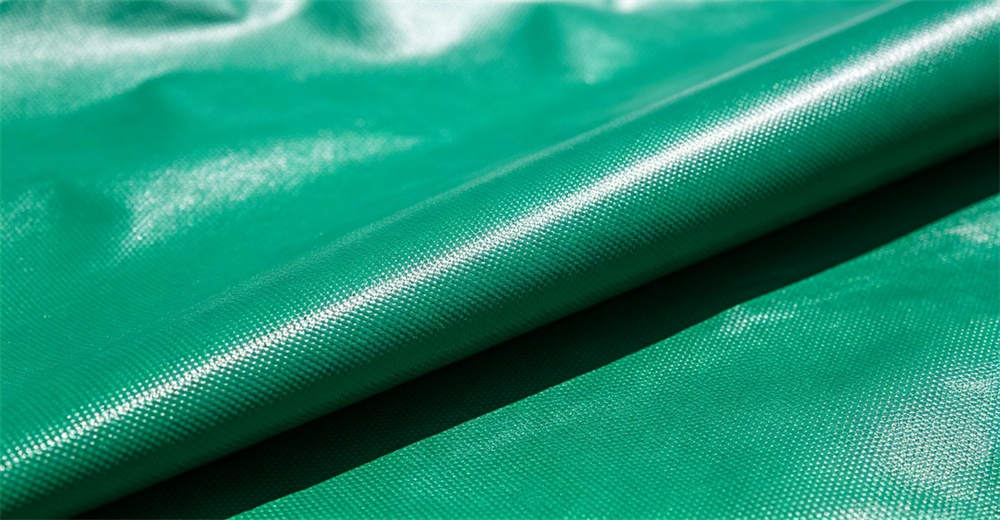
Outer PVC Fabric - 650g/m² Heavy Duty
Base Fabric: 1000D high-tenacity polyester filament yarn, woven in plain weave with 23×23 threads per square inch for maximum tensile strength
PVC Coating: Double-sided PVC coating, 0.55mm total thickness. Formulated with UV stabilizers, anti-microbial agents, and cold-resistant plasticizers
Total Weight: 650g/m² (19.2 oz/yd²), providing optimal balance between durability and portability
Tensile Strength: Warp direction: ≥2800N/5cm. Weft direction: ≥2400N/5cm. Tested per ISO 1421 standard
Tear Strength: Warp: ≥350N. Weft: ≥300N. Trapezoid tear test method per ISO 4674
Adhesion Strength: PVC to polyester base: ≥120N/5cm. Ensures no delamination under stress
Waterproof Performance: Hydrostatic head ≥5000mm. Tested per ISO 1420. 100% waterproof with welded seams
Flame Retardant: Meets BS5867 Part 2 Type B, EN 13773, and NFPA 701 standards. Self-extinguishing, no molten drips
UV Resistance: 500+ hours accelerated weathering testing (QUV). Color fastness grade 4-5. Maintains 80% strength after 5 years outdoor exposure
Temperature Range: Flexible from -30°C to +60°C. Special low-temperature formula available for Arctic conditions down to -45°C
Chemical Resistance: Resistant to common disinfectants, mild acids, alkalis, and petroleum products. Suitable for medical environment cleaning
Air Beam Structure - TPU Coated Polyester
Material: 1000D polyester fabric with double-sided TPU (thermoplastic polyurethane) coating, 0.9mm total thickness
Why TPU: Superior air retention compared to PVC. Excellent flexibility and fatigue resistance. Higher tensile strength for high-pressure applications
Air Retention: ≤5% pressure loss over 24 hours at standard conditions. High-frequency welded seams ensure zero air leakage
Working Pressure: 0.25-0.35 MPa (36-51 PSI). Burst pressure tested to 1.2 MPa (174 PSI) - 4x safety factor
Beam Diameter: Standard 200mm (8") diameter for main structural beams. 150mm (6") for secondary support beams
Construction: Cylindrical tube design with internal tensioning system. Multiple chambers for redundancy - single chamber failure does not cause collapse
Inner Lining - Antibacterial Breathable Fabric
Material: 200g/m² polyester fabric with silver-ion antibacterial treatment. Breathable to prevent condensation buildup
Antibacterial Efficacy: ≥99.9% reduction against E. coli, Staphylococcus aureus, and other common pathogens. Tested per ISO 22196
Removable & Washable: Velcro attachment for easy removal. Machine washable at 60°C for thorough disinfection. Replaceable if damaged
Light Reflective: White color with light-reflective coating to maximize interior brightness and reduce lighting energy needs
High-Frequency Welding Technology
Process: 27.12MHz high-frequency dielectric welding. Creates molecular-level bond between PVC layers - stronger than the base material itself
Weld Width: Standard 20mm (0.8") weld width for all structural seams. 30mm (1.2") for high-stress areas and air beam seams
Quality Control: 100% visual inspection of all welds. Random destructive testing to verify weld strength ≥ base fabric strength. Air pressure testing of every completed tent
Consistency: Computer-controlled welding parameters ensure consistent quality across production runs. Weld strength variation ≤5%
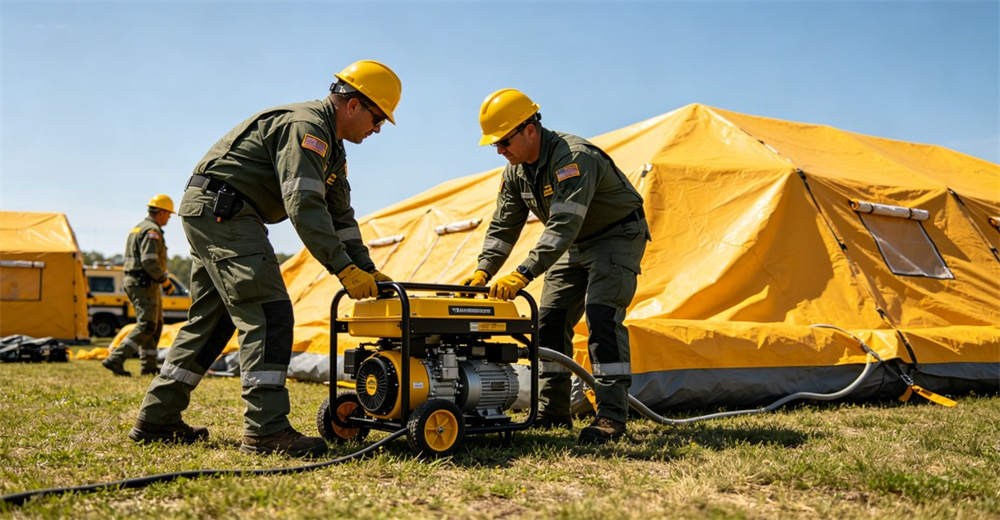
Medical Emergency Tent: Deployment Timeline
Deployment Phases
Efficient deployment of medical emergency tents follows a structured timeline, with priority areas established firIn the deployment of medical emergency tent, Team arrives at deployment site,.
Conducts rapid site assessment: ground conditions (level, firm, well-drained), access routes for ambulances and supply vehicles, proximity to hazards (downed power lines, unstable structures, flood zones), available utilities, and security considerations. Team leader assigns roles: tent deployment, equipment setup, supply organization, site security.
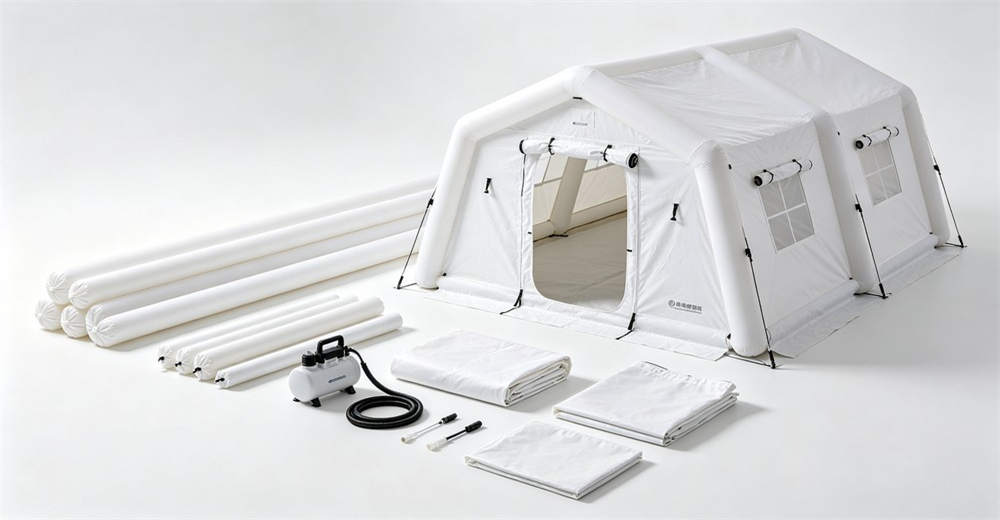
First priority: deploy the triage/emergency treatment tent. Two team members unroll and position the tent, connect blower, begin inflation.
While inflating, other team members prepare ground tarp, organize medical supplies, and set up initial lighting. Tent is fully inflated and secured with ground stakes and guy lines within 8 minutes of starting deployment. Our medical emergency tents is packed in durable carry bag for easy transport.
Triage tent is operational: patient intake area established, triage classification system in place, basic first aid supplies available, communication with EMS and receiving hospitals established. Patient care begins — initial triage and emergency treatment can start while additional tents are still being deployed.
This is the critical milestone: medical capability is established within 3-10 minutes of arrival. This medical emergency tents meets international quality standards.
Triage tent is opeSecond and third tents deployed simultaneously by separate teams: treatment/observation tent and support/supply tent. Tents positioned according to site layout plan, with adequate spacing between tents for walkways, ambulance access, and future expansion.
Timeline Milestones
Connection tunnels installed between tents if using connected configuration. All tents secured with ground stakes and guy lines, blowers connected to power source. This medical emergency tent meets international quality standards.
All tents deployed and secured. Interior setup completed: patient beds/cots arranged, medical equipment positioned (monitoring, oxygen, suction, medications), lighting installed, sanitation stations set up, supply storage organized, signage posted (triage, treatment, observation, staff only, exit).
Power distribution established — all tents connected to generator or power source, with circuit protection. Communication system tested (radios, phones, inter-tent communication). The medical emergency tents features durable PVC coated fabric.
Complete facility verification: all tents inflated and secured, all equipment functional, supplies stocked and organized, staff briefed and assigned, patient flow tested, infection control measures in place, waste management system operational, emergency evacuation plan communicated. Facility is fully operational and ready for sustained medical operations.
Team leader reports full operational capability to incident command. The medical emergency tent includes electric centrifugal blower.
Complete facility verification: all tents inflated and secured, all equipment functional, supplies stocked and organized, staff briefed and assigned, patient flow tested, infection control measures in place, waste management system operational, emergency evacuatio
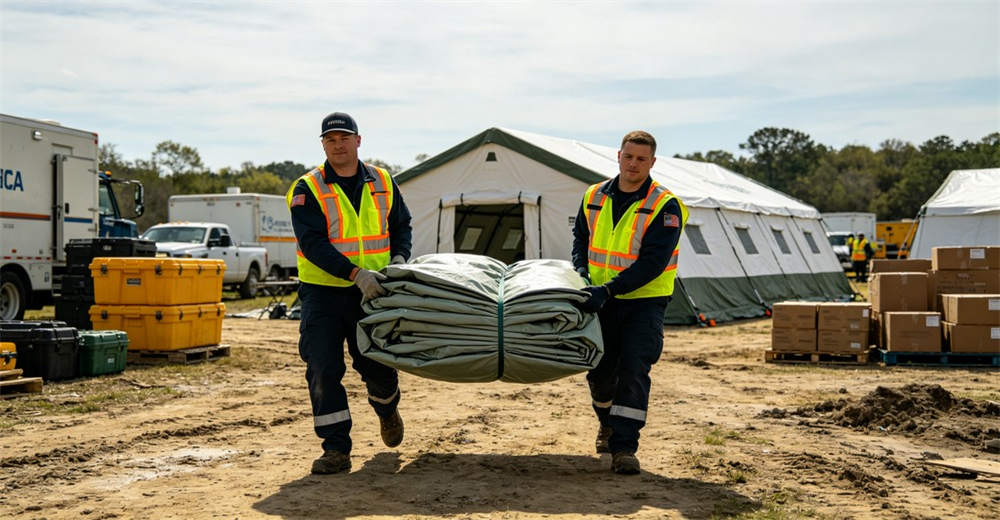
Step-by-Step Deployment Procedure
Proper deployment ensures optimal performance and safety. Follow these steps carefully:
Phas e 1: Site Preparation (5-10 minutes)
Site Selection: Choose flat, well-drained ground. Clear all debris, rocks, and sharp objects. Ensure minimum 2m clearance around tent perimeter for anchoring and access.
Ground Protection: Lay down ground sheet or protective tarp to prevent abrasion and moisture ingress. Ensure ground sheet extends 30cm beyond tent footprint.
Anchor Point Preparation: Identify and pre-mark all ground stake positions. For hard surfaces, prepare water ballasts or concrete weights as alternative anchoring.
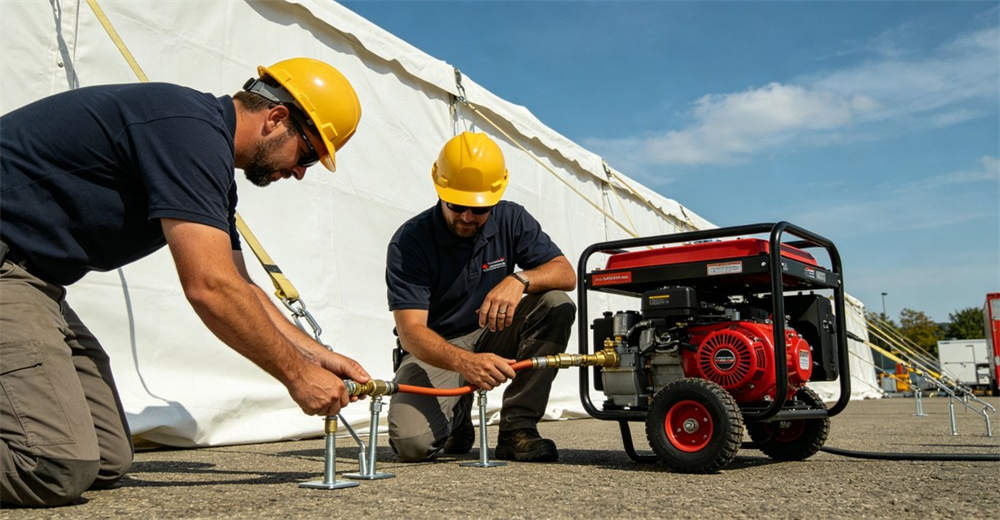
Power Source Setup: Position generator or power supply at safe distance (minimum 5m from tent). Ensure proper grounding and cable routing to prevent tripping hazards.
Phase 2: Unpacking & Layout (5 minutes)
Unpack Carefully: Remove tent from storage bag, following fold lines to avoid creating new creases. Lay out completely flat on ground sheet.
Orientation Check: Ensure doors and windows face desired directions. Check that all air beams are unrolled and not twisted.
Valve Inspection: Verify all inflation valves are in closed position. Check valve caps are present and undamaged.
Accessory Preparation: Unpack air pump, pressure gauge, ground stakes, and guy lines. Ensure pump fuel/charge is sufficient.
Phase 3: Inflation (5-20 minutes depending on size)
Connect Pump: Attach pump hose to main inflation valve. Ensure secure connection to prevent air leakage during inflation.
Initial Inflation: Start pump and inflate to approximately 50% of recommended pressure (0.12-0.18 MPa). This allows the structure to take shape without stressing seams.
Structure Adjustment: While partially inflated, adjust tent position and orientation. Straighten any twisted beams. Ensure all corners are properly aligned.
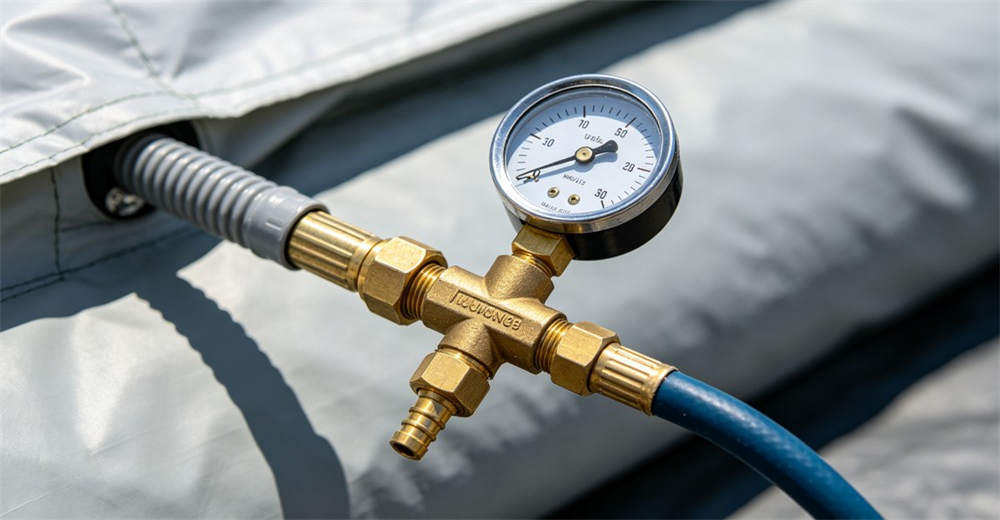
Full Inflation: Continue inflation to recommended operating pressure (0.25-0.35 MPa). Monitor pressure gauge closely to avoid over-inflation.
Pressure Verification: Use calibrated pressure gauge to verify all beams reach correct pressure. Close all valves securely and replace valve caps.
Timing Note: Standard 30m² model: 5-8 minutes. Medium 50m²: 8-12 minutes. Large 100m²: 15-20 minutes with high-capacity pump.
Phase 4: Anchoring & Stabilization (10-15 minutes)
Ground Stake Installation: Install all ground stakes at 45-degree angle, fully embedded. Use appropriate stake length for ground conditions (30cm standard, 50cm for soft ground).
Guy Line Tensioning: Attach and tension all guy lines evenly. Use tensioners to achieve consistent tension. Do not over-tension as this can stress the structure.
Wind Stability Check: In windy conditions, install additional guy lines and ground stakes. Consider using windbreak panels if wind exceeds Beaufort 6.
Final Structure Check: Walk around entire perimeter. Verify no sagging, no twisted beams, all doors/windows operate smoothly. Check that tent is level and stable.
Phase 5: Interior Setup (15-30 minutes)
Floor Installation: Lay down removable floor liner (if equipped). Ensure proper fit and secure with Velcro or snap fasteners.
Equipment Placement: Position medical equipment, beds, and supplies according to planned layout. Ensure clear walkways and emergency egress paths.
Power & Lighting: Install interior lighting, power distribution, and equipment connections. Ensure all cables are properly routed and secured to prevent tripping.
HVAC Connection: Connect air conditioning, heating, or ventilation systems if required. Verify proper airflow and temperature control.
Final Inspection: Complete comprehensive checklist. Verify all systems operational. Document setup with photos for records.
Safety Warning: Never exceed recommended air pressure. Do not use the tent during extreme weather (wind > Beaufort 8, heavy snow load). Always ensure proper anchoring before use. Keep heat sources away from fabric walls.
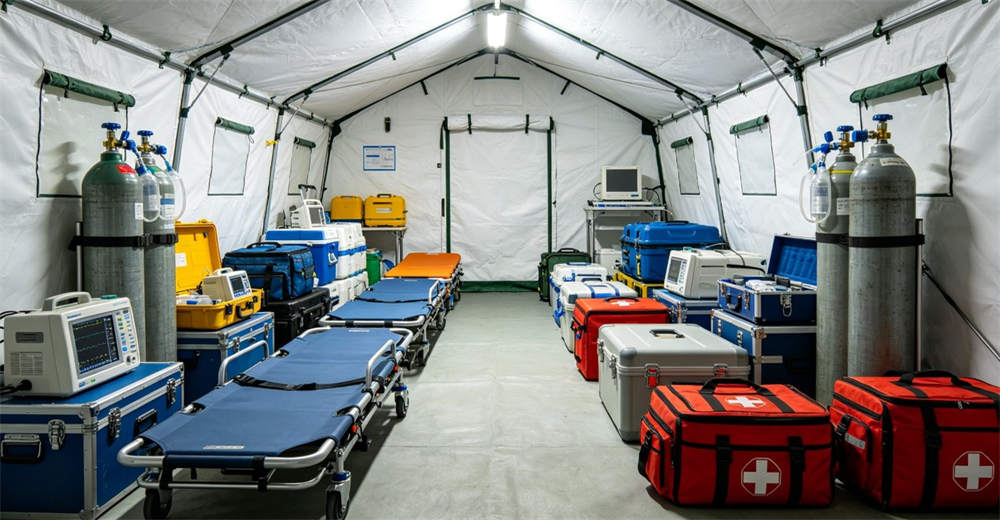
Medical Emergency Tent: Site Layout Planning
Proper site layout is critical for efficient patient flow, infection control, staff safety, and operational effectiveness. A well-planned layout minimizes cross-contamination, reduces staff fatigue, improves patient throughput, and supports future expansion. The medical emergency tent uses high-frequency welding technology for airtight seams.
For a 3-4 tent medium facility (30-50 beds), the following linear layout is recommended:
One-way patient flow: Patients enter at one end, move through triage → treatment → observation → discharge, and exit at a separate point. No backtracking or cross-flow between clean and contaminated areas.
Zone separation: Clearly delineate contaminated zones (triage, decontamination, patient treatment), clean zones (staff areas, supply storage, pharmacy), and support zones (sanitation, waste, power generation). Physical barriers (tents, fencing, tape) separate zones.
Ambulance access: Designate clear ambulance entry and exit routes, with a patient drop-off area adjacent to triage. Ambulance routes should not cross pedestrian walkways or staff areas.
Expansion capacity: Leave space around the facility for additional tents if patient volume exceeds initial capacity. Plan for 30-50% expansion space in the initial layout.
Utilities access: Position generator, water supply, and sanitation facilities for easy access without crossing patient care areas. Run power cables in protective conduits or elevated to prevent tripping hazards.
Security and crowd control: Establish a perimeter with controlled entry points. Separate patient entrance from staff/supply entrance. Designate areas for family waiting, media, and visitors away from patient care areas.
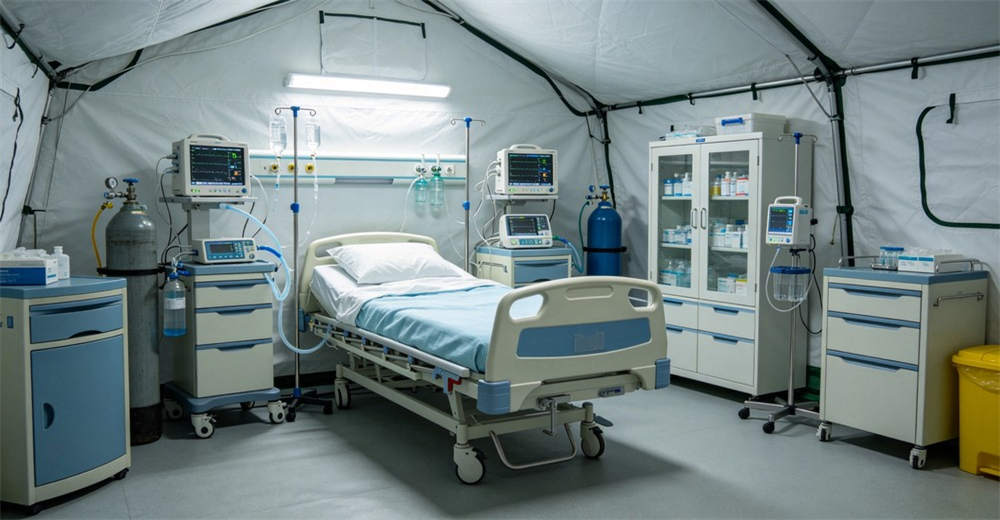
Table Analysis: The following table outlines the complete deployment timeline for our medical emergency inflatable tents, broken down by phase, duration, key activities, and responsible personnel. This timeline serves as a standard operating procedure for your deployment team to ensure efficient and consistent setup.
|
Position |
Area |
Tent |
Notes |
|
Entry (front) |
Ambulance Drop-off & Patient Intake |
Outdoor covered area |
Contro |
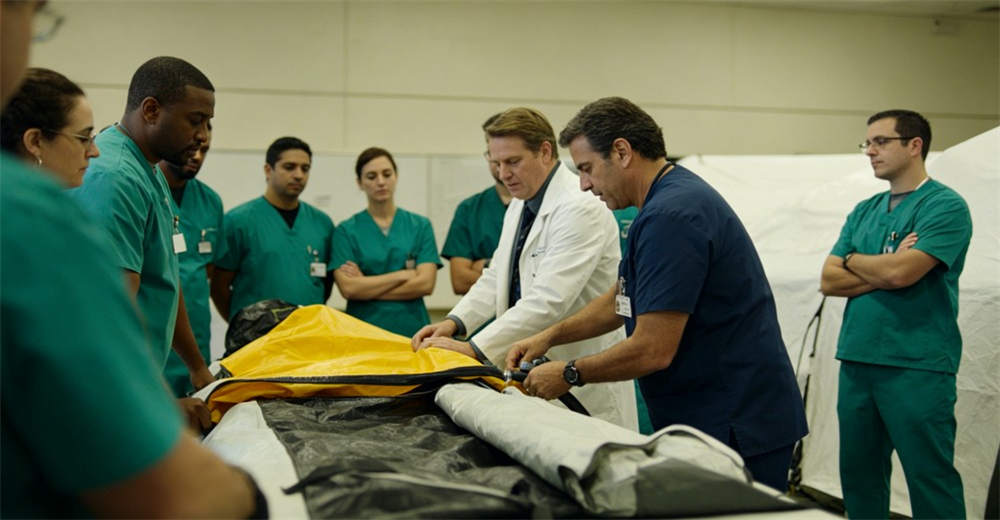
Medical Emergency Tent: Equipment and Supply Checklist
A medical emergency tent facility requires comprehensive equipment and supplies to function as a healthcare facility. Below is a categorized checklist for a medium field medical facility (30-50 beds).
The following table provides a comprehensive overview of key specifications and configuration options for our medical emergency Ground stakes and guy lines (complete set per tent) Portable generator (5-10 kW capacity, fuel supply for 48-72 hours) Power distribution cables, circuit breakers, and outlet strips Lighting (LED overhead lights, task lights for treatment areas, emergency backup lights) Medical Emergency Tent: Personnel Training and Operational Readiness Training Requirements A medical tent facility requires properly trained and organized personnel to function effectively.
The staffing model depends on facility size, patient volume, and deployment duration. This medical emergency tent is customizable with logos, colors, and accessories.
Triage Protocol: Implement a standardized triage system (e.g., START — Simple Triage and Rapid Treatment) to classify patients by acuity: Immediate (red), Delayed (yellow), Minor (green), Deceased/Expectant (black). Triage officer at entry assesses each patient within 30-60 seconds, assigns triage category, and directs to appropriate area. Reassess triage categories periodically as patient conditions change.
Our mPatient Flow Management: Maintain one-way patient flow from entry → triage → treatment → observation → discharge/transfer. Use visual cues (colored floor tape, signage, staff directions) to guide patients. Prevent overcrowding in treatment areas — set capacity limits and implement holding areas when needed.
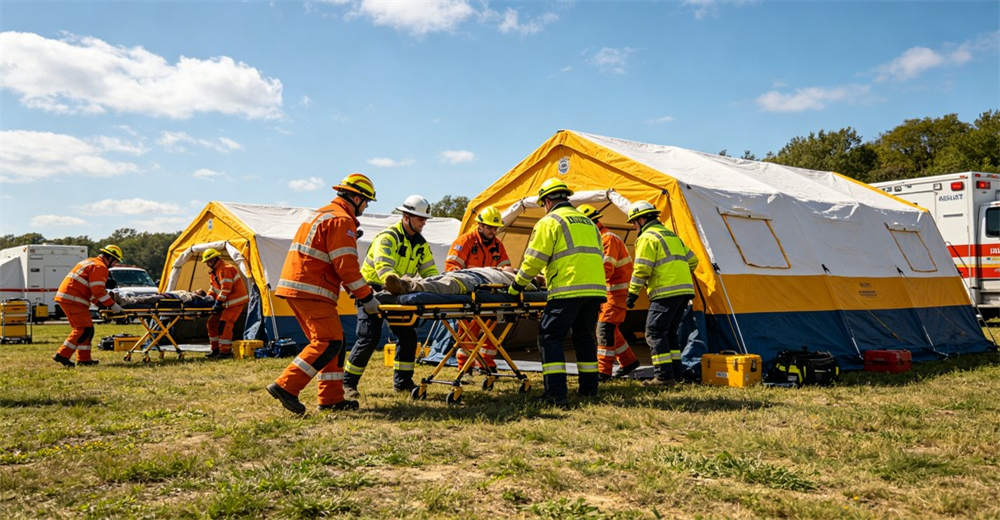
Operational Readiness
Assign a patient flow officer to monitor and manage movement through the facility. This Infection Control: Implement standard precautions for all patient contact (gloves, hand hygiene, appropriate PPE). Designate clean and contaminated zones with controlled access. Establish PPE donning/doffing stations at zone boundaries. Implement regular cleaning and disinfection schedules (high-touch surfaces every 2-4 hours, patient areas between patients). Manage biohazard waste according to protocols — segregate, label, store, and dispose properly.
The mCommunication: Establish clear communication channels: internal (between staff areas via radios or runners), external (with EMS, hospitals, public health agencies, incident command via phone/radio), and patient/family communication (information boards, designated liaison). Conduct regular briefings (every 4-6 hours) to update staff onInfection Control: Implement standard precautions for all patient contact (gloves, hand hygiene, appropriate PPE). Designate clean and contaminated zones with controlled access.
Establish PPE donning/doffing stations at zone boundaries. Implement regular cleaning and disinfection schedules (high-touch surfaces every 2-4 hours, patient areas between patients). Manage biohazard waste according to protocols — segregate, label, store, and dispose properly.
Our mCommunication: Establish clear communication channels: internal (between staff areas via radios or runners), external (with EMS,
Conduct regular safety checks (equipment function, fire safety, electrical safety, tent structural integrity). Document adverse events and implement corrective actions. The medical emergency tent features durable 600D Oxford PVC coated fabric.
Medical Emergency Tent: Personnel Training and Operational Readiness
Deployment Best Practices
Medical Emergency Tent: Best Practices and Lessons Learned
Based on decades of medical emergency tent deployment worldwide, the following best practices and lessons learned have emerged from actual field operations.
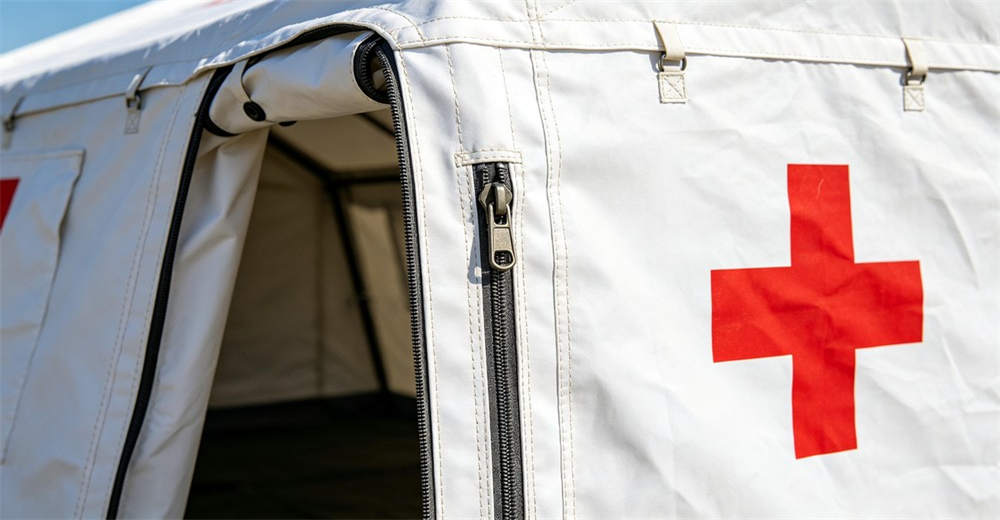
The 30sqm medical inflatable tent is the core building block for medical emergency response, ideal for triage stations, first aid centers, small clinics, and pharmacy/laboratory facilities. With 3-5 minute setup, 8-10 person capacity, medical-grade white PVC, and red cross customization, this tent provides immediate medical capability in any emergency scenario.
Common Mistakes to Avoid
View 30sqm Medical Tent Details → The medical emergency tent uses high-frequencyFor larger medical operations requiring high patient capacity, the 60sqm large field hospital inflatable tent provides 30-40 person capacity with dual blower redundancy for uninterrupted operation. Multiple tents can be connected via sealed tunnels to create complete field hospital complexes with specialized departments (emergency, surgery, ICU, wards, pharmacy).
View 60sqm Field Hospital Tent Details → The medical emergency tent includes a powerful For infectious disease response, the negative pressure isolation inflatable tent provides a controlled, sealed environment with HEPA filtration and directional airflow to prevent pathogen transmission. With integrated negative pressure system, sealed airlock entrance, and transparent isolation barriers, this tent is essential for pandemic response, Ebola treatment centers, and highly contagious patient isolation.
View Negative Pressure Isolation Tent Details → The medical emergency tent uses high-frequency weldFor organizations requiring a turnkey medical emergency response capability, we offer complete medical tent system packages including: multiple medical tents, connection tunnels, blowers and power generation, medical equipment (beds, monitors, oxygen, suction, medications), supply kits, lighting and HVAC, sanitation facilities, storage/transport containers, and comprehensive deployment documentation and training.
Packages range from small 8-person rapid response kits to 100+ bed field hospital systems, all customizable to organizational requirements. Request Medical System Package Quote → The medical emergency tent is trusted by humanitarian organizations worldwide.
Train regularly: Conduct quarterly deployment exercises with the full team. Practice tent setup, site layout, patient flow simulation, and equipment operation. Teams that train together deploy 30-50% faster and make fewer errors than ad-hoc teams.
Start small, expand as needed: Deploy the minimum viable facility first (triage + treatment), then add capacity as patient volume and resources allow. Avoid over-deploying tents that cannot be adequately staffed or supplied — an empty tent is a wasted resource and a security liability.
Plan for the environment: Consider climate conditions in deployment planning. Hot climates: ensure adequate ventilation, shade, and cooling — heat stress is a major risk for both patients and staff in enclosed tents. Cold climates: use insulation liners, heating units, and cold-weather rated equipment. Rainy/wet conditions: ensure proper ground drainage, elevated tent floors, and waterproof equipment storage.
Coordinate with local healthcare: Establish communication with local hospitals, clinics, and public health agencies before or immediately upon deployment. Understand local capacity, referral patterns, and available resources. Coordinate patient transfer agreements and shared supply chains. Medical tent facilities should complement, not duplicate, local healthcare capacity.
Underestimating power requirements: Medical equipment, lighting, HVAC, and blowers require significant power. A common mistake is bringing a generator that is too small, leading to circuit overloads and equipme
Poor waste management: Medical facilities generate significant waste (biohazard, regular trash, wastewater). Without a proper waste management plan, waste accumulates rapidly, creating infection control risks, odors, and pest problems. Plan for waste segregation, storage, and regular removal. Coordinate with local waste management authorities for proper disposal.
Medical Emergency Inflatable Tent: Technical Specifications & Product Parameters
This quick deploy emergency medical tent is constructed with waterproof inflatable medical tent materials and supports modular inflatable field hospital configurations, allowing medical teams to scale their facility based on operational requirements.
Table Analysis: The comparison table below illustrates the key differences between our inflatable medical tents and traditional pole tents, demonstrating the advantages of air beam technology.
Table Analysis: The following technical specifications provide a comprehensive overview of our medical emergency inflatable tents. These parameters are tested and verified under factory conditions, ensuring reliable performance in real-world emergency situations. All specifications can be customized based on your specific requirements.
|
Parameter |
Standard Model (30m²) |
Medium Model (50m²) |
Large Model (100m²) |
|
External Dimensions (L×W×H) |
6m × 5m × 3.2m |
10m × 5m × 3.5m |
20m × 5m × 3.8m |
|
Internal Usable Area |
28m² |
48m² |
96m² |
|
Total Weight (including air pump) |
85kg |
135kg |
260kg |
|
Patient Capacity (beds) |
8-10 beds |
15-20 beds |
30-40 beds |
|
Maximum Occupancy (standing) |
30 persons |
50 persons |
100 persons |
|
Inflation Time (with standard pump) |
5-8 minutes |
8-12 minutes |
15-20 minutes |
|
Recommended Air Pressure |
0.25-0.35 MPa (36-51 PSI) |
||
|
Air Beam Material |
High-strength TPU coated polyester fabric, 1000D |
||
|
Outer Fabric |
Heavy-duty PVC coated polyester, 650g/m², 1000D |
||
Table Analysis: This warranty coverage table details our comprehensive after-sales support and quality assurance commitments for every medical emergency inflatable tent we manufacture.
tent with white cross symbol in outdoor emergency shelter setting" title="Blue medical inflatable tent with white cross symbol in outdoor emergency shelter setting.
Table Analysis (Part 2 - Performance & Materials): The following table details performance specifications, material properties, and environmental ratings for each model. These parameters determine the tent's suitability for different climate conditions and operational requirements.
|
Parameter |
Standard Model (30m²) |
Medium Model (50m²) |
Large Model (100m²) |
|
Inner Lining |
Breathable polyester fabric, antibacterial treated, 200g/m² |
||
|
Waterproof Rating |
≥5000mm hydrostatic head, IP65 |
||
|
Flame Retardant Standard |
BS5867 Part 2 Type B, EN 13773, NFPA 701 |
||
|
Wind Resistance |
Up to Beaufort 8 (62-74 km/h), with proper anchoring |
||
|
Operating Temperature Range |
-30°C to +60°C (-22°F to +140°F) |
||
|
UV Resistance |
UV stabilized, 500+ hours exposure testing |
||
|
Expected Service Life |
8-10 years with proper maintenance and storage |
||
|
Packing Dimensions (folded) |
1.2m × 0.8m × 0.6m |
1.5m × 1.0m × 0.7m |
2.0m × 1.2m × 0.8m |
|
Quantity per 20ft Container |
60 units |
40 units |
20 units |
Technical Diagrams & Structure Illustration
Note: The following descriptions provide detailed technical specifications that would typically be accompanied by engineering diagrams. Actual CAD drawings and technical illustrations are available upon request as part of our documentation package.
Cross-Section Structure Diagram
The inflatable medical tent consists of the following structural layers from outside to inside:
Outer Weather Layer (0.55mm PVC): 650g/m² heavy-duty PVC coated polyester fabric. Provides waterproofing, UV protection, flame retardancy, and abrasion resistance. Available in multiple colors.
Air Beam Structure (200mm diameter): TPU-coated polyester inflatable tubes at 0.25-0.35 MPa pressure. Forms the primary structural framework. Multiple independent chambers for safety redundancy. Spaced at 1.5m intervals along tent length.
Insulation Layer (optional): Removable thermal insulation blanket for extreme temperature conditions. R-value rating of 3.5. Attaches via Velcro to inner wall.
Inner Lining (200g/m²): Breathable antibacterial polyester fabric. Silver-ion treated for 99.9% bacterial reduction. Light-reflective white coating to maximize interior brightness. Removable and machine washable at 60°C.
Floor System (optional): Removable PVC floor liner with antibacterial coating. 1.2mm thickness, welded seams for waterproofing. Velcro attachment to tent walls for complete enclosure. Available in standard or insulated versions.
Deployment Process Flow Diagram
The standard deployment process follows these sequential stages:
[Stage 1: Site Prep] 5-10 min
├── Select flat, well-drained ground
├── Clear debris and sharp objects
├── Lay ground protection sheet
└── Prepare anchor points
↓
[Stage 2: Unpack & Layout] 5 min
├── Remove tent from storage bag
├── Unroll completely on ground sheet
├── Verify orientation (doors/windows)
└── Check all valves are closed
↓
[Stage 3: Inflation] 5-20 min (size dependent)
├── Connect pump to main valve
├── Inflate to 50% pressure (0.12-0.18 MPa)
├── Adjust position and straighten beams
├── Inflate to full pressure (0.25-0.35 MPa)
└── Verify pressure with gauge, close valves
↓
[Stage 4: Anchoring] 10-15 min
├── Install ground stakes at 45° angle
├── Attach and tension all guy lines evenly
├── Install additional anchors for windy conditions
└── Final structure stability check
↓
[Stage 5: Interior Setup] 15-30 min
├── Install floor liner (if equipped)
├── Position medical equipment and furniture
├── Install lighting and power distribution
├── Connect HVAC/utility systems
└── Final comprehensive inspection
↓
[READY FOR OPERATION] Total: 40-80 minutes
p>Our design team provides free layout consultation services.

Inflatable Medical Tent: Maintenance, Care & Storage Guide
Table Analysis: Proper maintenance and storage are critical to maximizing the lifespan and performance of your inflatable medical tent. Following these guidelines will ensure your tent remains in optimal condition for 8-10 years and is always ready for emergency deployment.
Daily Inspection Checklist
Before each deployment and during extended use, perform the following daily inspections:
Air Pressure Check: Verify air beam pressure is within 0.25-0.35 MPa range using the built-in pressure gauge. Top up if necessary.
Visual Inspection: Check for any signs of abrasion, cuts, or punctures on the outer fabric. Pay special attention to high-contact areas.
Seam Inspection: Examine all welded seams for any signs of separation or peeling. Check door and window seals for proper closure.
Anchoring Check: Ensure all ground stakes and guy lines are properly tensioned and secure. Re-tighten if loosened due to wind or settlement.
Zipper Maintenance: Test all zippers for smooth operation. Apply silicone lubricant if sticking occurs. Check zipper tracks for debris.
Ventilation Check: Verify all ventilation openings are unobstructed. Check air circulation fans and HVAC connections if installed.
Cleanliness Check: Remove any debris, dirt, or moisture from the interior. Wipe down surfaces with mild disinfectant solution.
Cleaning & Disinfection Procedures
Proper cleaning is essential for medical tents to maintain hygienic conditions and prevent cross-contamination:
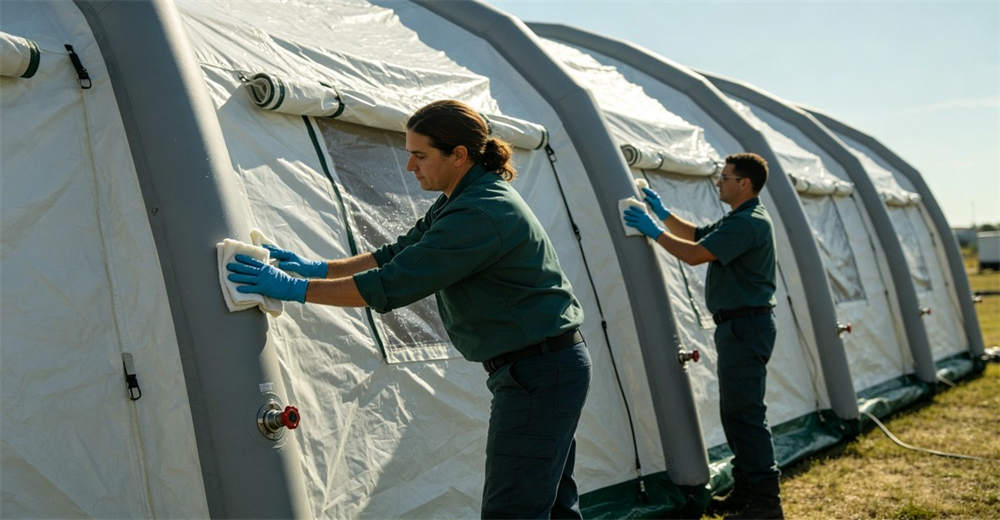
Regular Cleaning: Wipe interior and exterior surfaces weekly with a mild soap solution (pH neutral) and warm water. Use soft bristle brushes for stubborn stains.
Medical Disinfection: After each medical use, disinfect all interior surfaces with hospital-grade disinfectant (e.g., 70% isopropyl alcohol or quaternary ammonium compounds). Follow manufacturer dilution instructions.
Mold & Mildew Prevention: If the tent is exposed to prolonged moisture, treat with anti-fungal solution. Ensure complete drying before storage to prevent mold growth.
Stain Removal: For blood or biological stains, use enzyme-based cleaners by disinfection. For oil or grease stains, use degreasing agents compatible with PVC fabric.
What to Avoid: Never use bleach, abrasive cleaners, or solvents (acetone, gasoline) as these can damage the PVC coating and reduce waterproofing. Avoid high-pressure washing directly on seams.
Proper Storage Requirements
Correct storage protects your investment and ensures rapid deployment readiness:
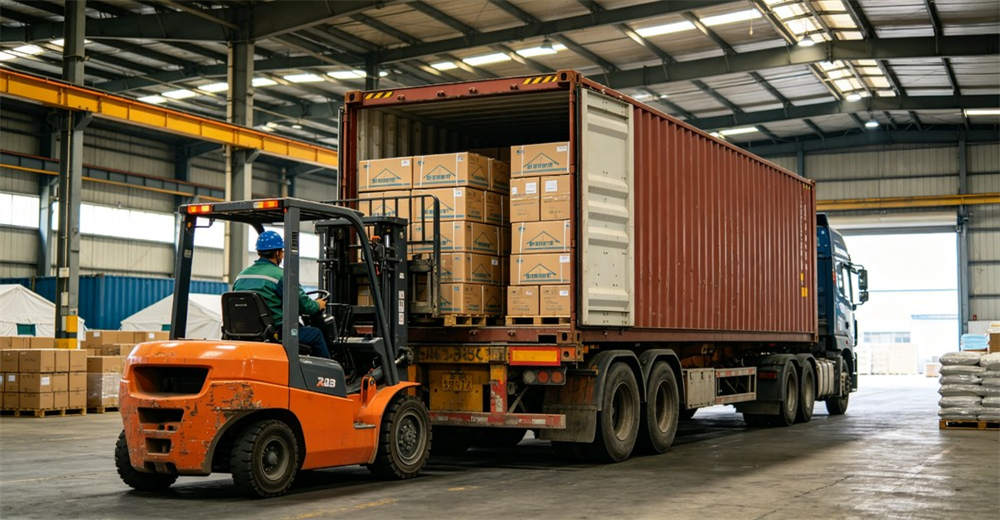
Shipping container loading with medical tent cartons using forklift in logistics warehouse
Complete Drying: Always ensure the tent is completely dry before folding and storage. Even minor moisture can cause mold and fabric degradation over time.
Clean Before Storage: Remove all dirt, debris, and foreign objects. Ensure no sharp objects are trapped in the folds that could puncture the fabric during storage.
Folding Technique: Fold the tent following the original fold lines. Avoid creating new sharp creases that can weaken the fabric over time. Roll rat
Table Analysis: This troubleshooting guide covers the most common issues encountered during tent operation, along with their causes and step-by-step solutions. Regular inspection and prompt resolution of these issues will significantly extend the service life of your inflatable medical tent.
her than fold if possible.
Storage Environment: Store in a cool, dry, well-ventilated area. Ideal temperature: 10-25°C (50-77°F). Relative humidity: below 60%. Avoid direct sunlight exposure.
Elevation: Keep stored tents elevated off the floor on pallets or shelves to prevent moisture absorption from concrete floors.
Pest Control: Ensure storage area is free from rodents and insects. Use pest control measures as needed, but avoid direct contact of pesticides with the tent fabric.
Regular Inspection: Inspect stored tents every 3 months. Unfold, check for any signs of degradation, and re-fold if necessary. This also prevents permanent creasing.
Common Repairs & Troubleshooting
Always use the factory-provided repair kit for emergency repairs. For major damage, contact our technical support team for professional repair services or replacement parts.
|
Issue |
Possible Cause |
Solution |
|
Slow air leakage |
Valve not fully closed, minor puncture |
Check and tighten valve. Locate leak with soapy water, apply repair patch from kit. |
|
Fabric abrasion |
Contact with rough surfaces, friction |
Apply fabric repair tape or patch. Reinforce high-wear areas with protective pads. |
|
Zipper sticking |
Dirt, debris, lack of lubrication |
Clean zipper track with brush. Apply silicone zipper lubricant. Avoid forcing stuck zippers. |
|
Mold or mildew |
Storage while damp, poor ventilation |
Clean with anti-fungal solution. Ensure complete drying. Improve storage ventilation. |
|
Seam separation |
Age, excessive stress, improper folding |
Apply seam sealant. For major separation, contact factory for professional repair. |
|
Yellowing/discoloration |
Prolonged UV exposure, age |
Cosmetic issue only, does not affect performance. Use UV protectant spray to slow further yellowing. |
Emergency Inflatable Tent: Packaging, Shipping & Logistics
Table Analysis: Understanding our packaging and logistics process ensures smooth customs clearance, accurate freight calculation, and timely delivery. We offer flexible shipping solutions tailored to your specific requirements and destination.
Standard Packaging Details
Each medical emergency inflatable tent is carefully packaged to ensure protection during international shipping:
Primary Packaging: Heavy-duty woven polypropylene bag with reinforced handles and zipper closure. Printed with product model, size, and handling instructions.
Secondary Packaging: Corrugated cardboard carton (5-ply, export quality) with foam corner protectors and moisture barrier lining.
Table Analysis: This table provides detailed packaging dimensions and container loading capacity for each tent model. Accurate packing information helps optimize shipping costs and ensures safe transportation of your medical equipment.
Accessory Kit: Separate bag containing air pump, pressure gauge, repair kit, ground stakes, guy lines, storage bag, and instruction manual.
Labeling: Each carton labeled with product name, model, quantity, gross/net weight, dimensions, country of origin, and handling symbols (fragile, this side up, keep dry).
Container Loading Capacity
Table Analysis: This troubleshooting guide covers the most common issues encountered during tent operation, along with their causes and step-by-step solutions. Regular inspection and prompt resolution of these issues will significantly extend the service life of your inflatable medical tent.
Loading capacities are approximate and may vary based on accessory configuration and custom packaging requirements. Mixed container loading available for multiple models.
|
Container Type |
Standard Model (30m²) |
Medium Model (50m²) |
Large Model (100m²) |
|
20ft Standard Container |
60 units |
40 units |
20 units |
|
40ft Standard Container |
125 units |
85 units |
42 units |
|
40ft High Cube Container |
140 units |
95 units |
48 units |

Shipping Methods & Delivery Times
Table Analysis: This table provides detailed packaging dimensions and container loading capacity for each tent model. Accurate packing information helps optimize shipping costs and ensures safe transportation of your medical equipment.
|
Shipping Method |
Transit Time |
Best For |
Cost Level |
|
Sea Freight (FCL) |
25-45 days |
Bulk orders, full container loads |
Lowest |
|
Sea Freight (LCL) |
30-50 days |
Small orders, less than container load |
Low-Medium |
|
Air Freight |
5-10 days |
Urgent orders, emergency response |
High |
|
Express Courier |
3-7 days |
Samples, small quantities |
Highest |
|
Rail Freight (Europe/Asia) |
15-25 days |
Land bridge routes, cost-effective |
Medium |
Production Lead Times
Sample Order: 5-7 working days after design confirmation
Small Batch (1-10 units): 15-20 working days after deposit
Medium Batch (11-50 units): 20-30 working days after deposit
Large Batch (50+ units): 30-45 working days after deposit
Emergency Rush Order: Expedited production available, contact sales for priority scheduling
Lead times are estimates and may vary based on current production capacity, material availability, and order customization complexity. We will confirm exact delivery schedule with your sales representative at time of order.
Proper installation requires attention to ground stake placement and air beam inflation sequence. Our technical team provides on-site guidance to ensure your medical emergency inflatable tent is deployed correctly and safely for immediate operational use.
Customs & Documentation
We provide complete export documentation to facilitate smooth customs clearance:
Commercial Invoice: Detailed pricing and product description
Packing List: Itemized contents, weights, and dimensions per carton
Bill of Lading / Air Waybill: Transport document
Certificate of Origin: Chamber of Commerce certified (CO/Form A/Form E/Form F as applicable)
CE Certificate: Copy of CE conformity declaration
Test Reports: Material test reports, flame retardant certificates, waterproof test reports
MSDS: Material Safety Data Sheet for PVC materials (if required)
Medical Inflatable Tent: Warranty, After-Sales Support & Quality Assurance
Table Analysis: We stand behind the quality of our medical emergency inflatable tents with comprehensive warranty coverage and dedicated after-sales support. Our commitment to customer satisfaction extends far beyond the initial purchase, ensuring your investment is protected throughout the product lifecycle.
Warranty Coverage
|
Component |
Warranty Period |
Coverage Details |
|
Air Beam Structure |
5 years |
Manufacturing defects, seam separation, air leakage from factory defects |
|
Outer PVC Fabric |
3 years |
Coating delamination, waterproofing failure, UV degradation under normal use |
|
Inner Lining |
2 years |
Fabric tearing at seams, zipper failure, antibacterial coating effectiveness |
|
Air Pump & Accessories |
1 year |
Motor failure, pressure gauge malfunction, valve defects (excluding wear items) |
|
Zippers & Hardware |
1 year |
Zipper track separation, buckle breakage, D-ring pull-out from manufacturing |
What the Warranty Covers
Manufacturing Defects: Any defect in materials or workmanship that arises during normal use and proper maintenance
Seam Failure: Welded seam separation or delamination not caused by improper use, accident, or unauthorized modification
Air Leakage: Air loss from factory defects in air beam construction (excluding punctures from external causes)
Material Degradation: Premature coating failure, fabric cracking, or waterproofing breakdown under normal environmental conditions
What is Not Covered
Damage from improper use, over-inflation, or failure to follow operating instructions
Punctures, cuts, or abrasions from external objects, sharp surfaces, or accidents
Damage from fire, explosion, natural disasters, or extreme weather beyond rated specifications
Normal wear and tear, including fabric fading, minor scuffs, and zipper wear from regular use
Damage from unauthorized repairs, modifications, or use of non-factory replacement parts
Damage from improper cleaning methods, use of harsh chemicals, or solvent exposure
Consequential damages, including loss of use, revenue, or medical operation interruption
After-Sales Support Services
Technical Support Hotline: Dedicated technical support team available via email, phone, or WhatsApp during business hours. Response within 24 hours for technical inquiries.
Video Troubleshooting: Live video support for deployment issues, maintenance guidance, and repair demonstrations. Our technicians can guide you through most common issues remotely.
Replacement Parts: Comprehensive inventory of spare parts including air pumps, valves, zippers, repair patches, guy lines, and ground stakes. Most parts shipped within 3-5 business days.
Professional Repair Service: For major damage beyond field repair capability, we offer factory repair services. Send your tent to our service center for professional assessment and repair with warranty on repaired areas.
Training & Documentation: Detailed operation manuals, maintenance guides, and deployment training videos available in multiple languages. On-site training available for large orders (additional fees may apply).
Warranty Claim Process: Simple 3-step process: (1) Contact your sales representative with photos/videos of the issue, (2) Our technical team assesses and provides solution within 48 hours, (3) Replacement parts or repair service arranged promptly.
Quality Assurance Commitment
Our medical emergency inflatable tents undergo rigorous quality control at every stage of production:
Raw Material Inspection: Every batch of PVC fabric and TPU air beam material tested for tensile strength, waterproofing, flame retardancy, and color consistency before production
In-Process Quality Checks: Multiple inspection points during cutting, welding, and assembly. Each seam visually inspected and spot-tested for integrity
Final Inflation Test: Every completed tent undergoes 24-hour air retention test under full pressure. No air loss exceeding 5% passes quality control
Waterproof Testing: Random samples undergo hydrostatic pressure testing and simulated rain exposure to verify waterproof performance
CE Certification: All products CE certified with regular audits by notified bodies. Technical documentation maintained for each product model
ISO 9001 Quality System: Factory operates under ISO 9001:2015 quality management system with annual third-party audits
For specific warranty claims, technical support, or replacement parts, please contact your dedicated sales representative or our customer service team. We are committed to ensuring your complete satisfaction with every purchase.
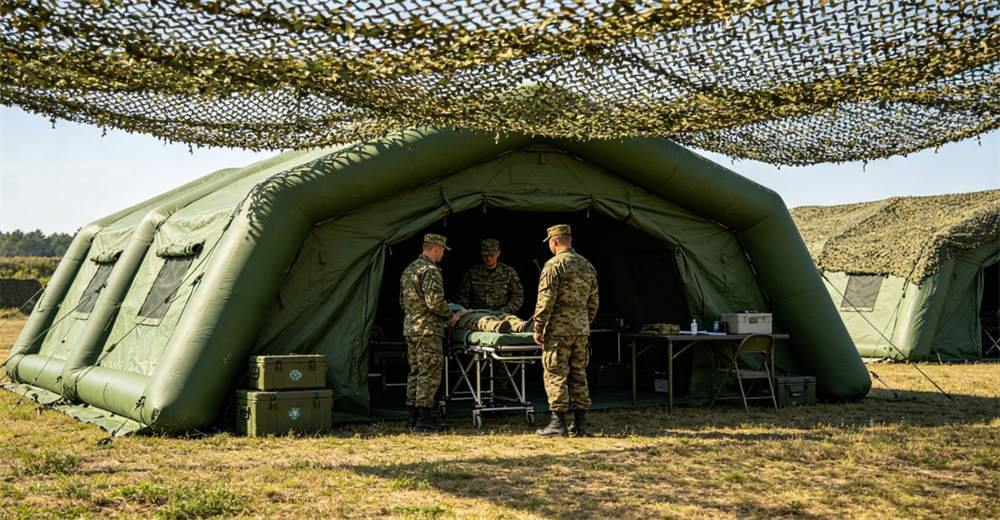
Emergency Medical Tent: Client Case Studies & Success Stories
Table Analysis: Real-world deployments demonstrate the reliability and effectiveness of our medical emergency inflatable tents. These case studies showcase how our products perform in actual emergency situations, providing proven solutions for medical response teams worldwide.
Case Study 1: Earthquake Response - Turkey/Syria Border (2023)
Client: International humanitarian aid organization
Deployment: 50 units of 50m² medical tents
Location: Gaziantep, Turkey - Syrian border region
Response Time: 48 hours from order confirmation to on-site delivery
Challenge: Following the devastating 7.8 magnitude earthquake, thousands of injured survivors required immediate medical care. Local hospitals were damaged or destroyed, and winter temperatures dropped below freezing. The aid organization needed a rapidly deployable medical facility solution that could operate in extreme cold conditions.
Solution: We deployed 50 units of our 50m² medical tents with enhanced cold-weather packages, including integrated heating systems and extra insulation. The tents were configured as: 10 triage units, 20 emergency treatment tents, 10 recovery wards, 5 surgical units, and 5 command centers. Each tent was fully equipped with medical furniture, lighting, and power distribution.
Medical staff working inside inflatable emergency tent, doctor examining patient with equipment
Results:
All 50 tents deployed and operational within 6 hours of arrival
Treated over 3,500 patients in the first 2 weeks
Maintained interior temperature of 20-22°C despite -5°C exterior temperatures
Zero equipment failures during 3-month deployment
Client placed repeat order for additional 30 units for long-term recovery
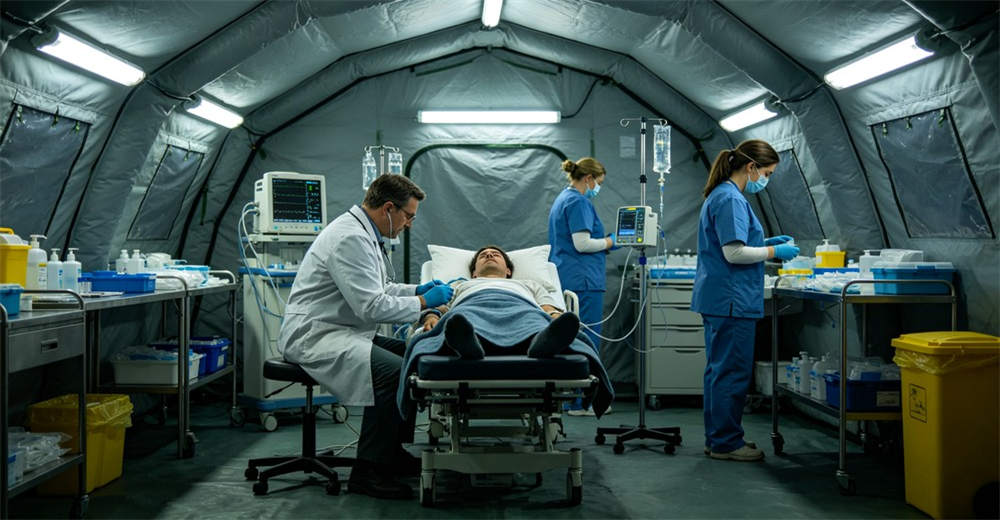
Case Study 2: Military Field Hospital - Middle East (2022)
Client: NATO member country defense ministry
Deployment: Complete Role 3 field hospital system (120 units)
Location: Forward operating base, Middle East
Project Duration: 6-month deployment
Challenge: The military required a fully functional Role 3 field hospital with surgical capabilities, ICU, imaging, and laboratory services. The system needed to be transportable by C-130 aircraft, rapidly deployable by 8 personnel, and capable of operating in 45°C desert temperatures with frequent sandstorms.
Solution: We delivered a comprehensive 120-tent modular field hospital system, including: 20 surgical suites with sterile environments, 15 ICU tents with negative pressure capability, 30 ward tents, 10 imaging units, 5 laboratories, 10 pharmacy/storage tents, 10 command/administration, and 20 support facilities. The system included NBC protection, solar power arrays, and water purification systems.
Results:
Full hospital operational within 4 hours of aircraft landing
Performed over 200 surgical procedures during deployment
Maintained sterile surgical environment despite frequent sandstorms
95% patient satisfaction rate in post-deployment survey
System recommended for standardization across all military medical units
Case Study 3: Pandemic Response - Southeast Asia (2021)
Client: National Ministry of Health
Deployment: 200 units of isolation and treatment tents
Location: Multiple sites across 3 major cities
Timeline: Emergency procurement during COVID-19 surge
Challenge: During the peak of the COVID-19 pandemic, the country's hospital system was overwhelmed with over 90% bed occupancy. The Ministry of Health needed 200 negative pressure isolation and quarantine tents within 2 weeks to expand treatment capacity and prevent hospital-associated transmission.
Solution: We mobilized our production capacity and delivered 200 units of our 30m² negative pressure medical tents in 12 days. Each tent was equipped with HEPA filtration systems, pressure monitoring alarms, dedicated PPE donning/doffing areas, and medical gas connections. We also provided on-site training for 500 healthcare workers on proper operation and maintenance.
Results:
200 tents delivered and installed in 12 days (3 days ahead of deadline)
Added 2,000 isolation beds to national healthcare capacity
Zero cross-contamination incidents reported in 6-month operation
98% of healthcare workers reported the tents were easy to operate
Ministry of Health adopted our tents as standard emergency response equipment
Inflatable Tent vs Traditional Pole Tent - Comprehensive Comparison
Table Analysis: Understanding the differences between inflatable air beam tents and traditional pole-supported tents helps you make an informed decision for your medical emergency response needs. This comparison covers all critical factors from deployment speed to long-term cost of ownership.
|
Comparison Factor |
Inflatable Air Beam Tent |
Traditional Pole Tent |
Winner |
|
Deployment Time (50m²) |
8-12 minutes, 2-3 people |
45-60 minutes, 6-8 people |
Inflatable (5x faster) |
|
Teardown Time |
10-15 minutes |
30-45 minutes |
Inflatable |
|
Personnel Required |
2-3 trained personnel |
6-8 experienced workers |
Inflatable (60% less labor) |
|
Packed Volume (50m²) |
1.05m³ (1.5×1.0×0.7m) |
2.5-3.5m³ (poles + fabric + accessories) |
Inflatable (60% smaller) |
|
Total Weight (50m²) |
135kg (tent + pump) |
180-220kg (poles are heavy) |
Inflatable (25-40% lighter) |
|
Wind Resistance |
Beaufort 8 (62-74 km/h) with proper anchoring |
Beaufort 6-7 (39-61 km/h), poles can bend/break |
Inflatable (flexible structure absorbs wind) |
|
Snow Load Capacity |
5-10 kg/m² (curved roof sheds snow) |
3-5 kg/m² (flat roof accumulates snow) |
Inflatable |
|
Interior Space |
100% u sable, no internal poles obstr ucting |
85-90% usable, poles reduce floor space |
Inflatable (obstruction-free) |
|
Headroom |
Consistent 2.5-3.2m throughout |
Variable, lower near walls and poles |
Inflatable |
Table Analysis (Part 2 - Performance & Cost): The following comparison covers long-term durability, maintenance requirements, total cost of ownership, and environmental performance. These factors are critical for making an informed procurement decision.
|
Comparison Factor |
Inflatable Air Beam Tent |
Traditional Pole Tent |
Winner |
|
Modularity |
Easy connection via tunnel connectors |
Limited, custom connectors required |
Inflatable |
|
Durability (Lifespan) |
8-10 years with proper maintenance |
5-7 years (poles bend, fabric wears at pole contact) |
Inflatable (40-60% longer life) |
|
Repairability |
Field repair with patch kit (5 minutes) |
Pole replacement required (specialized parts) |
Inflatable |
|
Initial Cost (50m²) |
$4,500-$6,500 (includes pump) |
$3,000-$4,500 |
Traditional (lower upfront) |
|
Total Cost of Ownership (10 years) |
$5,500-$7,500 (minimal maintenance, no pole replacements) |
$6,500-$9,000 (pole replacements, repairs, higher labor) |
Inflatable (15-20% lower TCO) |
|
Transportation Cost |
Lower (smaller, lighter) |
Higher (larger, heavier, poles need special handling) |
Inflatable |
|
Training Required |
2-4 hours basic training |
8-16 hours (pole assembly is complex) |
Inflatable (easier to learn) |
|
Safety During Setup |
Low risk (no heavy poles to drop) |
Higher risk (poles can fall, pinch injuries) |
Inflatable |
|
Customization Options |
Extensive (size, shape, color, features) |
Limited by pole structure |
Inflatable |
|
Medical Suitability |
Excellent (sterile environment, equipment mounting, utility connections) |
Good (but poles interfere with equipment and layout) |
Inflatable |
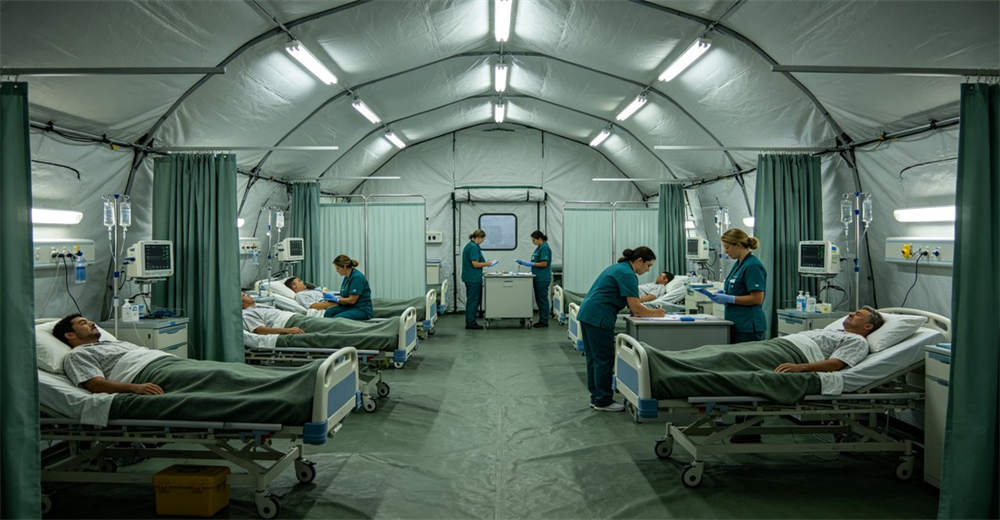
Medical Emergency Inflatable Tent: Frequently Asked Questions (FAQ)
Table Analysis: Comprehensive answers to the most common questions about our medical emergency inflatable tents, covering product specifications, ordering, shipping, operation, maintenance, and after-sales support.
All materials used in our medical tents are selected for their suitability in biomedical and clinical environments. The inner lining features silver-ion antibacterial treatment that achieves 99.9% bacterial reduction, meeting the stringent hygiene requirements of modern medical facilities. Our manufacturing process follows ISO 9001 quality management standards, and every tent undergoes rigorous quality inspection before shipment to ensure full compliance with international medical equipment standards.
Q1: H ow long does it take to set up a medical inflatable tent?
A: Setup time depends on tent size and personnel experience. Standard 30m² tent: 5-8 minutes with 2 people. Medium 50m²: 8-12 minutes with 2-3 people. Large 100m²: 15-20 minutes with 3-4 people. This includes inflation and basic anchoring. Full interior setup with equipment takes an additional 15-30 minutes. We provide detailed video training and on-site training for large orders.
Q2: What is the expected lifespan of your inflatable medical tents?
A: With proper maintenance and storage, our tents have an expected service life of 8-10 years. The air beam structure is rated for 10,000+ inflation/deflation cycles. Key factors affecting lifespan include: frequency of use, environmental conditions (UV exposure, temperature extremes), proper cleaning and storage, and timely repairs. We offer refurbishment services to extend tent life beyond 10 years.
Q3: Are your tents CE certified and suitable for medical use?
A: Yes, all our medical inflatable tents are CE certified and comply with relevant European standards. Our fabrics meet BS5867 Part 2 Type B, EN 13773, and NFPA 701 flame retardant standards. We provide full technical documentation, test reports, and certificates of conformity with every order. For specific regulatory requirements in your country, please contact our sales team for additional certification support.
Q4: Can the tents be connected together to form larger medical complexes?
A: Absolutely! Our modular tent system is designed for easy connection. We offer tunnel connectors in various lengths (2m, 3m, 5m) that create weather-protected corridors between tents. Multiple tents can be configured into complete medical complexes with separate zones for triage, treatment, surgery, recovery, pharmacy, and administration. We provide layout design services for complex configurations at no additional cost.
Q5: What is the minimum order quantity (MOQ)?
A: Our standard MOQ is 1 unit for most models. For custom colors, custom sizes, or special features, the MOQ may be higher (typically 10-50 units depending on the customization). Sample orders are available at full price with sample discount on subsequent bulk orders. We encourage customers to order a sample first for evaluation before placing large orders.
Q6: How long is the production lead time?
A: St andard models in stock colors: 15-20 working days for small orders (1-10 units), 20-30 working days for medium orders (11-50 units), and 30-45 working days for large orders (50+ units). Custom orders with special sizes, colors, or features require an additional 15-20 working days for design confirmation, material sourcing, and production setup. Emergency rush orders may be available for standard models depending on current production capacity. Emergency rush orders can be accommodated with priority production scheduling - please contact our sales team for availability. All lead times are from receipt of deposit and design confirmation.
Q7: What payment terms do you accept?
A: Standard payment terms: 30% deposit by T/T (bank transfer) at order confirmation, 70% balance before shipment. For established customers with good payment history, we can offer more flexible terms including L/C at sight. We also accept PayPal for sample orders and Western Union for small amounts. All prices are quoted in USD unless otherwise specified. Trade terms: FOB, CIF, DDP available.
Q8: How are the tents packaged for international shipping?
A: Each tent is carefully packaged in a heavy-duty woven polypropylene bag with reinforced handles, then placed in a 5-ply export corrugated carton with foam corner protectors and moisture barrier lining. Accessories (pump, repair kit, stakes, guy lines) are packed separately. Each carton is labeled with product name, model, quantity, gross/net weight, dimensions, country of origin, and handling symbols. We can provide custom packaging with your branding for orders over 50 units.
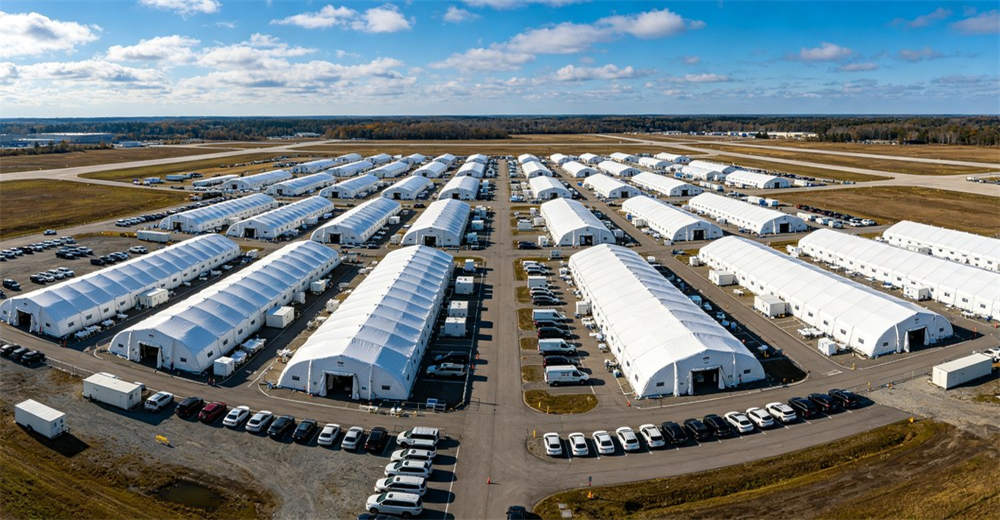
Q9: What is included in the standard accessory package?
A: Every tent comes with a comprehensive accessory package including: (1) High-capacity electric air pump with pressure gauge, (2) Repair kit with fabric patches, adhesive, and application tools, (3) Ground stakes (quantity based on tent size), (4) Guy lines with tensioners, (5) Storage/transport bag, (6) Operation and maintenance manual in English (other languages available on request), (7) CE certificate and test reports. Optional accessories available: spare pump, solar power kit, LED lighting system, HVAC unit, medical furniture pack age.
Q10: Can the tents operate in extreme temperature conditions?
A: Yes, our tents are designed to operate in a wide temperature range from -30°C to +60°C (-22°F to +140°F). For extreme cold conditions below -20°C, we recommend our cold-weather package with enhanced insulation and integrated heating systems. For hot environments above 40°C, we recommend our climate control package with air conditioning and enhanced ventilation. Special low-temperature TPU formula is available for Arctic conditions down to -45°C.
Q11: How do I maintain and clean the tent after use?
A: Proper maintenance ensures maximum lifespan. After each use: (1) Allow tent to completely dry before packing - even minor moisture causes mold, (2) Clean with mild soap and warm water using soft brush, (3) For medical use, disinfect with hospital-grade disinfectant (70% isopropyl alcohol or quaternary ammonium compounds), (4) Inspect for damage and repair promptly using the repair kit, (5) Store in cool, dry, well-ventilated area, elevated off floor, (6) Inspect stored tents every 3 months.
Never use bleach, abrasive cleaners, or solvents as these damage the PVC coating. Full maintenance guide included with every tent.
Q12: What warranty do you offer and what does it cover?
A: We offer comprehensive warranty coverage: Air beam structure: 5 years, Outer PVC fabric: 3 years, Inner lining: 2 years, Air pump & accessories: 1 year, Zippers & hardware: 1 year. Warranty covers manufacturing defects in materials and workmanship under normal use and proper maintenance.
This includes seam separation, air leakage from factory defects, and premature material degradation. Warranty does not cover: damage from improper use, punctures from external causes, accidents, normal wear and tear, unauthorized repairs, or consequential damages. Warranty claims process: contact sales rep with photos/videos → technical assessment within 48 hours → replacement parts or repair arranged promptly.
Q13: Can I customize the tent with my organization's logo and colors?
A: Yes, we offer comprehensive customization services. Logo printing: silk screen for simple logos (up to 4 colors), digital printing for complex full-color graphics. Logo placement on roof, walls, or doors.
Colors: 6 standard colors (white, red, blue, green, camouflage, orange) with no MOQ. Custom RAL/Pantone colors available with MOQ of 10-50 units depending on color. Additional customization: reflective markings, ID numbering, QR codes for asset tracking, custom interior layouts, equipment mounting points, utility connections, and special functionality options (negative pressure, HVAC, solar power, NBC protection). Design services provided at no additional cost.
Q14: Do you provide training for operation and maintenance?
A: Yes, we provide comprehensive training options: (1) Video training package with detailed operation, maintenance, and repair videos in multiple languages (included with every order), (2) Written operation and maintenance manual (included), (3) Online video training sessions with our technical team via Zoom/Teams (available for orders over 10 units), (4) On-site training at your facility by our technical experts (available for orders over 50 units, travel expenses additional).
Training covers: site preparation, unpacking, inflation, anchoring, interior setup, operation, daily maintenance, cleaning, storage, common repairs, and troubleshooting. We recommend at least 2-4 personnel per tent be fully trained.
Q15: What is your return and exchange policy?
A: Due to the custom nature of our products and health/safety considerations for medical equipment, we generally do not accept returns for standard stocked items once shipped. However: (1) If the product arrives damaged
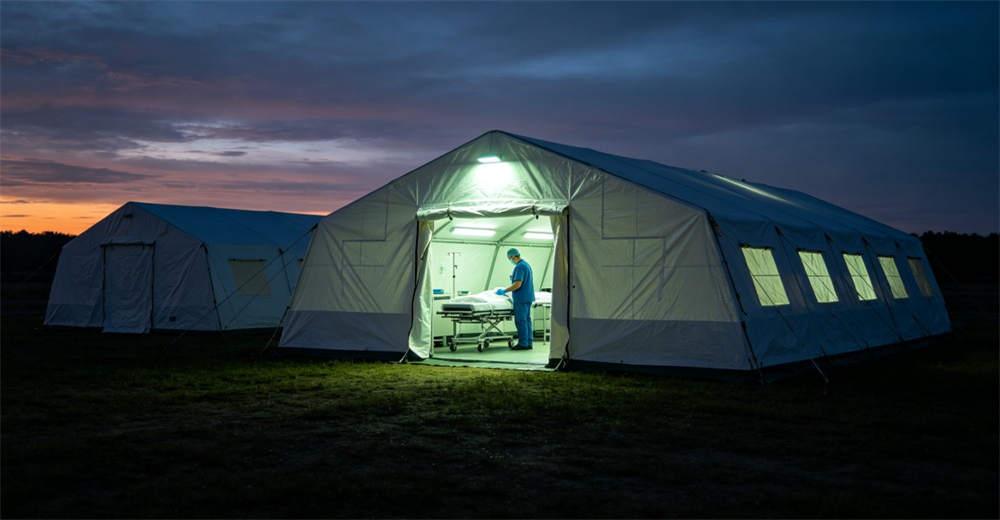
Summary
Our medical emergency inflatable tents provide rapid-deployment field hospital solutions for disaster response, mass casualty incidents, and military operations. With heavy duty air beam technology, CE certified construction, and factory direct pricing, these tents deliver reliable healthcare infrastructure when minutes matter.
Available in custom sizes from 8-person rapid response units to 100+ bed field hospital systems, all tents feature waterproof PVC fabric, flame retardant materials, and complete medical equipment packages.
Whether you need a temporary medical facility for a planned event or an unforeseen emergency, our modular tent systems can be customized to meet your specific healthcare requirements.
As a fully equipped portable hospital system, our inflatable tents include all necessary medical infrastructure, from ICU units to operating rooms, in a compact, transportable format.
Our inflatable medical tents serve as a reliable emergency shelter solution, providing immediate protection for patients and medical staff in crisis situations.
Previous :
Inflatable Disaster Relief Tent for Emergency and Humanitarian AidNext :
Decontamination Shower Inflatable Tent | 3-Zone Hazmat & Fire Decontamination CorridorCopyright © Custom Disaster - Relief Bedding: Tents, Sleeping Bags, Blankets All Rights Reserved
the professional team to service !


