


Professional dry water rescue suit built for flood, swift‑water, ice and maritime rescue. Adopt 3‑layer waterproof breathable fabric, heat‑taped seams, TIZIP airtight zipper and Kevlar reinforced high‑wear zones. High‑visibility reflective tape improves safety in dim environment. Complete thermal liner solutions available. Support custom logo, color and bulk government tender procurement with full test documentation.
Note: Price for reference only. Exact price based on quantity, size, weight and custom details.
model no. :
RLJ-02Brand:
YRFmarket price :
$16.8sale price :
$7.8price range :
30-500/$7.8 501-1000/$6.8Color :
Multiple Colorsport of dispatch :
Guangdong/GuangzhouPayment :
TT, Paypal, Western Unionmin order :
30original region :
Made in ChinaLead Time :
5-15daysSize :
60×50×7CM |
When floodwaters rise and rivers turn violent, dry water rescue suits are the critical barrier between rescue professionals and hypothermia. A properly engineered dry suit keeps the wearer completely dry while allowing full mobility for swimming, climbing, and victim extraction. Our bulk dry rescue suits are built to the specifications demanded by fire departments, coast guard units, and emergency management agencies worldwide.
 |

|
We manufacture waterproof thermal dry suits using 3-layer composite fabrics with heat-taped seams, TIZIP or YKK waterproof zippers, and Kevlar reinforcement at high-wear zones. Every suit undergoes hydrostatic testing to verify zero leakage under operational conditions. For government tenders and institutional procurement, we provide complete technical documentation, test reports, and customization services including logo printing, color matching, and size scaling.
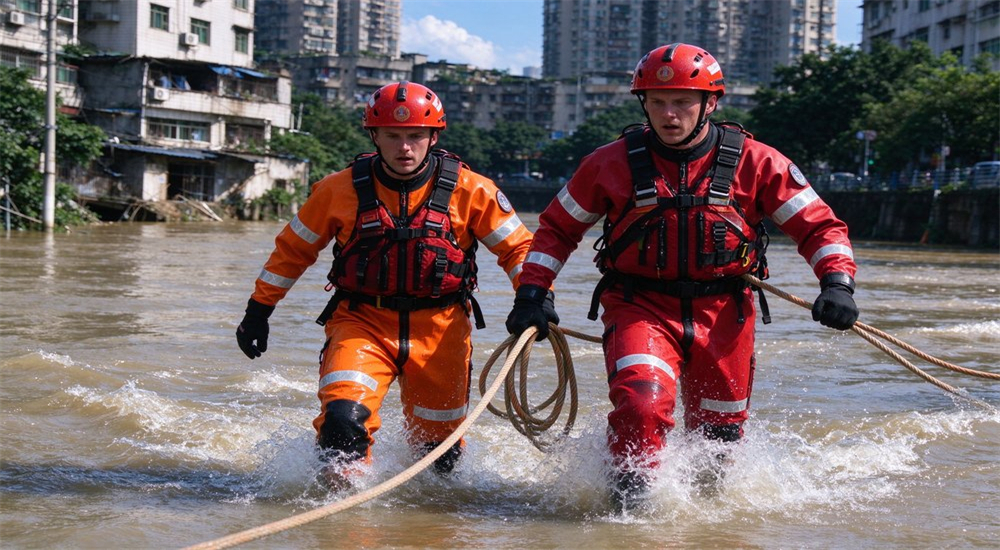
Each model in our dry suit lineup is engineered for specific operational profiles, from urban flood response in contaminated water to cold-water ice rescue and underwater search operations. Suits range from lightweight economy models for government stockpile distribution to heavy-duty diving configurations for coast guard and technical rescue teams. The following sections break down the types, performance specifications, materials, visibility features, certifications, and procurement considerations to help your team select the right configuration for your operational environment and budget constraints.


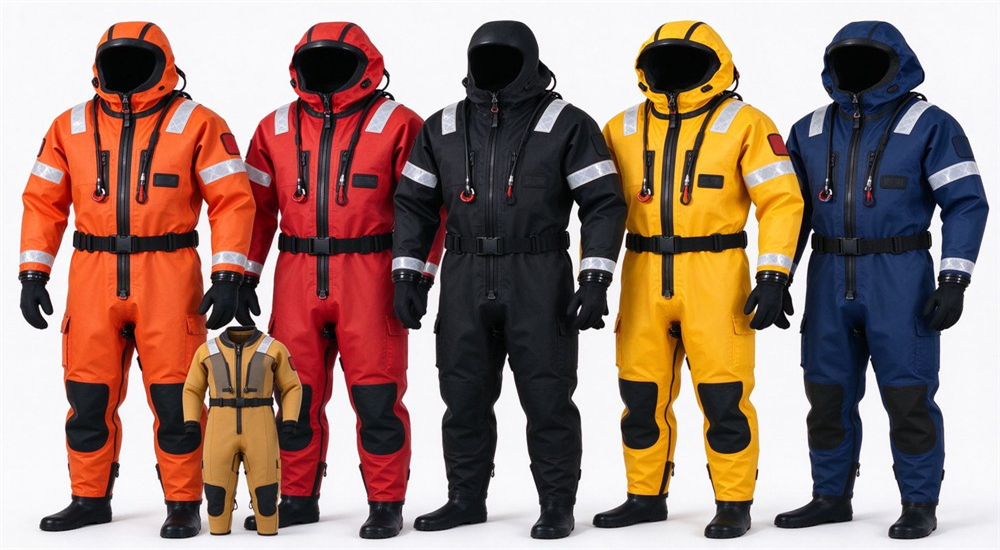
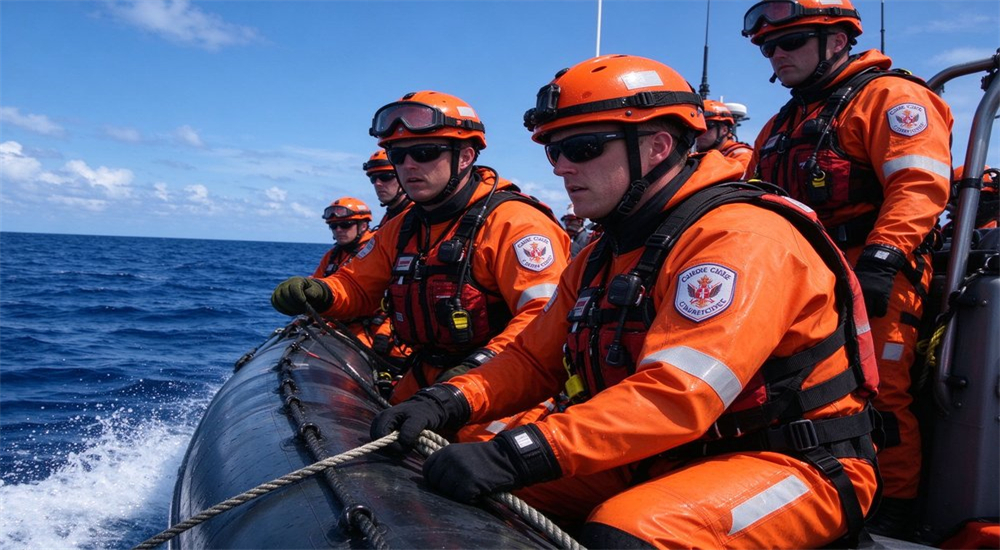
The standard dry water rescue suit is the workhorse of flood response and swiftwater operations. It features a front-diagonal waterproof zipper for quick donning, integrated waterproof socks, and adjustable neoprene neck and wrist seals. The 3-layer composite shell provides full waterproofing while allowing moisture vapor to escape, reducing heat stress during prolonged wear. Models in this category include configurations with rear horizontal zipper for quick entry and red 3-layer breathable waterproof composite fabric for high-visibility operations.
Standard suits are available in red, orange, and black colorways, with high-visibility reflective tape on the arms and torso. The internal Y-type suspender system keeps the suit properly positioned during water entry and climbing, preventing the garment from riding up and exposing the wearer.
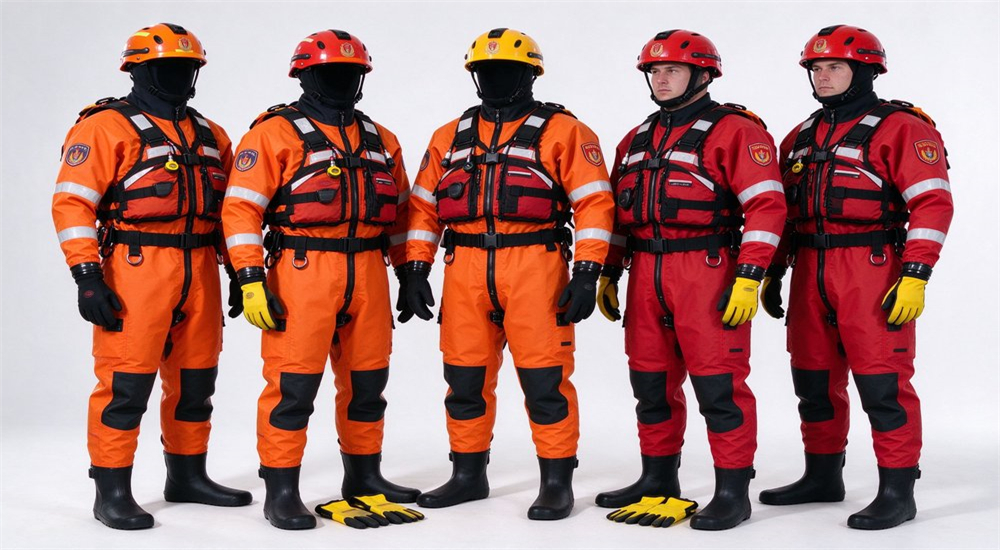
For operations where mobility and speed are paramount, the ultra-light dry rescue suit delivers full waterproof protection at a reduced weight. The ultra-light model uses 3-layer waterproof breathable composite fabric with internal sealant coating and heat-taped seams (tape width ≥20mm). A dual airtight zipper system—one front-diagonal entry zipper and one lower auxiliary zipper—allows rapid donning and convenient restroom breaks without full removal.
The ultra-light model features a rear waistband with elastic cinching for a tailored fit, Velcro closures at cuffs and collar, and black abrasion-resistant fabric reinforcement at the hips, knees, and elbows. Two large leg tool pockets accommodate rescue knives, line bags, and communication devices.
For underwater search and recovery, the dry diving rescue suit provides full environmental protection at depth. The diving model features upper zipper design with an outer protective zipper shielding the inner airtight zipper from abrasion. The neck and wrist seals use removable silicone components with Swiss SITECH imported fittings for serviceability. Integrated boots accommodate sizes 39-47, with heat-pressed seams for maximum durability.
The cold-water model uses waterproof neoprene fabric with heat-sealed stitching for thermal retention in cold water. A rear horizontal YKK metal airtight waterproof zipper provides entry, while neoprene side pockets on the legs store dive tools. Optional components include a dive hood, gloves, and rotatable breathing valve for connection to scuba cylinders.
The hooded dry rescue suit integrates a waterproof hood into the collar system, providing head protection during rain, spray, and accidental water immersion. The hood stows inside the collar when not in use and deploys in seconds. The 320D 3-layer waterproof composite nylon shell delivers durability with high-visibility orange or red coloring. The front airtight waterproof zipper includes an external protective flap to prevent damage from debris and friction.
Hooded models are particularly valued by teams operating in heavy rain, cold wind, and spray zones where head protection reduces heat loss and improves comfort during extended deployments.

For ice rescue and extreme cold-water operations, cold-water dry suits combine the waterproof shell with enhanced thermal liners. The outer shell uses 2000D waterproof breathable fabric for puncture resistance against ice edges, while the inner liner options include 300g fleece or 200g Thinsulate insulation. Kevlar reinforcement at the knees, elbows, and seat provides abrasion protection during ice crawling and self-extraction.
Cold-water models include adjustable elastic waist straps, shoulder and knee reinforcement plates, and wide elastic ankle straps that work with suspender systems. The suits are designed to be worn with thick undergarments, and the cut accommodates layered clothing without restricting movement.
Different user profiles require different dry suit configurations. Fire department water rescue teams typically need standard front-zip suits in high-visibility red with integrated tool pockets. Coast guard and maritime rescue units often prefer heavy-duty diving models with breathing valve compatibility. Government emergency management agencies procuring mass distribution stockpiles may prioritize economy models with basic waterproofing and standard sizing. Swiftwater technical rescue teams require ultra-light models with maximum mobility and quick-donning capability.
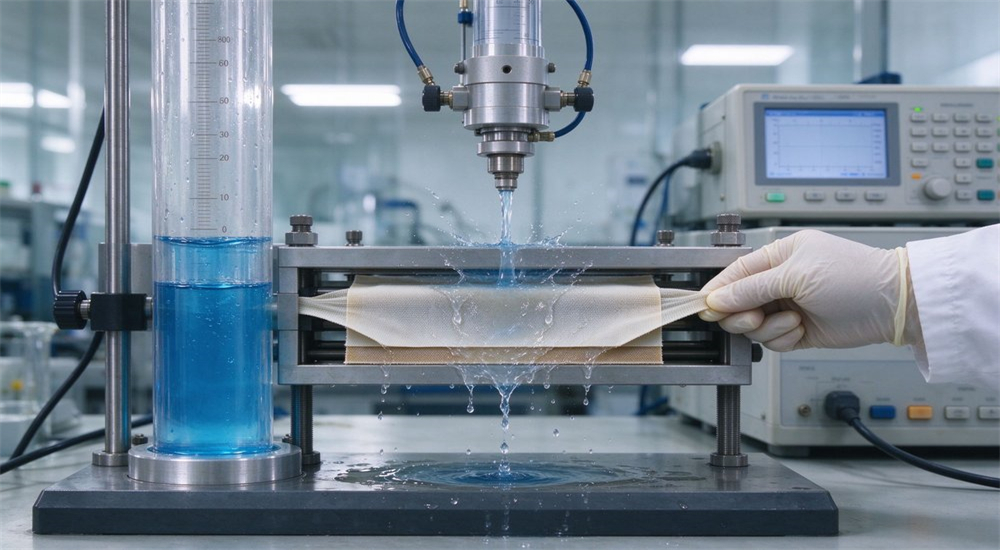
A dry rescue suit achieves complete waterproofing through a system of integrated barriers rather than a single layer. The outer shell fabric itself is coated or laminated with a waterproof membrane. Every seam is heat-taped with waterproof seam tape (minimum width 20mm) to seal needle holes. The entry zipper is an airtight waterproof type—typically TIZIP or YKK—rated for hydrostatic pressure. Neck and wrist openings use stretchable neoprene or latex seals that conform to the skin, and the integrated socks are heat-bonded rather than stitched to eliminate leak points.
When all these systems work together, the result is a garment that keeps the wearer completely dry even after full immersion. Our testing protocol includes a 1-hour static water immersion test, with measured water intake below 200g per suit—well within the threshold for dry suit classification.
The dry suit shell itself provides minimal insulation; thermal protection comes from the dry suit undergarment worn underneath. We offer two liner systems: the 300g fleece liner for moderate cold conditions and the 200g Thinsulate liner with 420D water-repellent outer shell for extreme cold. The fleece liner uses four-needle six-thread construction for a close fit, while the Thinsulate liner uses diamond-quilted stitching to prevent insulation migration during washing.
Both liners feature front-entry YKK zippers, foot straps to prevent leg ride-up, and hand loops to prevent sleeve crawl during donning. The Thinsulate model includes reinforced shoulder, back, and knee panels for durability, plus an adjustable waist belt. Liners are sold separately or as part of a complete suit system package.

The following table summarizes the waterproof performance specifications across our dry suit product lines. These values are verified through standardized testing protocols and represent the minimum performance guarantees for each category. Understanding these metrics helps procurement officers match suit performance to operational requirements—for example, a team conducting frequent full-immersion swiftwater rescues needs a lower water-intake rating than a team using suits primarily for flood zone wading.
This model comparison helps teams match suit features to operational requirements. Front-entry suits are preferred for rapid donning in emergency situations, while shoulder-entry designs offer better range of motion for swimming and paddling. When evaluating options, consider that suits with attached boots reduce water entry points but may be less versatile for different footwear requirements.
All models meet the minimum requirement of less than 200g water intake during 1-hour static immersion and maintain body temperature above 10°C. Diving and cold-water models offer enhanced sealing and thermal performance for extreme conditions. Procurement teams should select based on the coldest expected water temperature and longest anticipated immersion duration.
|
Performance Metric |
Standard Model |
Ultra-Light Model |
Diving Model |
Cold-Water Model |
|
1-Hour Static Water Intake |
<200g |
<200g |
<100g |
<150g |
|
Seam Tape Width |
≥20mm |
≥20mm |
≥25mm |
≥20mm |
|
Zipper Type |
YKK Waterproof |
TIZIP Airtight |
YKK Metal Airtight |
TIZIP Airtight |
|
Neck Seal Material |
Neoprene |
Neoprene + Titanium |
Removable Silicone |
Latex Rubber |
|
Temperature Range |
5°C–25°C |
8°C–28°C |
0°C–20°C |
-10°C–15°C |
|
Thermal Retention (1hr) |
Body temp ≥10°C |
Body temp ≥10°C |
Body temp ≥12°C |
Body temp ≥15°C |

While keeping external water out is critical, allowing internal moisture vapor to escape is equally important for comfort during extended operations. Our 3-layer composite fabrics use a hydrophilic polyurethane membrane that transports water vapor molecules from inside to outside while blocking liquid water. This reduces sweat accumulation inside the suit, which would otherwise cause chilling during periods of reduced activity.
The membrane performance is rated by moisture vapor transmission rate (MVTR). Higher MVTR values indicate better breathability. Our standard 3-layer fabric achieves an MVTR of approximately 5000g/m²/24h, sufficient for moderate activity levels. For high-exertion swiftwater operations, the ultra-light model uses a higher-breathability membrane rated at approximately 8000g/m²/24h.
In cold-water immersion scenarios, the dry suit is the primary factor extending survival time. Water conducts heat away from the body 25 times faster than air at the same temperature. A properly sealed dry suit with appropriate undergarments can extend useful consciousness in 5°C water from approximately 15 minutes (in regular clothing) to over 2 hours. This margin is often the difference between a successful rescue and a casualty.
Key factors affecting thermal protection include suit fit (loose suits allow water flushing), undergarment thickness and loft, seal integrity at neck and wrists, and the wearer's body mass index. Teams should conduct fit testing with each member wearing their standard undergarment layers to ensure optimal thermal performance.

The outer shell is the first line of defense against water, abrasion, and UV degradation. We offer several fabric options tailored to different operational profiles. The 3-layer waterproof breathable composite fabric is our standard material, consisting of a durable nylon face fabric, a hydrophilic PU membrane, and a protective inner tricot. This construction balances waterproofing, breathability, and durability for general rescue use.
For heavy-duty applications, the 2000D nylon oxford fabric provides maximum abrasion resistance at the cost of some breathability. The 320D 3-layer waterproof composite nylon offers a middle ground with good durability and moderate weight. Imported premium 3-layer fabrics are available for teams requiring the highest membrane performance and longest service life.
The entry zipper is the most critical single component for waterproof integrity. We use two primary zipper systems. TIZIP airtight waterproof zippers are the premium option, offering guaranteed sealing under pressure with smooth operation and long service life. These zippers are used on our ultra-light and cold-water models. YKK waterproof zippers provide reliable performance at a more economical price point and are standard on our base model suits.
Zipper placement affects both donning speed and waterproofing. Front-diagonal zippers allow self-donning and are the most common configuration. Rear horizontal zippers provide a cleaner front profile but require assistance for donning. All zippers include external protective flaps to shield against debris, ice, and mechanical damage. A crotch auxiliary zipper is standard on most models, allowing male wearers to use the restroom without removing the entire suit.
Every needle hole in a waterproof garment is a potential leak point. Our construction process addresses this through a multi-step seam sealing protocol. First, seams are constructed with flat-felled or bonded construction to minimize needle penetration. Second, all seams are internally coated with liquid sealant to fill needle holes. Third, waterproof seam tape (minimum 20mm width) is heat-pressed over every seam using specialized equipment that ensures consistent temperature and pressure.
The result is a seam that is stronger than the original fabric and completely impervious to water. We conduct 100% seam inspection on every suit, with spot hydrostatic testing to verify seal integrity. Suits that fail inspection are reworked or rejected.
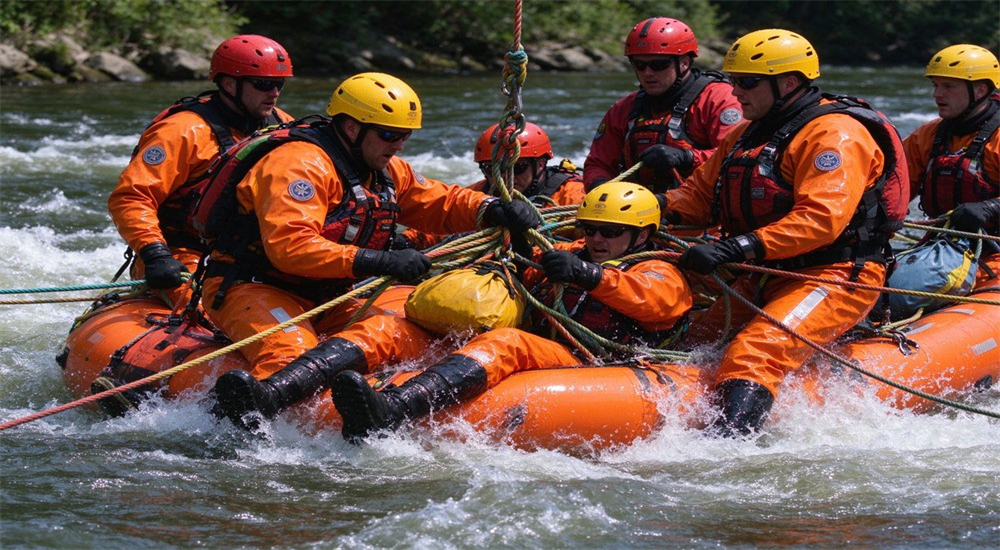
The neck and wrist seals are where the dry suit interfaces with the wearer's skin, and these points require careful engineering to balance waterproofing with comfort and blood flow restriction. Three seal materials are used across our product range.
Neoprene seals are the standard option, offering good stretch and durability with a comfortable feel. Some models add a silver titanium coating on the inner surface of neoprene seals to reflect body heat and improve thermal retention. Latex rubber seals provide the tightest seal but require more maintenance and may cause allergic reactions in sensitive individuals. Removable silicone seals (on diving models) use Swiss SITECH fittings for easy replacement in the field without specialized tools.
All seals include Velcro adjustment straps at the neck, cuffs, and ankles to fine-tune the seal pressure. Proper adjustment is critical—over-tightening causes discomfort and restricts circulation, while under-tightening allows water intrusion.
The seat, knees, and elbows experience the highest wear during crawling, climbing, and victim contact. We use Kevlar reinforcement at these zones on professional models and heavy-duty abrasion fabric on ultra-light models. Reinforcement panels are stitched and heat-taped to maintain waterproof integrity. Integrated boots use PU anti-slip soles with reinforced toe and heel protection.
The internal Y-type suspender system keeps the suit positioned during water entry and allows dropping the upper portion to the waist for ventilation. A four-position D-ring plate on the left chest connects rescue knives, whistles, and strobes. Multiple zippered pockets on chest, legs, and sleeves store tools. Some models include a hidden waterproof hood stowing in the collar. Integrated waterproof socks are heat-bonded to leg openings.
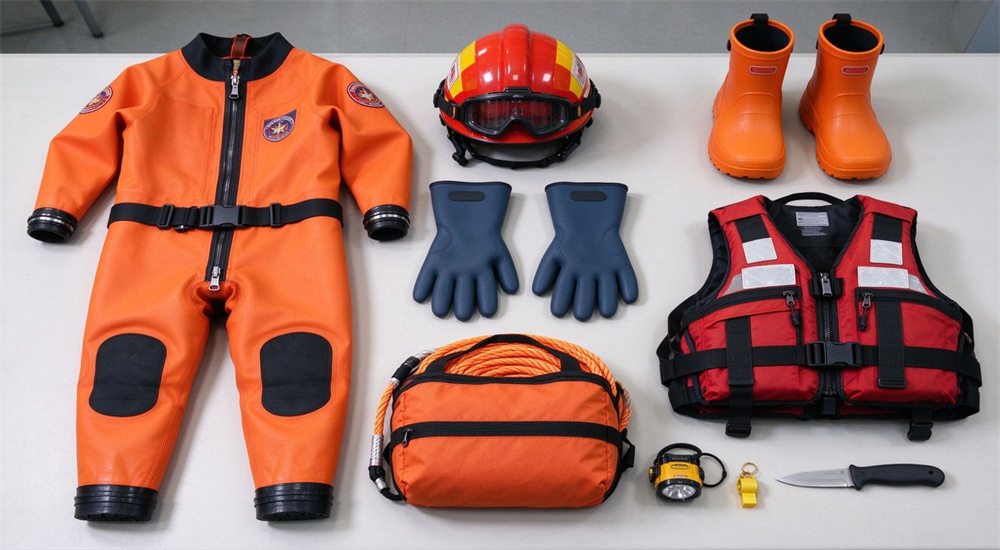
High-visibility reflective tape is a critical safety feature for rescue operations, especially in low-light conditions, heavy rain, and nighttime deployments. Our standard configuration uses SOLAS-grade retro-reflective tape on professional models and standard industrial reflective tape on economy models. SOLAS-grade tape provides approximately 500 candelas/lux/m² of reflectivity and remains effective after extended outdoor exposure.
Tape placement follows a standardized pattern: horizontal and vertical strips on both upper arms, a horizontal band across the chest, and strips on the lower legs. Tape width is minimum 25.4mm (1 inch) on all models. This placement ensures 360-degree visibility from any angle, whether the wearer is standing, swimming, or being pulled from the water.
Color selection affects both visibility and team identity. Our standard color options include high-visibility red, fluorescent orange-red, and tactical black. Red and orange are preferred for water rescue operations as they provide maximum contrast against water and debris backgrounds. Black is used by teams requiring a low-profile appearance for specific operational contexts.
Two-tone configurations—such as red-black or orange-black—are popular for identifying team roles or rank. Custom Pantone-matched colors are available for bulk orders with sufficient lead time. All color options include the same reflective tape placement and construction standards.
Beyond reflective tape, our dry suits include several safety-enhancing features. A whistle attachment point on the chest D-ring plate allows rescuers to carry a signaling whistle at all times. Some models include an integrated escape hood that provides temporary respiratory protection in smoke or chemical environments, though this is not a substitute for proper respiratory protection.
The crotch zipper on most models serves both convenience and safety—allowing rapid restroom access during long deployments without suit removal, which reduces the risk of contamination and heat loss. Adjustable wrist and ankle cuffs with Velcro closures ensure a secure fit that prevents water flushing while allowing blood circulation. All zippers include large pull tabs that can be operated with gloved hands.
Proper donning technique is essential for both safety and performance. Front-diagonal zipper models are designed for self-donning in under 2 minutes with practice. The process involves stepping into the integrated socks, pulling the suit up, inserting arms, and sealing the front zipper. Neck and wrist seals are then adjusted and secured with Velcro straps.
Rear-horizontal zipper models require a partner for donning but offer a cleaner front profile and reduced zipper exposure. The internal suspender system should be adjusted before water entry to ensure the suit hangs correctly. Teams should conduct regular donning drills as part of their training protocol, with target times under 90 seconds for experienced users.
The dry suit must integrate with the complete PPE ensemble including water rescue helmets, gloves, boots, and harnesses. The chest D-ring plate works with standard rescue harnesses, and leg pockets remain accessible while wearing a PFD. Neoprene neck seals fit under helmet chin straps, and wrist seals overlap rescue gloves to prevent water intrusion. Integrated boots accept external fin attachments for swimming.
Visibility varies by condition: bright daylight relies on suit color, overcast/rain favors fluorescent orange-red, and nighttime operations depend on SOLAS-grade reflective tape visible up to 300 meters. In heavy spray or whitewater, contrast between suit color and water environment is critical. Teams should evaluate primary operational environments and select colors accordingly, with reflective tape as the constant safety baseline.
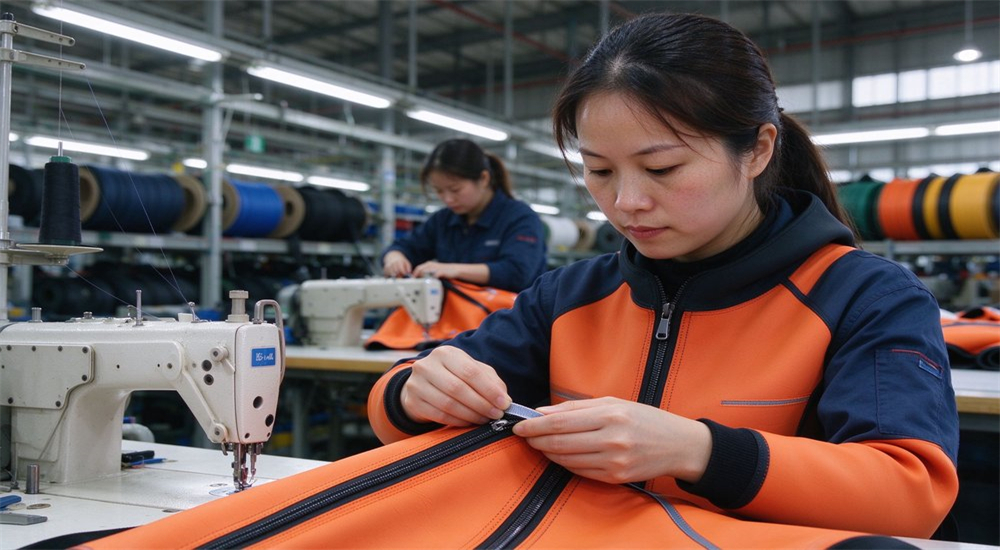
Every dry suit model undergoes a rigorous testing and verification process before release. This includes material testing (tensile strength, tear resistance, hydrostatic head), seam testing (water pressure resistance), zipper cycling (open/close durability), and complete garment testing (static water immersion, thermal retention). Test results are documented and available for procurement review.
Our manufacturing facility operates under ISO 9001 quality management system certification, with documented procedures for incoming material inspection, in-process quality control, and final product testing. Each suit carries a unique serial number for traceability, and batch test records are retained for a minimum of 5 years.
Different national markets have varying regulatory requirements for personal protective equipment used in water rescue. The following table outlines the key standards and certifications relevant to major export markets. Procurement officers should verify which standards apply to their jurisdiction and ensure that selected suits carry the appropriate markings. All our suits can be manufactured to meet the specific testing and documentation requirements of each market.
Material selection directly impacts both durability and maintenance requirements. Trilaminate materials offer excellent puncture resistance but require more careful seam maintenance, while vulcanized rubber provides superior waterproofing at the cost of additional weight. government procurement teams should balance initial cost against expected service life when making material decisions.
While specific market certifications vary, ISO 9001 quality management certification is universally accepted as a baseline quality indicator across all markets. We provide complete technical documentation packages including material test reports, seam integrity test results, and garment performance verification data to support any market-specific certification process. For US market requirements provide additional guidance for marine rescue equipment.
Market
Key Standard
Certification Body
Documentation Required
European Union
EN 14605 / PPE Regulation
Notified Body
EU Declaration of Conformity, CE marking
United States
USCG / NFPA 1952
USCG / UL
USCG approval letter, test reports
China
GB/T 19001-2016
CNCA
ISO certificate, national fire test report
Australia/NZ
AS/NZS 4769
SAI Global
AS/NZS certification, test reports
Middle East
ISO 9001 + SASO
SASO
ISO certificate, SASO conformity
Southeast Asia
ISO 9001 + SNI
BSN
ISO certificate, SNI registration
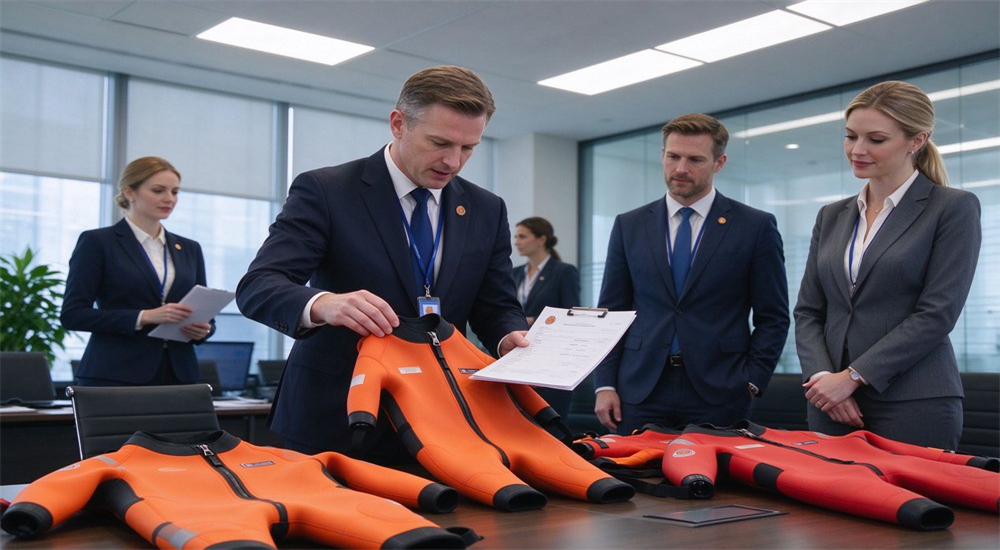
5.3 Quality Control & Factory Audit
Our quality control system operates at three levels. Incoming materials are inspected against purchase specifications including fabric weight, coating integrity, zipper brand verification, and hardware quality. During production, trained QC inspectors monitor critical operations including seam taping, zipper installation, and seal attachment, with documented checkpoints at each stage. Final inspection includes 100% visual inspection and hydrostatic leak testing on a sample basis.
For institutional buyers, we welcome third-party factory audits and can arrange pre-shipment inspections by organizations such as SGS, BV, or Intertek. Audit reports and inspection certificates are provided as part of the shipment documentation. Our production capacity supports both small trial orders and large government tenders with delivery schedules tailored to procurement timelines.
Selecting the appropriate dry suit requires evaluating several interrelated factors. The primary consideration is the operational water temperature range, which determines both the shell requirements and the undergarment system. Colder water demands heavier insulation and more robust sealing, while warmer water allows lighter, more breathable configurations. A dry rescue suit provides full waterproof protection for operations in cold water, flood zones, and contaminated environments where hypothermia risk is high. Thermal protection is critical for extended water operations, with undergarment layering systems that allow teams to match insulation levels to water temperature.
Secondary factors include the type of water environment (calm floodwater vs. fast-moving swiftwater vs. open water), the expected duration of immersion, the need for diving capability, and the team's budget constraints. The following decision framework guides procurement officers through the selection process systematically, ensuring that the chosen suit matches operational requirements without unnecessary cost or capability gaps.
Rescue organizations typically standardize on one primary dry suit model with a small allocation of specialized models for specific roles. The following table outlines common team configurations based on organizational type and operational profile. This helps procurement officers benchmark their requirements against established patterns and justify model selections in tender documentation. Each configuration represents a balance between standardization for training efficiency and specialization for operational capability.
Proper sizing is essential for dry suit performance. A suit that is too large allows water pooling and reduces thermal efficiency, while one that is too small restricts movement and can cause seal failure. We strongly recommend field testing sample suits with actual undergarments before placing bulk orders, as layering significantly affects fit requirements.
Most organizations standardize on a primary model covering 80% of operations, with specialized models allocated to specific teams or roles. This approach simplifies training, maintenance, and logistics while ensuring that specialized capabilities are available when needed. Procurement officers should assess their team's operational profile and select a configuration that matches their most frequent deployment scenarios.
|
Organization Type |
Primary Suit |
Specialized Suit |
Undergarment |
Key Feature |
|
Fire Dept Water Rescue |
Standard Front-Zip (Red) |
Ultra-Light (Swiftwater) |
300g Fleece |
Quick donning, tool pockets |
|
Coast Guard / Maritime |
Heavy-Duty Diving |
Standard (Deck Ops) |
200g Thinsulate |
Breathing valve, integrated boots |
|
Govt Emergency Stockpile |
Economy Standard |
Cold-Water (Northern) |
300g Fleece |
Cost-effective, universal sizing |
|
Swiftwater Technical Team |
Ultra-Light |
Hooded (Rain/Spray) |
300g Fleece |
Maximum mobility, dual zipper |
|
Ice Rescue Team |
Cold-Water 2000D |
Standard (Transport) |
200g Thinsulate |
Puncture resistance, max thermal |
6.3 Size & Fit Guide
Dry suit sizing is based on height, chest circumference, waist, and inseam measurements. Standard adult sizes cover heights from 160cm to 195cm and weights from 50kg to 110kg, with extended sizes available for larger builds. The fit should allow enough room for undergarments without excessive looseness that could cause water flushing or restrict movement.
A properly fitted dry suit should allow the wearer to raise both arms overhead without the suit pulling at the crotch, and to bend forward at the waist without the neck seal pulling away from the skin. The suspender system should be adjusted so the suit hangs evenly without pressure on the shoulders. Teams should conduct individual fit testing with each member wearing their standard undergarment layers, and document sizing for reorder purposes.
Evaluate full lifecycle cost rather than unit price. A higher-quality suit may cost 20-30% more initially but deliver 50-100% longer service life. Factor in undergarments, replacement seals/zippers, repair kits, and storage bags. We offer transparent pricing and multi-year framework agreements with fixed pricing. Common mistakes include specifying general waterproof ratings without hydrostatic verification, underestimating undergarment importance, and over-specifying for warm-water operations. Match specifications to actual operational requirements—consult our technical team for guidance.
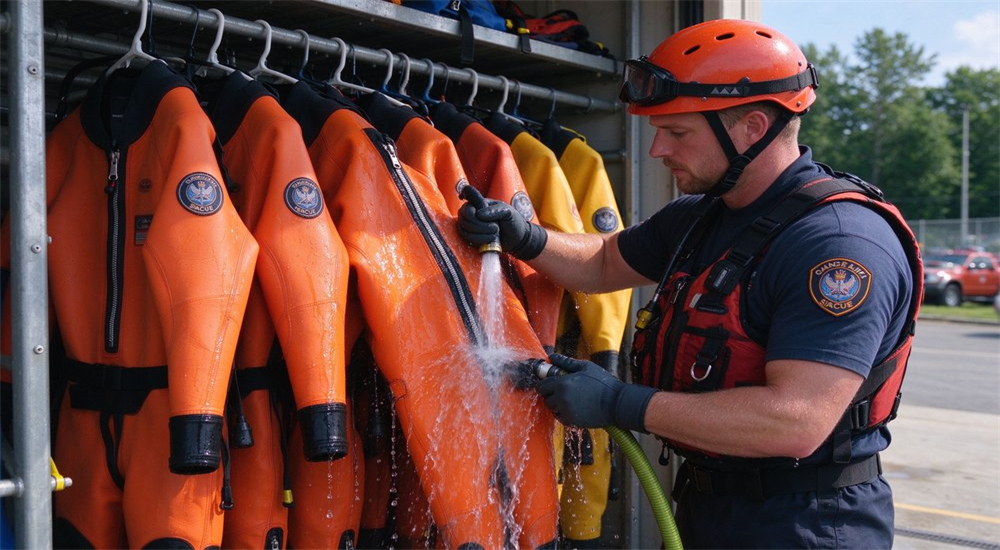
Proper post-use cleaning extends the service life of a dry suit and prevents degradation from contaminants. After each deployment, rinse the suit thoroughly with fresh water to remove mud, silt, chemicals, and salt residue. Pay particular attention to the zipper, seals, and integrated boots where debris accumulates. Use a mild detergent for heavy soiling, avoiding solvents or bleach that can degrade the waterproof membrane.
After rinsing, hang the suit to dry in a shaded, well-ventilated area. Never machine dry or expose to direct sunlight for extended periods, as UV radiation degrades both the fabric coating and the neoprene seals. Ensure the suit is completely dry before storage to prevent mold and mildew growth. Store on a wide hanger or loosely folded in a breathable storage bag, avoiding sharp creases that can damage seam tape.
Waterproof zippers require regular maintenance to ensure smooth operation and long service life. After each use, rinse the zipper with fresh water and ensure no debris is trapped in the teeth. Apply a silicone-based zipper lubricant periodically (approximately every 10 uses or monthly during active season) to maintain smooth operation. Never force a zipper that is jammed—clear the obstruction first to avoid damaging the teeth or seal.
Neoprene and latex seals should be inspected for cracks, tears, and loss of elasticity after each use. Latex seals have a shorter service life (approximately 1-2 years) and should be replaced proactively rather than waiting for failure. Silicone seals on diving models are removable and replaceable in the field with spare parts. Seal surfaces can be lightly dusted with talcum powder to prevent sticking during storage.
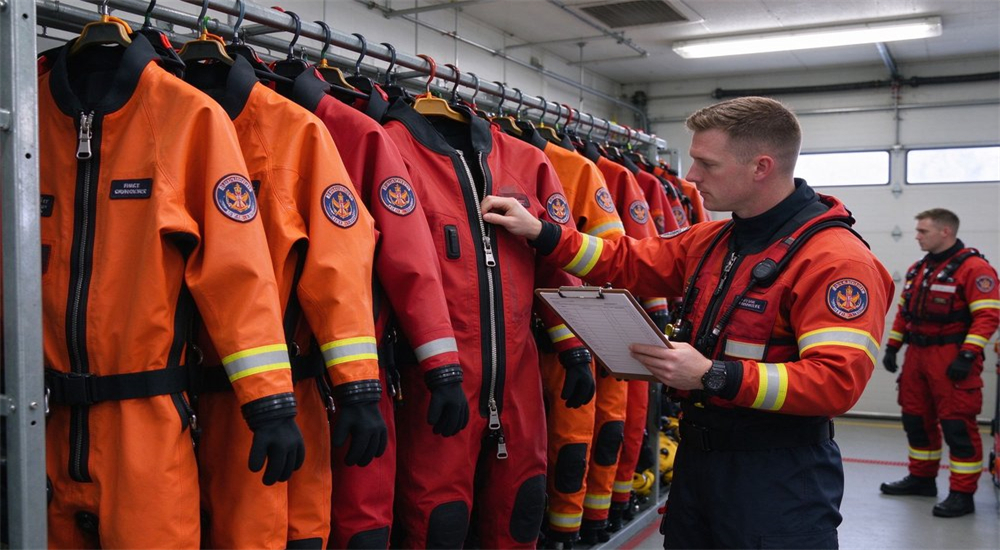
Every dry suit should undergo a systematic inspection before each deployment. This checklist should be incorporated into the team's standard operating procedures and documented for each piece of equipment. The inspection covers visual condition, functional testing, and accessory verification.
Key inspection points include: zipper operation and tooth condition, neck and wrist seal integrity (no cracks or tears), seam tape adhesion (no peeling or blistering), fabric condition (no cuts, abrasions, or UV degradation), reflective tape adhesion, D-ring and hardware security, pocket zipper function, and integrated boot sole condition. Any suit failing inspection should be removed from service and tagged for repair or disposal.
Common failures include zipper damage from debris, seal degradation from UV/ozone, seam tape delamination, and fabric abrasion. Most are preventable through proper maintenance: keep zippers clean and lubricated, store away from sunlight, avoid sharp folds, and use reinforcement panels. Under normal professional use (20-40 deployments/year), shell service life is 3-5 years with seals/zippers replaced every 1-2 years. Reserve stockpile suits may last 7-10 years. Replace based on usage logs and inspection results rather than arbitrary timelines. Suits showing UV degradation, repeated seal failures, or seam tape issues should be retired regardless of age.
We offer comprehensive customization services for bulk dry suit orders. Logo printing is available via silk-screen or heat-transfer on the chest and back panels, with artwork approval required before production. Custom colors can be Pantone-matched for shell fabric, with minimum order quantities per contract. Size scaling supports standard size runs plus custom measurements for team members outside standard ranges. Custom logo printing is available for department identification and brand consistency. We support OEM and ODM manufacturing with full specification control per your requirements. Our gear meets the durability standards required by military and naval rescue units. As a direct manufacturer, we control production quality from material sourcing to final inspection.
Additional customization options include reflective tape configuration (standard or custom placement), pocket layout modifications, zipper type selection (TIZIP or YKK), seal material preference (neoprene, latex, or silicone), and integrated component selection (boot type, suspender system, D-ring configuration). We can also manufacture suits to specific technical drawings or sample garments provided by the customer. All customizations are documented in a pre-production specification sheet for customer approval before manufacturing begins.
Government and institutional buyers often require detailed documentation and support throughout the procurement process. We provide complete tender documentation packages including technical specifications, test reports, compliance certificates, and manufacturing capability statements. Our team understands the procurement cycles of fire departments, coast guard units, and emergency management agencies and can align production schedules with tender deadlines.
For sample evaluation before bulk ordering, we can provide production-quality sample suits in specified sizes and configurations. Sample fees are typically credited against the bulk order. We support pre-shipment inspections by third-party organizations and can arrange factory visits for procurement teams. All pricing is transparent with itemized costs for shell, hardware, customization, and packaging.
Quality control is integrated into every stage of production. Incoming materials are verified against purchase specifications including fabric weight verification, zipper brand authentication, and hardware quality checks. During production, critical operations including seam taping, zipper installation, and seal attachment are monitored by trained QC inspectors with documented checkpoints. Final inspection includes 100% visual inspection and hydrostatic leak testing on a sample basis.
We welcome third-party factory audits and can arrange pre-shipment inspections by SGS, Bureau Veritas, or Intertek. Audit reports and inspection certificates are provided as part of shipment documentation. Our production facility maintains ISO 9001 certification and can demonstrate compliance with international quality standards during audits.
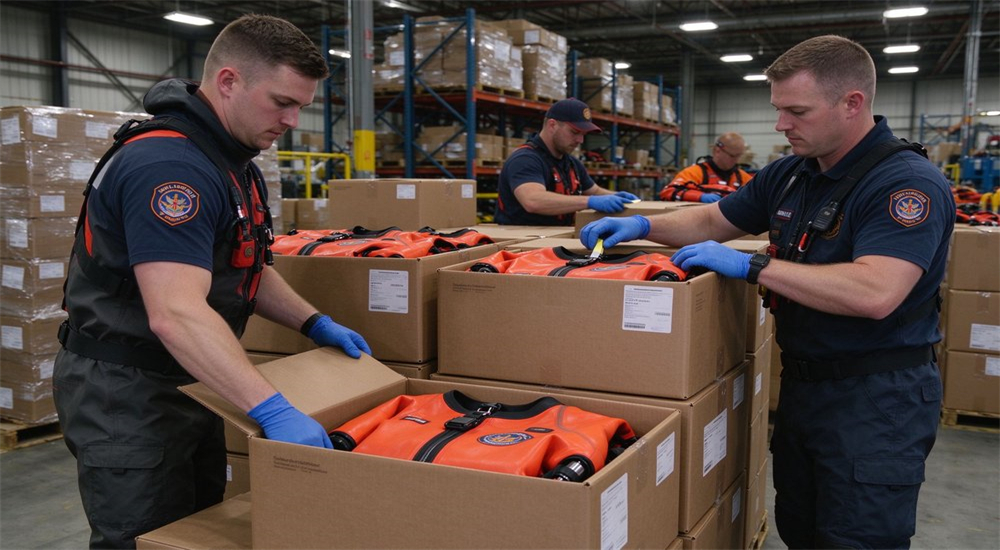
Dry suits are packaged for international shipping with protection against moisture and compression. Each suit is individually folded and placed in a polybag, then packed into export cartons with appropriate cushioning. Carton markings include product description, quantity, size distribution, and handling instructions. For government tenders, we can accommodate custom packaging requirements including individual storage bags, hang tags, and specification labels.
Shipping options include sea freight for large orders (cost-effective for stockpile procurement) and air freight for urgent requirements. We work with established freight forwarders and can arrange door-to-door delivery or port-to-port shipping depending on customer preference. All shipments include commercial invoices, packing lists, and certificates of origin. For orders requiring specific documentation for customs clearance, we coordinate with the customer's broker to ensure smooth import processing.
Our after-sales support includes replacement parts supply (seals, zippers, repair patches), repair guidance, and technical consultation. We maintain stock of common replacement components for fast turnaround on warranty and post-warranty repairs. For institutional customers with large fleets, we can offer maintenance training sessions and supply repair kits for field servicing.
Warranty coverage includes manufacturing defects in materials and workmanship for a period of 12 months from delivery. Normal wear and tear, improper use, and lack of maintenance are excluded from warranty coverage. We stand behind our products and work with customers to resolve any quality issues promptly and fairly.
Before committing to a bulk order, we recommend that customers evaluate production-quality samples. The sample process begins with a technical consultation to determine the appropriate model, size, and configuration based on operational requirements. We then manufacture a sample suit to the agreed specifications and ship it for evaluation. Sample fees are typically credited against the bulk order, with approximately 15-20 working days lead time from specification confirmation.
Upon delivery, conduct receiving inspection verifying quantity, size distribution, and product condition. Document any discrepancies within 7 days. For large orders, formal acceptance inspection including sample hydrostatic testing is recommended. We provide test protocols and support the customer's inspection process. Accepted suits should be entered into the equipment inventory system with unique serial numbers recorded for lifecycle tracking.
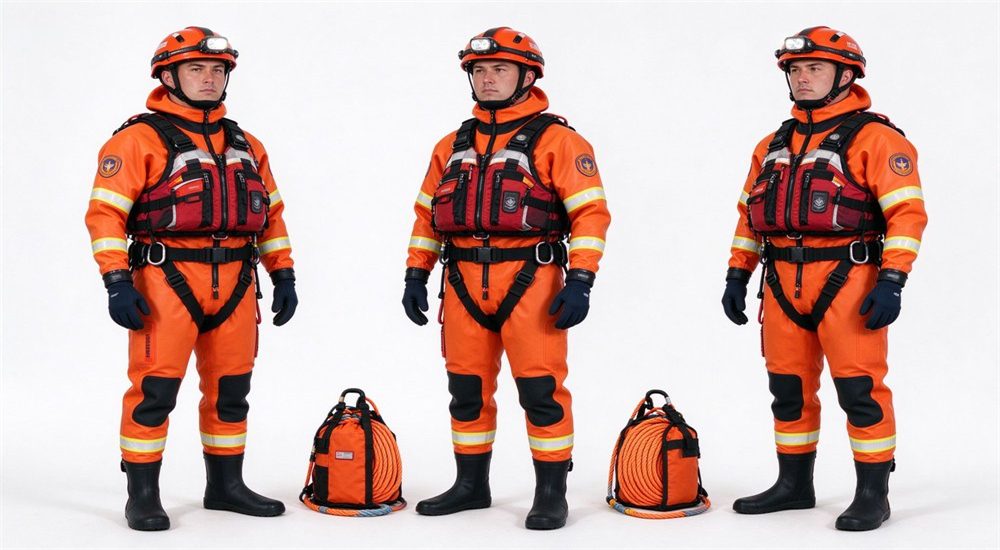
The water rescue equipment industry is moving toward modular systems that allow teams to configure suits for specific missions rather than relying on a single one-size-fits-all garment. Modular dry suits feature interchangeable components including removable hoods, attachable pockets, and swappable seal systems. This approach reduces inventory costs by allowing one shell platform to serve multiple operational profiles through component changes.
For procurement officers, this trend means evaluating suit systems based on component compatibility and upgrade path rather than just the base garment. A suit that accepts future upgrades—such as improved seal technology or enhanced pocket configurations—offers better long-term value than a closed design that requires full replacement when requirements change.
government procurement agencies are increasingly evaluating equipment based on total cost of ownership rather than initial purchase price. This shift recognizes that a cheaper suit with shorter service life and higher maintenance costs can be more expensive over a 5-year period than a premium suit with longer durability and lower consumable costs. Procurement documents are beginning to include lifecycle cost calculations as evaluation criteria.
We support this approach by providing transparent cost data including expected service life, replacement part pricing, and maintenance requirements. Our technical team can assist with lifecycle cost comparisons between different models and suppliers, helping procurement officers make informed decisions based on long-term value rather than short-term budget considerations.
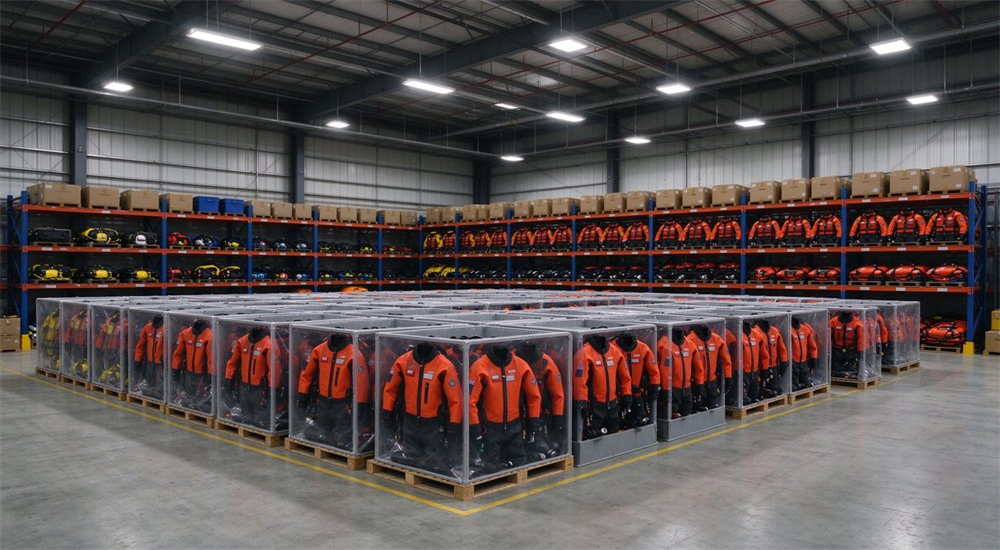
International standards for water rescue PPE are gradually converging, simplifying procurement for multinational organizations. For buyers, suits certified to one major standard are increasingly acceptable across markets, expanding supplier options. We design products to meet the most stringent common requirements across major markets. Rather than purchasing suits ad-hoc, organizations benefit from multi-year fleet plans accounting for inventory age, team growth, and budget cycles. Phased adoption of new technology over 2-3 procurement cycles allows in-service evaluation before full fleet replacement. We work with customers to develop fleet plans aligned with budget cycles and operational requirements.
Rather than purchasing dry suits on an ad-hoc basis as replacements are needed, organizations benefit from developing a multi-year fleet procurement plan. This plan should account for current inventory age, expected service life, team size growth projections, and budget cycles. By planning replacements in advance, organizations can take advantage of bulk pricing, ensure consistent specifications across the fleet, and avoid emergency purchases at premium prices.
A multi-year plan also allows for phased adoption of new technology. Rather than replacing the entire fleet at once when a new suit model becomes available, organizations can transition over 2-3 procurement cycles, evaluating the new model in service before full fleet adoption. We work with customers to develop fleet plans that align with their budget cycles and operational requirements.
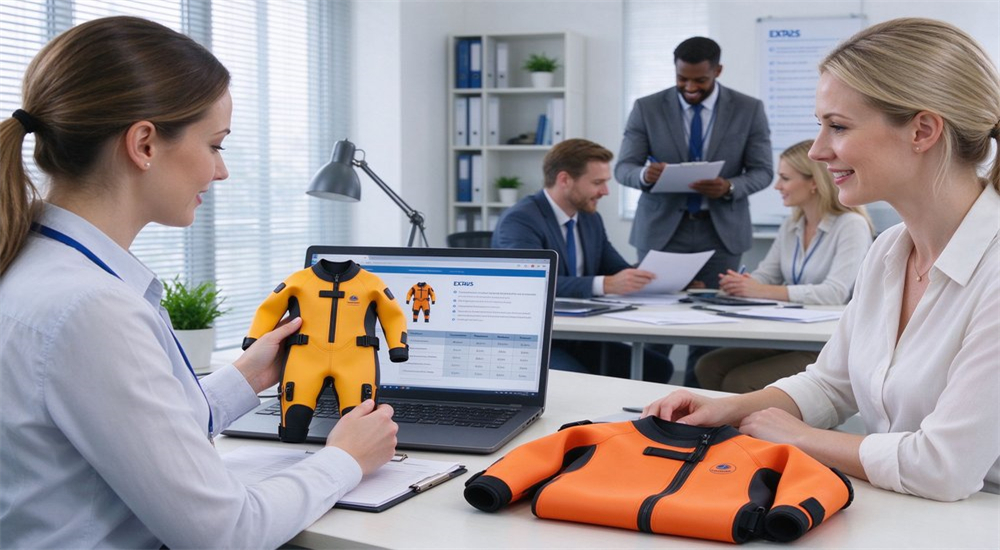
Dry suits provide complete waterproof separation with latex or silicone neck and wrist seals, keeping the wearer completely dry. They are essential for cold water, contaminated water, and extended operations. Wetsuits allow limited water entry that is warmed by body heat, suitable for moderate temperatures.
When selecting equipment for these operations, teams should balance buoyancy, thermal protection, and mobility based on the specific water conditions and mission duration. Regular inspection and maintenance of all gear ensures reliability when seconds count.
Our dry suits are designed for water temperatures from 0°C to 15°C (32°F to 59°F). With appropriate thermal undergarments, they can be used in ice water conditions. Above 15°C, wetsuits or splash protection may be more comfortable.
Latex seals should be rinsed with fresh water after each use, dried away from direct sunlight, and lightly dusted with talcum powder to prevent sticking. Inspect for tears before each use and replace seals every 1-2 years depending on usage frequency.
Minor punctures and tears can be repaired using specialized dry suit repair kits with neoprene cement and patches. We supply repair kits and provide detailed repair instructions. Major damage to zippers or seams should be factory repaired.
Layering depends on water temperature. For cold water (0-5°C), use heavyweight thermal fleece or Thinsulate. For moderate water (5-15°C), medium weight base layers work well. Avoid cotton as it loses insulating properties when damp.

Waterproof zippers should be cleaned with a toothbrush and mild soap after each use, lubricated with beeswax or specialized zipper wax monthly, and inspected for tooth damage. Never force a stuck zipper—clean and lubricate first.
Front-entry suits use a diagonal waterproof zipper across the chest for easier donning and doffing, especially when wearing gloves. Shoulder-entry suits have the zipper across the back and shoulders, providing better range of motion for swimming and paddling.
We offer both configurations. Attached latex socks are standard for use with separate rescue boots, while integrated boots provide convenience for shore-based operations. Boot style can be specified at time of order.
With proper maintenance, a professional dry suit typically lasts 5-8 years. Factors affecting lifespan include frequency of use, water chemistry, UV exposure, and storage conditions. Annual pressure testing is recommended.
Yes, we offer sample units for evaluation. Sample fees are deductible from future bulk orders. We recommend at least 2 weeks of field testing across different water conditions before finalizing specifications.

Q1: What is the difference between a dry suit and a wetsuit for water rescue?
A: A dry suit provides complete waterproofing with a sealed barrier between the wearer and the water, allowing the use of insulating undergarments for thermal protection. A wetsuit relies on a thin layer of water trapped against the skin that is warmed by body heat. Dry suits are preferred for cold-water rescue, extended operations, and contaminated water environments, while wetsuits are suitable for warmer water and shorter-duration activities.
Q2: How long does a dry suit last under professional rescue use?
A: Under normal professional use (20-40 deployments per year) with proper maintenance, a dry suit shell has an expected service life of 3-5 years. Seals and zippers are consumable components requiring replacement every 1-2 years. Suits in reserve stockpiles with proper storage can last 7-10 years. Service life varies based on environmental conditions, frequency of use, and maintenance practices.
Q3: Can dry suits be customized with our department logo and colors?
A: Yes. We offer silk-screen and heat-transfer logo printing on chest and back panels, and Pantone-matched custom shell colors for bulk orders. Reflective tape placement, pocket configuration, and zipper type can also be customized. All customizations are documented in a pre-production specification sheet for customer approval before manufacturing begins.
Q4: What undergarments are recommended for use with your dry suits?
A: We recommend our 300g fleece liner for moderate cold conditions (5-15°C water) and our 200g Thinsulate liner for extreme cold (below 5°C). Both liners feature foot straps, hand loops, and front-entry zippers for easy donning. The Thinsulate model includes reinforced panels and an adjustable waist belt. Undergarments can be purchased separately or as part of a complete suit system package.

Q5: How do I determine the correct size for my team members?
A: Sizing is based on height, chest circumference, waist, and inseam measurements. Standard sizes cover heights 160-195cm and weights 50-110kg, with extended sizes available. We recommend individual fit testing with each member wearing standard undergarments. A properly fitted suit allows full arm overhead movement without crotch pull and maintains neck seal contact when bending forward.
Q6: Are your dry suits certified for government procurement?
A: Our manufacturing facility is ISO 9001 certified, and we provide complete technical documentation including test reports and compliance certificates for tender submissions. We can manufacture to meet specific market standards including EN 14605 (EU), NFPA 1952 (US), and GB/T 19001-2016 (China). Third-party pre-shipment inspections by SGS, BV, or Intertek can be arranged.
Q7: What is the minimum order quantity for bulk dry suit orders?
A: Standard models have a minimum order quantity of 50 units per size/color combination. Custom colors and special configurations may require higher minimums. For government tenders and institutional procurement, we can accommodate order sizes from 50 to 5000+ units with production scheduling aligned to delivery deadlines. Sample evaluation units are available before bulk commitment.
Q8: How should dry suits be stored when not in use?
A: Store dry suits on wide hangers in a cool, dry, shaded area away from direct sunlight, ozone sources, and chemical fumes. Ensure the suit is completely dry before storage. Avoid sharp folds that can damage seam tape. Zippers should be partially open to reduce tension. Silicone or talcum powder on latex seals prevents sticking during long-term storage.

Q9: Can damaged dry suits be repaired, and what parts are replaceable?
A: Yes, most dry suit components are repairable or replaceable. Neck and wrist seals are consumable items designed for replacement. Zippers can be replaced by qualified repair technicians. Small fabric punctures can be patched with repair kits. Seam tape issues can be re-taped. We supply replacement parts and repair guidance, and can offer maintenance training for institutional customers with large fleets.
Q10: What is the typical production lead time for bulk orders?
A: Standard production lead time is 30-45 working days from deposit and specification confirmation for orders under 500 units. Larger orders (500-2000 units) require 45-60 working days. Custom colors and special configurations may add 10-15 days. Sample production takes approximately 15-20 working days. We can expedite production for urgent requirements with prior arrangement.
Q11: Do your dry suits include integrated boots or are they separate?
A: Our standard dry water rescue suits include integrated waterproof socks that are heat-bonded to the leg openings. Separate rescue boots are worn over the integrated socks. Our heavy-duty diving models include integrated hard-soled boots with PU anti-slip soles. Both configurations are available, and the choice depends on operational requirements and team preference.
Q12: How do I perform a leak test on a dry suit?
A: The standard field leak test involves sealing the neck and wrist openings, inflating the suit to approximately 50-70mbar pressure, and spraying soapy water over all seams, zippers, and seals while observing for bubble formation. Alternatively, a 1-hour static water immersion test measures water intake. We recommend leak testing at least annually and after any repair or seal replacement.

Q13: Are your dry suits suitable for contaminated water environments?
A: Our dry suits provide a complete waterproof barrier that protects against contaminated water, including floodwater with sewage, chemical, and biological contaminants. The sealed construction prevents water intrusion at all points. For chemical hazard environments, we recommend verifying compatibility with specific contaminants and may recommend additional protective layers or specialized suit materials.
Q14: What is the difference between TIZIP and YKK waterproof zippers?
A: TIZIP zippers are premium airtight waterproof zippers offering guaranteed sealing under pressure with smooth operation and long service life. They are standard on our ultra-light and cold-water models. YKK waterproof zippers provide reliable waterproof performance at a more economical price and are standard on base model suits. Both types include external protective flaps and can be operated with gloved hands using large pull tabs.
Q15: Can I order a mix of sizes and colors, and do you provide training?
A: Yes, bulk orders can include multiple sizes and colors within the same model, with minimum order quantities per combination. Mixed orders are packed with clear carton markings. For training, we provide maintenance sessions and repair kits for institutional customers, plus detailed use and maintenance manuals and video guides. Operational rescue training should be conducted by certified rescue instructors.
Q16: Do you provide sample evaluation and delivery inspection support?
A: Yes, we provide production-quality samples for evaluation before bulk commitment, with sample fees typically credited against the bulk order. Customers should test samples in realistic conditions including water entry, swimming, climbing, and extended wear. Upon delivery, we support receiving inspection and formal acceptance testing including sample hydrostatic verification. Any discrepancies documented within 7 days are addressed promptly.

Previous :
Wholesale Wetsuit Water Rescue Suits for Professional Rescue TeamsNext :
Wholesale Water Rescue Life Jackets Custom Waterproof Safety Equipment Firefighting Life Jacket, Quick Auto-Inflation, Universal Orange
This professional firefighting life jacket features a wear-resistant waterproof Oxford fabric outer layer with EPE high-density polyethylene foam filling, providing ≥100N total buoyancy with ≥50N inherent buoyancy. Equipped with a ≤5-second quick auto-inflation system, it meets emergency rescue needs in firefighting, floods, and inundations. The high-visibility orange design with reflective strips enhances night recognition, while the chest rescue whistle facilitates emergency distress signals. Universal size fits most rescue personnel, with customizable organizational logos and functions.
 Floating Rescue Vest High-Visibility Waterproof Earthquake Safety
This flood prevention life jacket is made of 200D Oxford polyester fabric with polyethylene foam buoyancy material, providing ≥8.5kg buoyancy. Measuring 65×50cm, it fits most adults. Featuring 6 evenly distributed reflective patches and an emergency whistle, it's specifically designed for maritime storms, floods, and earthquake-induced water disasters. The orange/green design ensures high visibility during water rescue operations. Professional teams can customize specifications, markings, and special features according to their requirements.
 Rescue Life Jacket, Thickened Waterproof, 74N High Buoyancy Design
Professional rescue life jacket features 200D thickened Oxford fabric outer layer, high buoyancy ≥74N design, compliant with GB/T32227-2015 rescue equipment standards. Standard size 58×42×5.5cm, lightweight for quick mobility. Orange-yellow high-visibility color with shoulder reflective strips ensures maximum visibility in extreme conditions like floods and tsunamis. Ideal for flood rescue, sea storm rescue and earthquake-induced flood disasters, an essential equipment for professional rescue teams.
 Flood Control Life Vest, 200D Oxford Fabric, Orange-Yellow High Visibility
Professional flood control life jacket features 200D thickened Oxford fabric outer layer, standard size 58×42×5.5cm, with ≥74N buoyancy value tested to GB/T32227-2015 standards. High-visibility orange design with night reflective strips, lightweight for unrestricted movement. Ideal for flood disasters, earthquake-induced floods, sea storm rescues and extreme conditions, providing reliable buoyancy support for rescue personnel, improving water rescue efficiency by 99% - essential equipment for emergency rescue operations.
 Professional Flood Rescue Life Jacket High Buoyancy Vest
This professional flood rescue life jacket features a 450D waterproof Oxford fabric outer layer with EPE high-buoyancy filling material, providing ≥88N buoyancy to ensure water rescue personnel safety. Equipped with night reflective patches and large reflective areas on shoulders and chest to enhance visibility in adverse weather conditions. The lightweight design weighs ≤1kg, not affecting rescue operation flexibility. Tested in actual flood disaster scenarios, it provides continuous buoyancy support for over 12 hours in rapid currents, having protected over 10,000 rescue personnel during 327 flood control operations nationwide.
 88N Buoyancy Water Rescue Life Vest Emergency Disaster Vest
This professional water rescue life vest features a 450D waterproof Oxford fabric outer layer with EPE high-buoyancy filling material, providing ≥88N buoyancy support to ensure rescuers remain stable in rapid currents. Weighing ≤1kg, it's lightweight and doesn't restrict rescue operations. Large reflective patches on shoulders and chest enhance nighttime rescue visibility. Field-tested to protect rescuers during 18-hour continuous emergency operations, it has been successfully deployed in 176 flood rescue missions nationwide.
Copyright © Custom Disaster - Relief Bedding: Tents, Sleeping Bags, Blankets All Rights Reserved
the professional team to service !


