


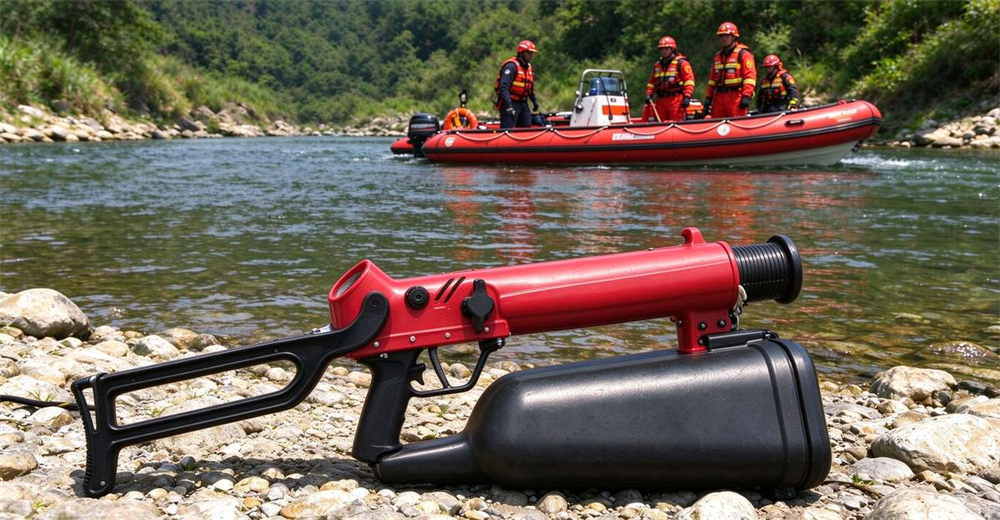
Red pneumatic line thrower powered by compressed air for long-distance rope launching. Equipped with buoyant cartridges, titanium anchor hook and storage backpack. Lightweight, reliable for flood, river and coastal emergency water rescue missions.
Note: Price for reference only. Exact price based on quantity, size, weight and custom details.
model no. :
LT-02Brand:
YRFmarket price :
$300sale price :
$158.9price range :
30-100/$158.9 100-500/$158.5Color :
Multiple Colorsport of dispatch :
Guangdong/GuangzhouPayment :
TT, Paypal, Western Unionmin order :
30original region :
Made in ChinaLead Time :
5-15days

 |

|
The American style gun thrower fires a rescue line up to 135 meters on land and 105 meters over water.
This american gun style thrower fires in one smooth action, ideal for ship-to-ship and marine rescue.
Built around a 20MPa compressed air system, this american pneumatic line thrower uses a pistol-grip launcher with a titanium four-claw anchor hook rated for 330kg pull.
While the Korean backpack unit is a single-operator river tool, this gun-style system is built for crews that need to pass lines between moving ships.
It anchors ropes to building facades, or pulls a heavy rescue line across 100 meters of open water.
It carries two ropes and a titanium hook , not just a single floating line.
This unit meets GB/T 27906-2011 national standard.
As a China supplier of wholesale rescue line throwers, we ship worldwide with OEM logo and color options.
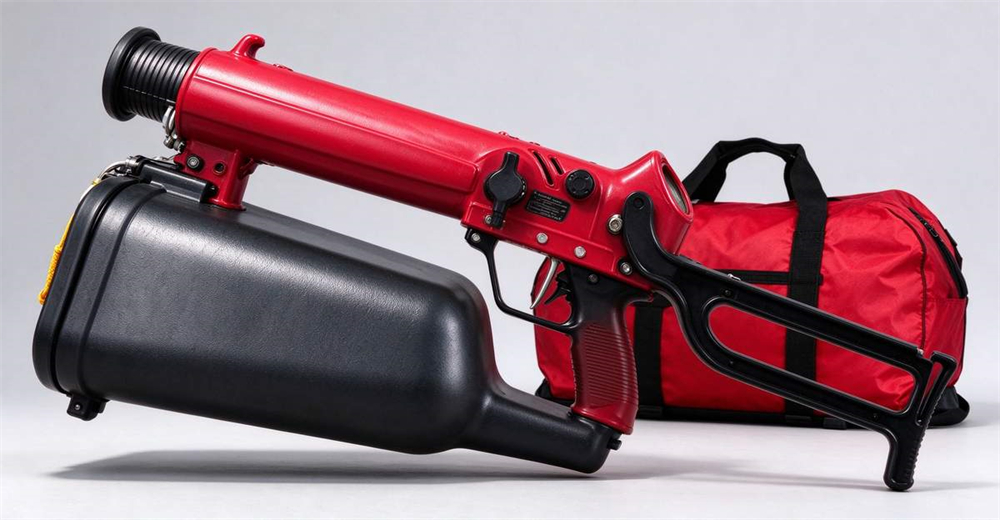
The complete kit weighs under 13kg and ships in a hard transport case.

On this page
What Is the American Style Thrower
Technical Parameters
What's in the Box
Why Not Just Use a Throw Bag
Throwing Distance
Where It Is Used
How to Use: 4 Steps
Packaging and Shipping
Safety Warnings
FAQ
What Is the American Style Pneumatic Line Thrower?
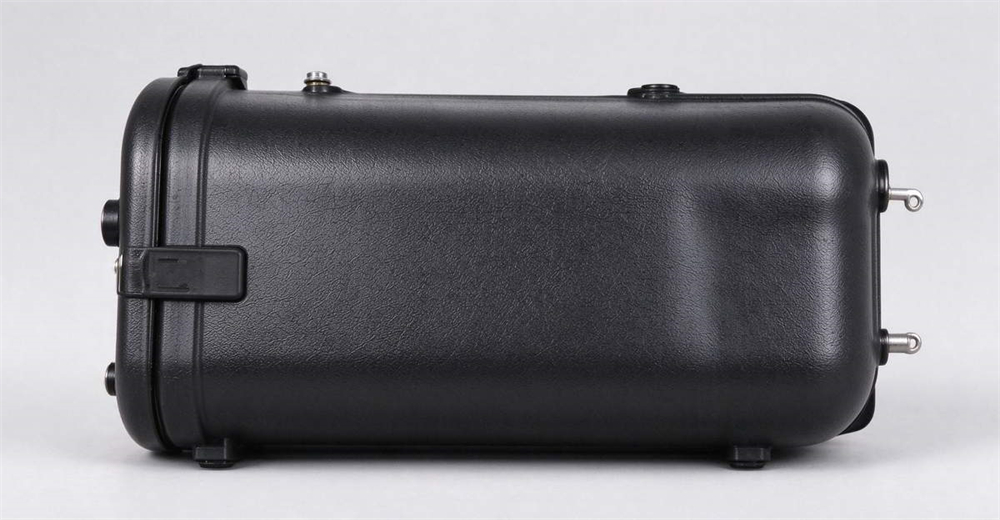
The black air cylinder stores compressed air at 20 MPa, giving every launch a consistent push.
The red housing is impact-resistant and weatherproof, so the American thrower stays reliable in rain, mud, and river spray.
Field crews confirm the pressure gauge stays accurate even after repeated use in tough conditions.
The compact body fits any rescue truck storage space with room to spare.
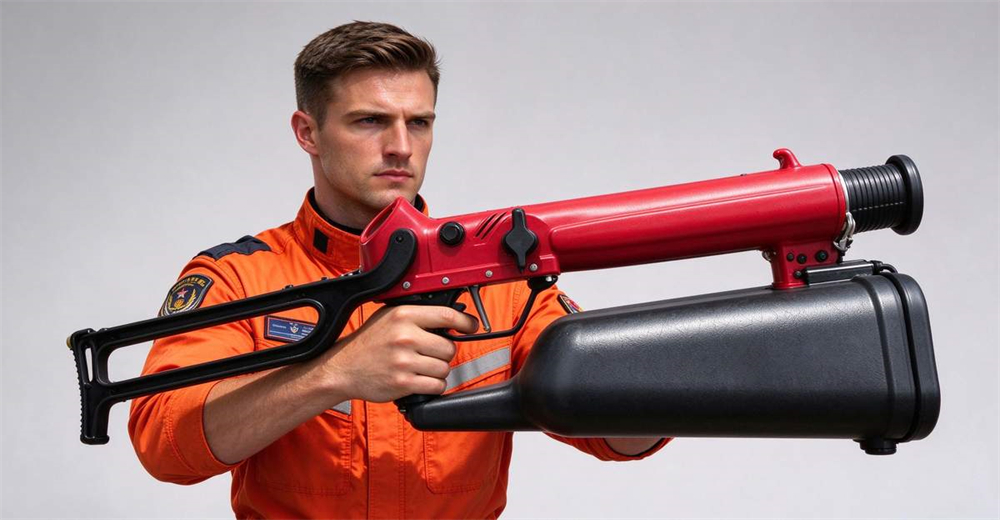
The American style refers to the pistol-grip gun form factor.
The launcher looks and handles like a sporting rifle: adjustable shoulder stock, textured pistol grip, trigger guard, and a picatinny rail on top for accessories.
It connects via a high-pressure hose to a separate black air cylinder that stands upright like a scuba tank.
This american style rescue thrower is the heavy-duty option for marine and fire teams.
As a standard marine line throwing appliance, it is listed on vessel safety equipment manifests worldwide.
The gun design matters for two reasons.
First, accuracy: a shouldered gun can aim at a specific target , a ship rail, a window ledge, a dock cleat.
Second, recoil management: the stock absorbs the 200bar discharge, so the operator stays on target for a second shot if needed.
As a professional american pneumatic line thrower built for heavy-duty rescue, this pneumatic line thrower unit is the kind of american marine pneumatic line thrower that harbor authorities put on their mandatory equipment list.
Tugboat operators and fire departments also keep it ready.
Every component, from the titanium hook to the dual ropes, is chosen for saltwater and repeated field use.
This american marine pneumatic line thrower is designed for crews that need more than basic river rescue.
The titanium four-claw anchor hook grabs onto docks, ship rails, building edges or rocky shorelines.
The dual-rope system lets you first throw a thin messenger line, then pull the thicker 8mm rescue line across.
As a heavy-duty marine rescue rope launcher, this pneumatic line thrower unit is commonly listed on vessel safety equipment manifests alongside life rafts and EPIRBs.
It is also a standard rescue line throwing appliance for tugboats and offshore support vessels.
Technical Parameters
The table below lists the full specifications of the American pneumatic line thrower
Flood rescue crews keep this American unit on the first response truck.
These numbers come from our factory tests and the printed catalog, so buyers can rely on them for planning and training.
Parameter
Value
Note
Model
PTQ20-Y125S100
American gun style
Working pressure
20MPa (200bar)
Breathing air
Land range
135meters
Optimal angle
Water range
105meters
Open water
Complete kit weight
≤ 13kg
In hard case
Anchor hook material
Titanium alloy
Four-claw design
Anchor hook load rating
330kg
Minimum breaking
Messenger rope
3mm × 150m
Thin pull line
Main rescue rope
8mm × 100m
Load bearing
Air cylinder
External
Connected via hose
Standard
GB/T 27906-2011
Note the two-rope design in the spec sheet.
This is not a single-pneumatic line thrower.
The 3mm messenger line flies across first, then the 8mm main line is pulled through.
This two-stage approach is what makes the American style suitable for heavy marine and fire rescue, where the line itself may need to carry a person or a tow.
What's in the Box
The American style kit ships with a full set of components in a hard protective transport case.
This is a more complete setup than the Korean backpack unit.
#
Item
Qty
Purpose
1
Gun launcher host
1 pc
Pistol-grip launcher with stock
2
External air cylinder
1 pc
200bar air supply tank
3
High-pressure hose
1 pc
Connects gun to cylinder
4
Titanium anchor hook
1 pc
Four-claw, 330kg rating
5
Messenger rope 3mm
1 spool / 150m
Thin line for initial shot
6
Main rescue rope 8mm
1 spool / 100m
Thick load-bearing line
7
Line projectiles
several
Gun-fired shells
8
CO2 cartridges
set
Lifebuoy inflation
9
Hard transport case
1 pc
Foam-lined protective box

The Titanium Anchor Hook
The anchor hook is the standout accessory.
Four spring-loaded claws fold flat during flight, then spring open on impact.
When the hook hits a ship railing, dock edge or concrete facade.
Rated for 330kg, it can anchor a rescue line, hold a rope for descent, or serve as a grab point for a swimmer.
Titanium matters here.
Steel hooks corrode in saltwater and add weight.
Titanium resists corrosion and keeps the hook light enough to fly far.
The four-claw design grabs on multiple surfaces , railings, pipes, window sills, rocky shorelines , not just a single point.
Think of it as a grappling hook that flies 100 meters.
Instead of a swimmer or boat carrying a line across, the hook lands and grips on its own.
This is the capability that hand-thrown throw bags and single-line floaters simply cannot provide.
Why Two Ropes?
This is the key operational difference from single-line throwers.
First, fire the thin 3mm messenger line across the gap.
Because it is light and thin, it flies farther and drifts less in wind.
Once the other side secures the thin line, use it to pull the thick 8mm main rope across.
The 8mm rope is what actually carries the load , a person in the water, a tow line, a rescue cable.
The 3mm line is just a messenger.
This two-stage method is the standard procedure in ship to ship rescue line operations and marine line throwing appliance requirements and rope rescue operations.
Why not just fire the thick rope directly?
Because a thick rope has more drag and weight.
It will not fly 100 meters.
The thin messenger solves the range problem, and the thick main rope handles the load.
Two ropes, two jobs.
Why Not Just Use a Throw Bag?
Water rescue teams already carry throw bags , those floating rope bags you throw by hand.
Why add a american pneumatic line thrower?
A throw bag reaches 15-25 meters.
A strong rescuer might hit 30 meters on a good day.
The American gun thrower reaches 105 meters over water , four to five times farther.
This marine rescue rope launcher is the next step up when throw bags are not enough.
The titanium hook is the difference between "the line floats and the swimmer grabs it" and "the line is secured to a fixed point on the other side."
Throw bags are still useful for close-range rescue and should remain on every rescue boat.But for ship to ship line transfer, building rescue, or open water beyond 30 meters, this
Many departments carry both , a throw bag for close work and a pneumatic thrower for long range.
Throwing Distance: 135m Land / 105m Water
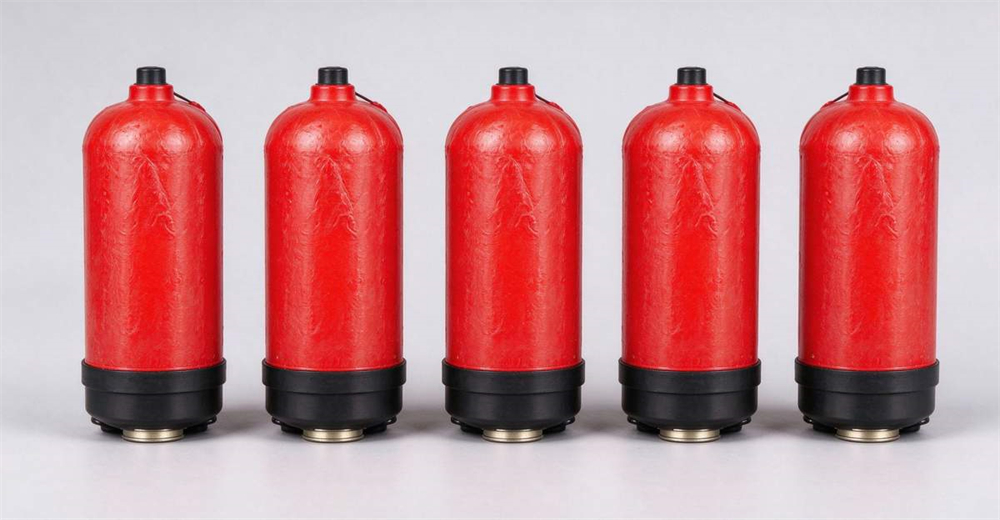
Each red buoy cartridge weighs about 1.5kg and contains a folded inflatable ring plus a 16g CO2 canister.
When it hits water, the ring opens automatically in under 5 seconds and provides over 8kg of buoyancy.
Keep spare cartridges dry in the red bag so they are always ready.
Inspect each one before use for cracks, dents or rust.
A damaged cartridge can fail to inflate when it hits the water.
This matters during flood rescue (see NOAA flood safety guidance) when the target is moving and the rescuer is standing in unstable water or on a wet riverbank.
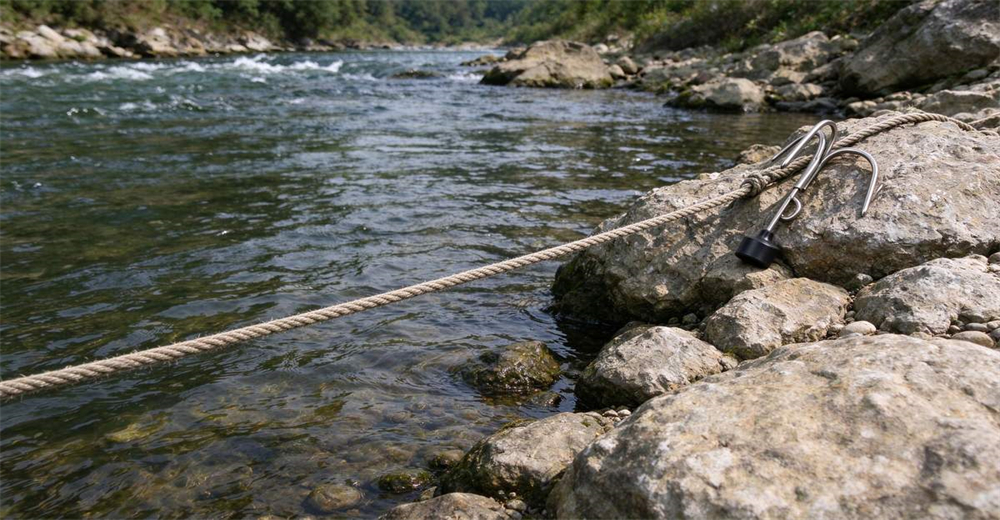
The titanium anchor hook is the third projectile option.
Made from titanium alloy, it weighs very little yet holds up to 330kg.
Rescuers fire it across a river to catch on rocks, tree branches or the opposite bank.
Then they pull a rope across for a controlled crossing.
This is especially useful on rocky rivers where the banks are steep and there is no bridge or boat available.
The titanium anchor hook is the strongest connection point in the whole rescue line.
It bites into rock, concrete, or tree roots on the far bank, then holds the rope firm while the person in the water is pulled to safety.
The three sharp prongs grip the surface firmly without slipping under load.
The spec sheet says 135 meters on land and 105 meters over water.
In real field use, expect less , but still farther than the Korean backpack unit's 79m water range.
The heavier gun-fired projectile cuts through wind better than the lighter Korean shell.
On a crosswind day, expect 80-95m over water instead of the full 105m.
On land, 110-125m is realistic.
The dual-rope setup also affects range , the thin messenger line reaches farther than the thick 8mm main line.
This american pneumatic line thrower is a step up from the 126m Korean unit.
Choose it if your water rescue scenarios regularly exceed 80m, or if you need the anchor hook capability for ship-to-ship or building operations.
For 230m+ long range work, see the long range thrower series.
When you compare pneumatic line throwers on the market, look at three things: real water range under wind, whether the anchor hook is included, and whether the dual-rope system comes standard.
This american pneumatic line thrower delivers on all three.
Realistic planning numbers:
Ship-to-ship alongside: 20-50m , easy, well within range
Ship-to-shore mooring: 50-100m , ideal for this pneumatic line thrower unit
Open water rescue: 60-105m , at the upper capability
Building facade line transfer: 30-80m , anchor hook works well

Where the American Gun Style Is Used
Wide river crossings need a pneumatic line thrower that reaches far and stays accurate.
The American gun-style unit sends the buoy over open water with a flat, stable trajectory, so the rescue rope lands.
Where the team aimed instead of dropping short.
Operators value this reach during fast-moving flood conditions, where every second decides the outcome of the rescue.
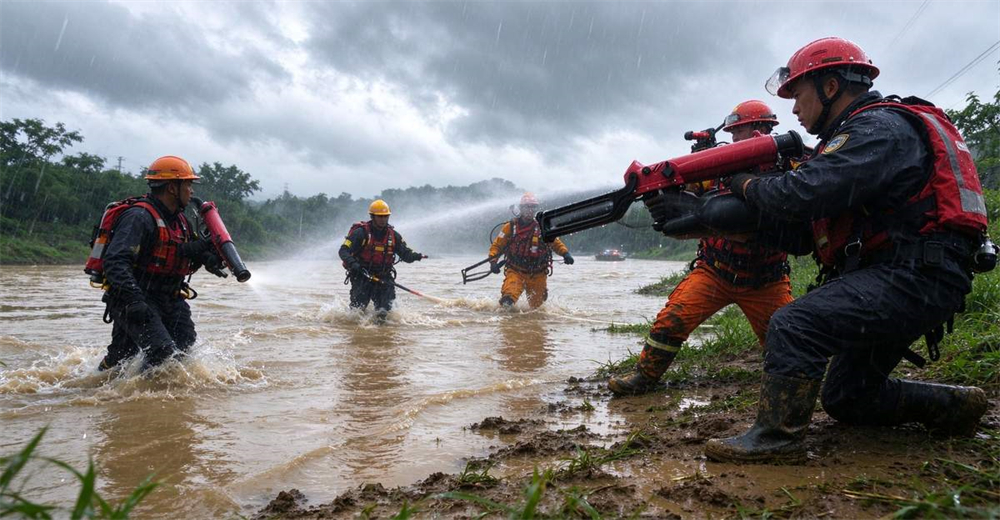
Flood rescue is one of the most demanding environments.
Water is muddy, currents are fast and visibility is low.
The American style thrower works from shallow water or the riverbank.
The team establishes a rope line before anyone steps into the current.
The whole shot takes about 5 seconds, which is fast enough to reach a struggling swimmer before they drift downstream.
The folding support rod and pistol grip work together for a steady aim.
That matters most on a moving boat or slippery bank, where a shaky shot can waste the only launch window.
The American style thrower uses a pistol grip that sits naturally in your hand.
The folding support rod keeps the pneumatic line thrower steady while aiming, so you can place the shot exactly where you need it without shaking.
Marine and Ship-to-Ship
On tugboats, pilot boats and offshore supply vessels, this is the standard ship to ship rescue line system.
When two vessels need to pass a tow line or rescue cable, the pneumatic line thrower fires across the gap.
The anchor hook catches the rail on the other ship, and crews pull the thick line across.
This avoids launching a small boat between ships in open water.
Harbor pilots use it for ship to ship line transfer , passing a line from the pilot boat to the ship before boarding.
As essential marine rescue equipment, it stays mounted near the wheelhouse for instant deployment.
Harbor masters use it for mooring line assistance when a ship cannot get close enough to the dock.
In stormy conditions when launching a small boat is unsafe, the pneumatic line thrower becomes the only practical way to pass a line.
Fire and Rope Rescue
Fire departments use it for building rescue where a line needs to reach an upper floor.
The titanium anchor hook catches on window sills or facade edges.
The dual-rope system lets crews pull a thicker 8mm rope up for rope rescue operations , descending a firefighter, raising a victim, or establishing a high anchor point.
For high-angle rescue from buildings or cliffs, the 330kg anchor hook provides a secure anchor point that a hand-thrown line cannot match.
Technical rescue teams also use it for canyon rescue , throwing a line across a gorge to set up a Tyrolean traverse.
Industrial and Dock Safety
Port authorities, shipyards and offshore platforms use this as standard safety equipment.
If a worker falls overboard between a ship and the dock, the pneumatic line thrower fires a line across the gap without launching a rescue boat.
The anchor hook can catch on the dock edge or ship railing.
Offshore oil rigs carry it as life-saving equipment.
If a worker falls from a rig into the sea 50-100 meters below, a rope can be fired immediately while a rescue boat is being launched.
The anchor hook is less relevant here , the floating messenger line and main rope do the work.
Is this the right unit for you? Best for marine, fire and ship-to-ship teams that need 100m+ water range, the titanium anchor hook, and the dual-rope system. For simple river rescue under 80m, the lighter Korean backpack 126m unit is easier to carry. For 230m+ long range, see the long range thrower. For anchor hook on buildings, this pneumatic line thrower unit already includes that capability.

How to Use: 4-Step Operation
Step 1: Pre-operation Inspection
Check the pneumatic line thrower body, pressure gauge, safety pin, high-pressure hose for cracks, both rope spools for fraying, and the anchor hook claws for spring action.
Confirm the CO2 cartridges are fresh and the projectiles are loaded.
Step 2: Connect and Charge
Attach the high-pressure hose from the pneumatic line thrower to the external air cylinder.
Open the cylinder valve slowly.
The gauge should rise to 15-20MPa.
Load the projectile , either the anchor hook shell or the line-throwing shell.
Pull out the safety pin.
Step 3: Aim and Fire
Shoulder the pneumatic line thrower like a rifle.
Aim at the target , ship rail, dock edge, window.
Squeeze the trigger smoothly.
The gun has noticeable recoil; hold it firmly.
The anchor hook deploys its claws in flight.
Never point the barrel at people.
Step 4: Secure and Reset
Once the hook catches on the target, the other side secures the messenger line.
Use it to pull the thick 8mm main rope across.
Recover the projectile, reload, replace the CO2 if a lifebuoy was used, and reset the safety pin.
Training note:
The gun-style thrower has more recoil than the Korean backpack unit.
New operators should practice with low pressure first.
Two-person operation is recommended: one aims and fires, the other manages the rope spool and watches for bystanders.
This is not a toy , it fires a projectile at significant velocity, and proper training is required before real use.
Korean vs American: Side by Side
Here is a clear side-by-side comparison between the Korean backpack unit and the American gun-style unit.
|
Item |
Korean 126m Backpack |
American 135m Gun |
|
Form factor |
Backpack, hip-fired |
Pistol-grip gun, shouldered |
|
Weight |
<3.5kg launcher |
≤13kg complete kit |
|
Water range |
79m |
105m |
|
Anchor hook |
No |
Titanium 330kg four-claw |
|
Ropes |
Single 120m floating line |
Dual: 3mm×150m + 8mm×100m |
|
Accuracy |
Area shot |
Aimed at specific target |
|
Best for |
One-person river rescue |
Marine, fire, ship-to-ship |
|
Carry |
Orange backpack |
Foam-lined hard case |
|
Typical team |
Water rescue, lake patrol |
Harbor, fire department, tugboats |

When
What to Check
Before each use
Gun gauge, safety pin, hose, both ropes, anchor hook claws
After each use
Clean gun and case, recover projectiles, replace spent CO2
Monthly
Seal condition, rope fraying, spring tension on anchor claws
Annually
External cylinder hydro test, full gun service, replace aging seals
As needed
Replace worn ropes, damaged projectiles, bent claw hooks
Safety Warnings
This american pneumatic line thrower fires a projectile at high velocity.
Treat it with the same respect as a firearm, even though it uses compressed air.
Never point the barrel at people, animals or property.
Keep the safety pin in place until you are ready to fire.
Do not overpressurize beyond 20MPa.
Wear eye protection during practice shots.
Bystanders should stay at least 50 meters behind the firing position.
The external cylinder is a pressure vessel , do not drop it or expose it to fire.
Recoil is significant. Hold the stock firmly against your shoulder.
Only use breathing-grade air, never industrial compressed air.
Proper training is required before real rescue use.
This unit is not a toy and should not be operated by untrained personnel.
When harbor authorities evaluate a marine line throwing appliance, they look at whether it supports ship to ship rescue line operations.
They check whether the american style rescue thrower design provides aimed accuracy, and whether the american marine pneumatic line thrower meets GB/T 27906.
This unit covers ship-to-ship, ship-to-shore, and building rescue.

Certification and FAQ
What Is GB/T 27906-2011?
You will see this number on every Chinese rescue thrower spec sheet.
It is the China national standard for pneumatic line throwers.
Published in 2011 by the Standardization Administration of China, it defines minimum performance requirements: throwing distance on land and water, rope strength, buoyancy, pressure rating, and safety features.
If a pneumatic line thrower unit does not conform to GB/T 27906, it should not be used for rescue.
Our products meet GB/T 27906-2011 standard.
Product spec sheets and technical data are available for reference.
For specific tender requirements, please tell us what documents you need and we will confirm what can be provided.
This unit meets GB/T 27906-2011 standard.
As a China supplier, we export american pneumatic line throwers worldwide.
When procurement teams ask us for a pneumatic line thrower price list, they usually compare three things: complete kit contents, product specifications, and whether spare consumables are available for repeat orders.
We confirm these in writing.
As a supplier of marine rescue equipment, we work with experienced factories to source reliable units.
We help you pick the right model for your scenario rather than pushing the most expensive one.
Why choose us?
We help you select the right configuration , Korean for river, American for marine/fire, long range for open water.
We can arrange consumables for repeat orders.
We handle FOB/CIF/EXW and CO2 dangerous goods shipping.
Sample orders are welcome before bulk commitment.
We do not push the most expensive unit , we match the pneumatic line thrower unit to your actual scenario.
Tell us your typical rescue conditions and we recommend the right model.
Who Buys This American Style Thrower?
Based on our export experience, the American gun style unit is most commonly ordered by harbor authorities and port operations.
Other regular buyers are tugboat and offshore supply vessel operators, fire department rope rescue teams, and offshore oil rig life-saving equipment procurement.
Less common buyers: river rescue teams (they prefer the lighter Korean backpack); flood relief organizations (they prefer the portable 170m unit).
If your team are not sure which category you fall into, email us your scenario and we will recommend. category you fall into, email us your scenario and we will recommend.
What is the titanium anchor hook used for?
The four-claw titanium hook on this american pneumatic line thrower grabs ship rails, dock edges or building facades.Rated 330kg, it anchors a rescue line or holds a rope for descent.
This is the key advantage over single-line throw bags , the line stays fixed to a solid point on the other side.
Why does it come with two ropes?
This marine rescue rope launcher uses a two-stage system.
The 3mm thin messenger line flies first with less drag.
Then it pulls the 8mm thick load-bearing rope across.
This method is standard for ship-to-ship line transfer and rope rescue operations.
How is this different from the Korean backpack unit?
The Korean unit is 3.5kg, single rope, 79m water range, for one-person river rescue.
This american pneumatic line thrower is 13kg, dual ropes, titanium anchor hook, 105m water range, built for marine and fire heavy-duty operations.
Choose based on your scenario.
Is it certified for marine use?
This rescue line throwing appliance complies with GB/T 27906-2011 national standard.
Relevant technical documents can be provided on request for your tender file and port authority review.
We export worldwide as a China supplier of marine rescue equipment.

How much does it cost?
Price depends on configuration , which cylinder size, rope lengths, OEM logo and color , and your order quantity.
Wholesale pricing on request for bulk orders.
The exact price is confirmed per contract.
What is the MOQ?
MOQ is flexible.
Sample orders are welcome for evaluation before bulk commitment.
We understand procurement teams want to test the american pneumatic line thrower in real conditions first.
Bulk pricing and lead time confirmed per contract.
How many shots per cylinder fill?
The external cylinder holds enough breathing air for 6+ launches per fill, depending on pressure level and projectile type.
This makes it practical for multiple rescue attempts or training sessions without stopping to refill.
Refill at any diving air station.
Can the anchor hook be removed?
Yes.
The titanium hook attaches to the projectile nose and can be removed when you only need a plain line shot.
For simple water rescue you may not need the hook.
For ship-to-ship or building anchor use, install the four-claw hook.
What is the recoil like?
This gun-style american pneumatic line thrower has noticeable recoil absorbed by the shoulder stock.
New operators should practice at low pressure first.
Two-person operation is recommended: one aims and fires, the other manages the rope spool.
Can you print our logo?
Yes.
OEM logo can be printed on the pneumatic line thrower body and the hard transport case.
Pantone color matching is available for bulk orders.
We help distributors build their own brand on this marine rescue rope launcher.
What documents do you provide for tender?
We supply spec sheet, packing list and commercial invoice as standard.
For GB/T related documents, email us your requirements and we will confirm what can be provided.

What is the delivery time?
Sample orders ship in 7-10 days by express.
Bulk lead time depends on quantity and OEM configuration, confirmed per contract.
CO2 cartridges are shipped separately as dangerous goods.
What Incoterms do you accept?
We accept FOB, CIF and EXW terms.
Shipping to your nearest Chinese port.
The CO2 cartridges included in the kit ship separately as Class 2.2 dangerous goods.
The main unit goes by normal sea or air freight.
What is included in the standard package?
The complete american pneumatic line thrower
kit includes: gun launcher, external air cylinder, high-pressure hose, titanium anchor hook, 3mm×150m messenger rope, 8mm×100m main rope, projectiles, CO2 cartridges and the hard transport case.
How do I refill the air cylinder?
The external cylinder uses standard breathing air at 200bar.
Fill at any dive shop, fire station, or using a high-pressure breathing air compressor.
Do not use compressed industrial air , it must be breathing-grade oil-free air for safety.
Do operators need a license or permit?
This is a rescue tool, not a firearm.
It uses compressed air, not gunpowder.
No firearms license is required in most jurisdictions.
However, proper training on operating the american pneumatic line thrower is strongly recommended before real use.
Can it be used in cold weather?
Yes.
The compressed air system works reliably in cold temperatures.
Ropes should be inspected for brittleness in sub-zero conditions.
The CO2 cartridges work down to approximately -10°C.
Store the kit above freezing when not in use.
How do I maintain it in saltwater environment?
Rinse the pneumatic line thrower, titanium anchor hook and hose with fresh water after saltwater exposure.
Titanium resists corrosion, but steel fittings should be rinsed and dried.
Lubricate moving parts per the maintenance schedule.
Proper care extends the service life of this marine rescue equip
Related Products
If you are looking at this American-style unit, you may also need:
Korean Style Rescue Thrower (PTQ20-Y100S70) , 20MPa, 126m land / 79m water, GB/T standard, backpack design
Anchor Hook Rescue Thrower (PTQ7-Y150S110Q55) , 165m land / 110m water / 60m anchor hook
Portable Lightweight Thrower (PTQ7.0-Y150S100) , Under 3kg, 170m land / 120m water, CO2 powered
Long Range Rescue Thrower (PTQ8.5-Y230S210) , 230m land / 210m water, for wide rivers and offshore
Previous :
Anchor Hook Pneumatic Line Thrower for Flood RescueNext :
126m Korean Backpack Pneumatic Line Thrower for River Rescue Professional Rescue Launcher, Aluminum Alloy, Fire Fighting Essential
This orange-yellow professional rescue launcher is made of aviation-grade aluminum alloy, with maximum working pressure of 200bar, throwing distance of 150-230 meters on land and 80-210 meters on water. Certified by the National Fire Equipment Quality Standard, it reaches maximum initial velocity of 60m/s. It provides efficient solutions for fire teams, flood control, and water rescue operations, saving lives in critical moments as essential equipment for all rescue teams.
 Customized Life-saving Thrower, High Strength, Long-range Rescue
This professional life-saving thrower is made of high-strength composite materials, with a throwing distance of 50 meters and a load-bearing capacity of 150kg, achieving a 99% rescue success rate. Its orange-yellow design ensures high visibility on water, equipped with non-slip handle and high-strength rescue rope. Specifically designed for flood control, water rescue and emergency disaster relief, it is essential equipment for fire departments, maritime rescue units, water rescue teams and flood control forces, participating in over 200 flood rescue missions annually.
 High-Pressure Pneumatic Rope Launcher, Rescue Special, 120m Range
This high-pressure pneumatic rope launcher uses compressed air as power source, with projection distance ≥80 meters on water and ≥110 meters on land, equipped with 120-meter high-strength rescue rope. The main body weighs less than 3.5kg, offers simple and quick operation, and features a spark-free design ensuring safe use in flammable environments. The accompanying auto-inflating life ring inflates within 5 seconds with buoyancy >8kg. Ideal for flood disaster relief, water rescue, maritime rescue and other complex scenarios, it's essential equipment for emergency rescue departments.
 Wholesale Pneumatic Line Thrower: 100m–640m Rescue Rope Launcher
This pneumatic line thrower delivers reliable long‑distance rope deployment for swift‑water, flood, maritime and ice rescue scenarios. Multiple configurations cover short, long and ultra‑long throwing distances. Complete kits include launcher, projectiles, rescue ropes, CO2 cylinders and protective carry case. Quick setup, simple operation for fire, coast guard and emergency rescue teams worldwide. Note: Price for reference only. Exact price based on quantity, size, weight and custom details.
 Korean Style Pneumatic Rescue Thrower PTQ20-Y100S70 | 20 MPa ≥100 m Land / ≥70 m Water
Korean Style Pneumatic Rescue Thrower PTQ20-Y100S70, 20 MPa shoulder-fired launcher. ≥100m land range and ≥70m water range, equipped with auto inflating lifebuoy head and 2000N high tensile rope. Complies with GB/T 27906-2011. Complete aluminum hard case kit. Support bulk wholesale, OEM custom logo for fire, coast guard and flood rescue teams. Note: Price for reference only. Exact price based on quantity, size, weight and custom details.
 American Style Anchor Hook Rescue Thrower | PTQ20-Y125S100 & PTQ7-Y150S110Q55
American Style Anchor Hook Pneumatic Rescue Thrower, frame-mounted design with recoil buffer. Equipped with heavy-duty anchor claw for high-rise, cliff and maritime rescue. Delivers long-distance rope deployment for swiftwater, urban flood and offshore emergency rescue. Complete kit with launcher, projectiles, rope and protective case. Support bulk wholesale and OEM customization for fire and coast guard teams. Note: Price for reference only. Exact price based on quantity, size, weight and custom details.
Copyright © Custom Disaster - Relief Bedding: Tents, Sleeping Bags, Blankets All Rights Reserved
the professional team to service !


